This book examines the application of intellectual property rights to traditional Chinese medicine (TCM). Conventional legal thinking describes authentic TCM as a common heritage that is owned by no one. Its genetic resources, therefore, should be freely available for pharmaceutical research. According to the author, this interpretation overlooks any rights that could accrue to the authentic inventors of TCM and, by classifying TCM as common property, disregards the value to be gained through the conservation (and consequent sustainable use) of TCM's genetic resources. The author claims that the recognition of custodial rights over traditional knowledge will provide incentives to developing countries (including China) to conserve, cultivate, and provide access - for the sake of pharmaceutical research - to valuable genetic resources. The book analyzes the patent law that regulates TCM and suggest how it may be improved so as, on the one hand, to ensure that pharmaceutical firms have sufficient incentives to continue to research and develop TCM while, on the other hand, to recognize the value of the authentic traditional contributions. This book raises to a new level the continuing discussion of the correlation between intellectual property rights and environmental law. In the establishment of the law concerning intellectual property rights, the State is primarily concerned with creating incentives for invention through the assignment of property rights. In enacting environmental law, the State prioritizes the prevention of environmental injury by regulating the harmful by-products of a particular economic activity. The idea that both categories of law should be separate because they are different is a simplistic answer to a complicated question. Regrettably, such rationalization, while not ill-intentioned, creates negative impacts on economic activities, such as the commercialization of traditional knowledge, a process where the technological depends upon the biological and vice-versa. Any law that denies this complexity in order to focus on governing its narrow objective will inevitably lead to adverse consequences. To the surprise of many who would assume that the rule of law is not developed on the mainland, China has a unique opportunity to contribute to the evolution of this important legal and economic advancement. This study will be of interest to academics, practicing lawyers, government legal advisors, and investors alike.
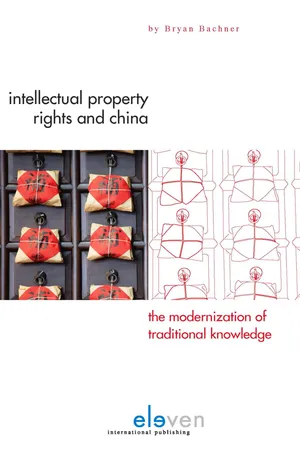
eBook - PDF
Intellectual Property Rights and China: The Modernization of Traditional Knowledge
- 249 pages
- English
- PDF
- Available on iOS & Android
eBook - PDF
Intellectual Property Rights and China: The Modernization of Traditional Knowledge
About this book
Information
Subtopic
Environmental LawIndex
LawTable of contents
- Cover
- Title Page
- Table of Contents
- List of Abbreviations
- Foreword
- Preface
- CHAPTER 1 Introduction
- CHAPTER 2 International Regulation of Traditional Knowledge
- CHAPTER 3 Patent Law in China
- CHAPTER 4 Transplantation of Modern Intellectual Property Law
- CHAPTER 5 Governing Traditional Chinese Medicine in Modern China
- CHAPTER 6 Conclusion
- Bibliography
- Index of Legal Sources and Cases
- Index
Trusted by 375,005 students
Access to over 1.5 million titles for a fair monthly price.
Study more efficiently using our study tools.
Frequently asked questions
Yes, you can cancel anytime from the Subscription tab in your account settings on the Perlego website. Your subscription will stay active until the end of your current billing period. Learn how to cancel your subscription
No, books cannot be downloaded as external files, such as PDFs, for use outside of Perlego. However, you can download books within the Perlego app for offline reading on mobile or tablet. Learn how to download books offline
Perlego offers two plans: Essential and Complete
- Essential is ideal for learners and professionals who enjoy exploring a wide range of subjects. Access the Essential Library with 800,000+ trusted titles and best-sellers across business, personal growth, and the humanities. Includes unlimited reading time and Standard Read Aloud voice.
- Complete: Perfect for advanced learners and researchers needing full, unrestricted access. Unlock 1.5M+ books across hundreds of subjects, including academic and specialized titles. The Complete Plan also includes advanced features like Premium Read Aloud and Research Assistant.
We are an online textbook subscription service, where you can get access to an entire online library for less than the price of a single book per month. With over 1.5 million books across 990+ topics, we’ve got you covered! Learn about our mission
Look out for the read-aloud symbol on your next book to see if you can listen to it. The read-aloud tool reads text aloud for you, highlighting the text as it is being read. You can pause it, speed it up and slow it down. Learn more about Read Aloud
Yes! You can use the Perlego app on both iOS and Android devices to read anytime, anywhere — even offline. Perfect for commutes or when you’re on the go.
Please note we cannot support devices running on iOS 13 and Android 7 or earlier. Learn more about using the app
Please note we cannot support devices running on iOS 13 and Android 7 or earlier. Learn more about using the app
Yes, you can access Intellectual Property Rights and China: The Modernization of Traditional Knowledge by Bryan S. Bachner in PDF and/or ePUB format, as well as other popular books in Law & Environmental Law. We have over 1.5 million books available in our catalogue for you to explore.