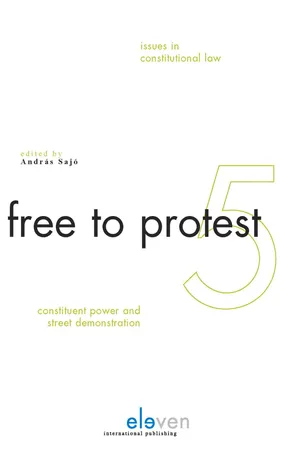
The recent history of mass protests in democracies and semi-democracies raises a number of concerns. Some of these concerns are related to the proper balance between the right to demonstrate and its impacts on third parties. When it comes to striking the proper balance, one cannot avoid the specific problems associated with crowd phenomena. Recent demonstrations concerning election results or regime legitimacy in a growing number of post-communist regimes raise a fundamental practical question: are mass demonstrations a (the) genuine expression of popular will? Are spontaneous forms of mass discontent genuinely supreme and legitimate expressions of popular sovereignty? What is the place of the expression of popular discontent in constitutional (indirect) democracy? A key question is whether the freedom of assembly should be placed into a different normative context, perceiving it not as an individual right of expression of ideas but as a collective right to directly shape politics. Free to Protest addresses the issue of public demonstrations, looking at the experiences of established democracies - EU Member States and the U.S. - and countries in transition. The approach of the book is to cover the problem not as a strictly legal one, but to combine the constitutional and human rights aspects with the historical, political, and philosophical dimensions.
- 289 pages
- English
- PDF
- Available on iOS & Android
eBook - PDF
Free to Protest: Constituent Power and Street Demonstration
About this book
Information
Subtopic
Civil Rights in LawIndex
LawTable of contents
- Cover
- Title Page
- Table of Contents
- List of Contributors
- The Importance of Freedom of Assembly: Three Models of Justification, Tamás Gyõrfi
- Balancing Emotionalism: Contemporary Implications of the Impact of Street Demonstrations on Third-Party Interests, Bogdan Iancu
- We, the People: Freedom of Assembly, the Rights of Others, and Inclusive Constitutionalism, Michael Hamilton
- A Dialogue on Law and Social Protest, Roberto Gargarella
- The Power of Assembled People: The Right to Assembly and Political Representation, Daniel Smilov
- New Trends in the Assembly and Protest Jurisprudence of the European Court of Human Rights, Orsolya Salát
- Limiting Freedom of Assembly Based on Harms to Third Parties: The Balancing of Economic Freedoms and Fundamental Rights in the European Union and MERCOSUR, Lucas Lixinski
- Ethical and Political Considerations of Exercising Freedom of Assembly in Poland, Anna Śledzińska-Simon
- Shaping the Freedom of Assembly: Counter-Productive Effects of the Polish Road towards Illiberal Democracy, Adam Bodnar
- The Human Rights Act, Public Protest and Judicial Activism, Helen Fenwick and Gavin Phillipson
- Demonstration Democracy in Hungary: Policing Protest – from the Catacomb of Unofficial Activities to Rioting, Máté Szabó
- A Comparative Study of Laws of Assembly in China: Historical Continuity and Transition, Kam C. Wong
Trusted by 375,005 students
Access to over 1.5 million titles for a fair monthly price.
Study more efficiently using our study tools.
Frequently asked questions
Yes, you can cancel anytime from the Subscription tab in your account settings on the Perlego website. Your subscription will stay active until the end of your current billing period. Learn how to cancel your subscription
No, books cannot be downloaded as external files, such as PDFs, for use outside of Perlego. However, you can download books within the Perlego app for offline reading on mobile or tablet. Learn how to download books offline
Perlego offers two plans: Essential and Complete
- Essential is ideal for learners and professionals who enjoy exploring a wide range of subjects. Access the Essential Library with 800,000+ trusted titles and best-sellers across business, personal growth, and the humanities. Includes unlimited reading time and Standard Read Aloud voice.
- Complete: Perfect for advanced learners and researchers needing full, unrestricted access. Unlock 1.5M+ books across hundreds of subjects, including academic and specialized titles. The Complete Plan also includes advanced features like Premium Read Aloud and Research Assistant.
We are an online textbook subscription service, where you can get access to an entire online library for less than the price of a single book per month. With over 1.5 million books across 990+ topics, we’ve got you covered! Learn about our mission
Look out for the read-aloud symbol on your next book to see if you can listen to it. The read-aloud tool reads text aloud for you, highlighting the text as it is being read. You can pause it, speed it up and slow it down. Learn more about Read Aloud
Yes! You can use the Perlego app on both iOS and Android devices to read anytime, anywhere — even offline. Perfect for commutes or when you’re on the go.
Please note we cannot support devices running on iOS 13 and Android 7 or earlier. Learn more about using the app
Please note we cannot support devices running on iOS 13 and Android 7 or earlier. Learn more about using the app
Yes, you can access Free to Protest: Constituent Power and Street Demonstration by Andras Sajo in PDF and/or ePUB format, as well as other popular books in Law & Civil Rights in Law. We have over 1.5 million books available in our catalogue for you to explore.