- English
- ePUB (mobile friendly)
- Available on iOS & Android
eBook - ePub
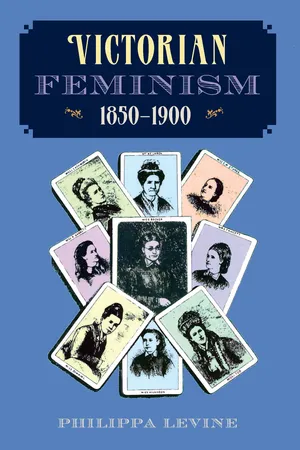
Victorian Feminism, 1850-1900
About this book
The second half of the nineteenth century saw in newly industrialized England the creation of a "domestic ideology" that drew a sharp line between domestic woman and public man. Though never the dominant reality, this demarcation of men's and women's spheres ordered people's values and justified the existing social structure. Out of this context sprang a women's movement that celebrated its female identity, its campaigns "concerned as much with promoting that optimistic self-image as with a simple call for equality with men."
Levine traces the changing face of a half century of England's feminist movement, the personalities who dominated it, its pressing issues, and the tactics employed in the fight. Political themes common to the specific protests, she finds, included women's moral superiority, a close-knit sense of a supportive female community, and a conscious woman-centeredness of interests.
Along the way, Levine puts to rest many inaccuracies and assumptions that have dogged the history of presuffragette feminism, causing it to be discredited or dismissed. She refutes, for example, the judgement that the movement served only the needs of bourgeois women, and she warns against the pitfall of defining feminism by the standards of a male politics whose practices make comparisons inadequate and unsuitable.
Levine has organized her study with an eye to the breadth of concerns that characterized England's nineteenth-century feminism: women's entry into education and the professions; trade unionism, working conditions, equal pay; suffrage and other political and property rights for women; marriage and morality issues—prostitution, incest, venereal disease, wife abuse, pornography, and equal rights to divorce.
Information
Table of contents
- Cover
- Title Page
- Copyright
- Contents
- 1 Introduction
- 2 Education: the first step
- 3 The public sphere: politics, local and national
- 4 Employment and the professions: middle-class women and work
- 5 Trade, industry and organization: working-class women and work
- 6 Marriage and morality
- 7 Epilogue
- Further reading
- Index
Trusted by 375,005 students
Access to over 1.5 million titles for a fair monthly price.
Study more efficiently using our study tools.
Frequently asked questions
Yes, you can cancel anytime from the Subscription tab in your account settings on the Perlego website. Your subscription will stay active until the end of your current billing period. Learn how to cancel your subscription
No, books cannot be downloaded as external files, such as PDFs, for use outside of Perlego. However, you can download books within the Perlego app for offline reading on mobile or tablet. Learn how to download books offline
Perlego offers two plans: Essential and Complete
- Essential is ideal for learners and professionals who enjoy exploring a wide range of subjects. Access the Essential Library with 800,000+ trusted titles and best-sellers across business, personal growth, and the humanities. Includes unlimited reading time and Standard Read Aloud voice.
- Complete: Perfect for advanced learners and researchers needing full, unrestricted access. Unlock 1.5M+ books across hundreds of subjects, including academic and specialized titles. The Complete Plan also includes advanced features like Premium Read Aloud and Research Assistant.
We are an online textbook subscription service, where you can get access to an entire online library for less than the price of a single book per month. With over 1.5 million books across 990+ topics, we’ve got you covered! Learn about our mission
Look out for the read-aloud symbol on your next book to see if you can listen to it. The read-aloud tool reads text aloud for you, highlighting the text as it is being read. You can pause it, speed it up and slow it down. Learn more about Read Aloud
Yes! You can use the Perlego app on both iOS and Android devices to read anytime, anywhere — even offline. Perfect for commutes or when you’re on the go.
Please note we cannot support devices running on iOS 13 and Android 7 or earlier. Learn more about using the app
Please note we cannot support devices running on iOS 13 and Android 7 or earlier. Learn more about using the app
Yes, you can access Victorian Feminism, 1850-1900 by Philippa Levine in PDF and/or ePUB format, as well as other popular books in History & Women in History. We have over 1.5 million books available in our catalogue for you to explore.