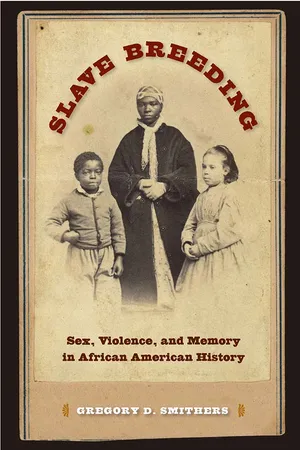
Slave Breeding
eBook - ePub

Slave Breeding

Sex, Violence, and Memory in African American History

  1. English
  2. ePUB (mobile friendly)
  3. Available on iOS & Android
eBook - ePub

Slave Breeding

Sex, Violence, and Memory in African American History

About this book

For over two centuries, the topic of slave breeding has occupied a controversial place in the master narrative of American history. From nineteenth-century abolitionists to twentieth-century filmmakers and artists, Americans have debated whether slave owners deliberately and coercively manipulated the sexual practices and marital status of enslaved African Americans to reproduce new generations of slaves for profit.

In this bold and provocative book, historian Gregory Smithers investigates how African Americans have narrated, remembered, and represented slave-breeding practices. He argues that while social and economic historians have downplayed the significance of slave breeding, African Americans have refused to forget the violence and sexual coercion associated with the plantation South. By placing African American histories and memories of slave breeding within the larger context of America's history of racial and gender discrimination, Smithers sheds much-needed light on African American collective memory, racialized perceptions of fragile black families, and the long history of racially motivated violence against men, women, and children of color.

Frequently asked questions

Yes, you can cancel anytime from the Subscription tab in your account settings on the Perlego website. Your subscription will stay active until the end of your current billing period. Learn how to cancel your subscription.
At the moment all of our mobile-responsive ePub books are available to download via the app. Most of our PDFs are also available to download and we're working on making the final remaining ones downloadable now. Learn more here.
Perlego offers two plans: Essential and Complete
  • Essential is ideal for learners and professionals who enjoy exploring a wide range of subjects. Access the Essential Library with 800,000+ trusted titles and best-sellers across business, personal growth, and the humanities. Includes unlimited reading time and Standard Read Aloud voice.
  • Complete: Perfect for advanced learners and researchers needing full, unrestricted access. Unlock 1.4M+ books across hundreds of subjects, including academic and specialized titles. The Complete Plan also includes advanced features like Premium Read Aloud and Research Assistant.
Both plans are available with monthly, semester, or annual billing cycles.
We are an online textbook subscription service, where you can get access to an entire online library for less than the price of a single book per month. With over 1 million books across 1000+ topics, we’ve got you covered! Learn more here.
Look out for the read-aloud symbol on your next book to see if you can listen to it. The read-aloud tool reads text aloud for you, highlighting the text as it is being read. You can pause it, speed it up and slow it down. Learn more here.
Yes! You can use the Perlego app on both iOS or Android devices to read anytime, anywhere — even offline. Perfect for commutes or when you’re on the go.
Please note we cannot support devices running on iOS 13 and Android 7 or earlier. Learn more about using the app.
Yes, you can access Slave Breeding by Gregory D. Smithers in PDF and/or ePUB format, as well as other popular books in History & World History. We have over one million books available in our catalogue for you to explore.

Information

Table of contents

  1. Cover
  2. Title
  3. Copyright
  4. Contents
  5. List of Figures
  6. Acknowledgments
  7. Introduction
  8. 1. American Abolitionism and Slave-Breeding Discourse
  9. 2. Slavery, the Lost Cause, and African American History
  10. 3. Black History and Slave Breeding in the Early Twentieth Century
  11. 4. The Theater of Memory
  12. 5. The WPA Narratives and Slave Breeding
  13. 6. Sex, Violence, and the Quest for Civil Rights
  14. 7. Slave Breeding in Literature, Film, and New Media
  15. Epilogue
  16. Notes
  17. Bibliography
  18. Index