- English
- ePUB (mobile friendly)
- Available on iOS & Android
About this book
The role of cultural heritage and museums in constructing national identity in postcolonial Cuba
During Fidel Castro's rule, Cuban revolutionaries coopted and reinterpreted the previous bourgeois national narrative of Cuba, aligning it with revolutionary ideology through the use of heritage and public symbols. By changing uses of the past in the present, they were able to shift ideologies, power relations, epistemological conceptions, and economic contexts into the Cuba we know today.
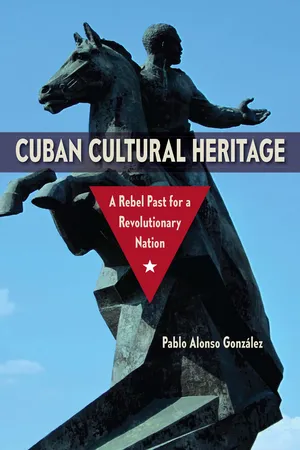
Cuban Cultural Heritage explores the role that cultural heritage and museums played in the construction of a national identity in postcolonial Cuba. Starting with independence from Spain in 1898 and moving through Cuban-American rapprochement in 2014, Pablo Alonso González illustrates how political and ideological shifts have influenced ideas about heritage and how, in turn, heritage has been used by different social actors to reiterate their status, spread new ideologies, and consolidate political regimes.
Unveiling the connections between heritage, power, and ideology, Alonso González delves into the intricacies of Cuban history, covering key issues such as Cuba's cultural and political relationships with Spain, the United States, the Soviet Union, and so-called Third World countries; the complexities of Cuba's status as a postcolonial state; and the potential future paths of the Revolution in the years to come. This volume offers a detailed look at the function and place of cultural heritage under socialist states.
A volume in the series Cultural Heritage Studies, edited by Paul A. Shackel
Frequently asked questions
- Essential is ideal for learners and professionals who enjoy exploring a wide range of subjects. Access the Essential Library with 800,000+ trusted titles and best-sellers across business, personal growth, and the humanities. Includes unlimited reading time and Standard Read Aloud voice.
- Complete: Perfect for advanced learners and researchers needing full, unrestricted access. Unlock 1.4M+ books across hundreds of subjects, including academic and specialized titles. The Complete Plan also includes advanced features like Premium Read Aloud and Research Assistant.
Please note we cannot support devices running on iOS 13 and Android 7 or earlier. Learn more about using the app.
Information
Table of contents
- Cover
- Title Page
- Copyright Page
- Contents
- List of Figures
- Foreword
- List of Abbreviations
- 1. Introduction
- 2. Negotiating the Past, Representing the Nation: The Contested Uses of Heritage during the Republic (1898–1959)
- 3. Heritage as Passion: The Early Years of the Cuban Revolution (1959–1973)
- 4. The Institutionalization of the Cuban Heritage Field (1973–1990)
- 5. The Reification of Ideology as Heritage and the Return of the Nation between 1990 and 2014
- 6. The Office of the City Historian of Havana and the Nation as Heritage after 1990: A Path toward Reconciliation or toward Touristification?
- 7. The Coloniality of Heritage in Postcolonial Cuba
- Appendix: Primary Sources
- References
- Index
- About the Author
- Cultural Heritage Studies