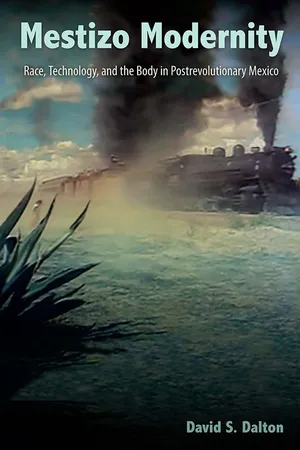
Mestizo Modernity
Race, Technology, and the Body in Post-Revolutionary Mexico
- English
- ePUB (mobile friendly)
- Available on iOS & Android
About this book
Honorable Mention, Latin American Studies Association Mexico Section Best Book in the Humanities
After the end of the Mexican Revolution in 1917, postrevolutionary leaders hoped to assimilate the country's racially diverse population into one official mixed-race identity—the mestizo. This book shows that as part of this vision, the Mexican government believed it could modernize "primitive" Indigenous peoples through technology in the form of education, modern medicine, industrial agriculture, and factory work. David Dalton takes a close look at how authors, artists, and thinkers—some state-funded, some independent—engaged with official views of Mexican racial identity from the 1920s to the 1970s.
Dalton surveys essays, plays, novels, murals, and films that portray indigenous bodies being fused, or hybridized, with technology. He examines José Vasconcelos's essay "The Cosmic Race" and the influence of its ideologies on mural artists such as Diego Rivera and José Clemente Orozco. He discusses the theme of introducing Amerindians to medical hygiene and immunizations in the films of Emilio "El Indio" Fernández. He analyzes the portrayal of indigenous monsters in the films of El Santo, as well as Carlos Olvera's critique of postrevolutionary worldviews in the novel Mejicanos en el espacio.
Incorporating the perspectives of posthumanism and cyborg studies, Dalton shows that technology played a key role in race formation in Mexico throughout the twentieth century. This cutting-edge study offers fascinating new insights into the culture of mestizaje, illuminating the attitudes that inform Mexican race relations in the present day.
A volume in the series Reframing Media, Technology, and Culture in Latin/o America, edited by Hector Fernandez L'Hoeste and Juan Carlos Rodriguez
Frequently asked questions
- Essential is ideal for learners and professionals who enjoy exploring a wide range of subjects. Access the Essential Library with 800,000+ trusted titles and best-sellers across business, personal growth, and the humanities. Includes unlimited reading time and Standard Read Aloud voice.
- Complete: Perfect for advanced learners and researchers needing full, unrestricted access. Unlock 1.4M+ books across hundreds of subjects, including academic and specialized titles. The Complete Plan also includes advanced features like Premium Read Aloud and Research Assistant.
Please note we cannot support devices running on iOS 13 and Android 7 or earlier. Learn more about using the app.
Information
Table of contents
- Cover
- Title Page
- Copyright Page
- Dedication
- Contents
- List of Figures
- Acknowledgments
- Introduction: (Re)Constructing the Racialized Body through Technology
- 1. Science and the (Meta)Physical Body: A Critique of Positivism in the Vasconcelian Utopia
- 2. Painting Mestizaje in a New Light: Racial, Technological, and Cultural Hybridity in the Murals of Diego Rivera and José Clemente Orozco
- 3. Emilio Fernández, Gabriel Figueroa, and the Race for Mexico’s Body: Immunization and Lamarckian Genetics
- 4. Colonizing Resistance: Liminal Imperiality in the Cinema of El Santo and in Carlos Olvera’s Mejicanos en el espacio
- Conclusion: The Legacy of the Modernization of the Body Today
- Notes
- Works Cited
- Index
- About the Author