- English
- ePUB (mobile friendly)
- Available on iOS & Android
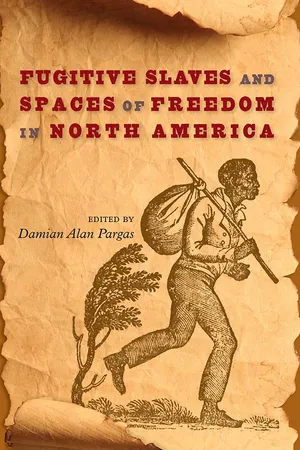
Fugitive Slaves and Spaces of Freedom in North America
About this book
This volume introduces a new way to study the experiences of runaway slaves by defining different "spaces of freedom" they inhabited. It also provides a groundbreaking continental view of fugitive slave migration, moving beyond the usual regional or national approaches to explore locations in Canada, the U.S. North and South, Mexico, and the Caribbean. Using newspapers, advertisements, and new demographic data, contributors show how events like the Revolutionary War and westward expansion shaped the slave experience.
Contributors investigate sites of formal freedom, where slavery was abolished and refugees were legally free, to determine the extent to which fugitive slaves experienced freedom in places like Canada while still being subject to racism. In sites of semiformal freedom, as in the northern United States, fugitives' claims to freedom were precarious because state abolition laws conflicted with federal fugitive slave laws. Contributors show how local committees strategized to interfere with the work of slave catchers to protect refugees. Sites of informal freedom were created within the slaveholding South, where runaways who felt relocating to distant destinations was too risky formed maroon communities or attempted to blend in with free black populations. These individuals procured false documents or changed their names to avoid detection and pass as free.
The essays discuss slaves' motivations for choosing these destinations, the social networks that supported their plans, what it was like to settle in their new societies, and how slave flight impacted broader debates about slavery. This volume redraws the map of escape and emancipation during this period, emphasizing the importance of place in defining the meaning and extent of freedom.
Contributors: Kyle Ainsworth | Mekala Audain | Gordon S. Barker | Sylviane A. Diouf | Roy E. Finkenbine | Graham Russell Gao Hodges | Jeffrey R. Kerr-Ritchie | Viola Franziska MĂźller | James David Nichols | Damian Alan Pargas | Matthew Pinsker
A volume in the series Southern Dissent, edited by Stanley Harrold and Randall M. Miller
Frequently asked questions
- Essential is ideal for learners and professionals who enjoy exploring a wide range of subjects. Access the Essential Library with 800,000+ trusted titles and best-sellers across business, personal growth, and the humanities. Includes unlimited reading time and Standard Read Aloud voice.
- Complete: Perfect for advanced learners and researchers needing full, unrestricted access. Unlock 1.4M+ books across hundreds of subjects, including academic and specialized titles. The Complete Plan also includes advanced features like Premium Read Aloud and Research Assistant.
Please note we cannot support devices running on iOS 13 and Android 7 or earlier. Learn more about using the app.
Information
Table of contents
- Cover
- Title Page
- Copyright Page
- Contents
- List of Figures
- List of Tables
- Foreword
- Introduction: Spaces of Freedom in North America
- 1. Black Self-Emancipation, Gradual Emancipation, and the Underground Railroad in the Northern Colonies and States, 1763â1804
- 2. Revisiting âBritish Principle Talkâ: Antebellum Black Expectations and Racism in Early Ontario
- 3. The Underground Railroad in âIndian Countryâ: Northwest Ohio, 1795â1843
- 4. After 1850: Reassessing the Impact of the Fugitive Slave Law
- 5. Seeking Freedom in the Midst of Slavery: Fugitive Slaves in the Antebellum South
- 6. Illegal but Tolerated: Slave Refugees in Richmond, Virginia, 1800â1860
- 7. Borderland Maroons
- 8. Advertising Maranda: Runaway Slaves in Texas, 1835â1865
- 9. âDesign His Course to Mexicoâ: The Fugitive Slave Experience in the TexasâMexico Borderlands, 1850â1853
- 10. Freedom Interrupted: Runaway Slaves and Insecure Borders in the Mexican Northeast
- 11. The U.S. Coastal Passage and Caribbean Spaces of Freedom
- Contributors
- Index
- Southern Dissent