Archaeology of Domestic Landscapes of the Enslaved in the Caribbean
eBook - ePub

Archaeology of Domestic Landscapes of the Enslaved in the Caribbean

  1. English
  2. ePUB (mobile friendly)
  3. Available on iOS & Android
eBook - ePub

Archaeology of Domestic Landscapes of the Enslaved in the Caribbean

About this book

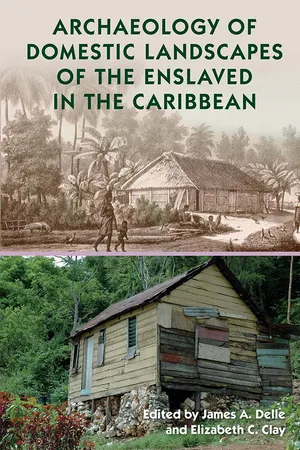
While previous research on household archaeology in the colonial Caribbean has drawn heavily on artifact analysis, this volume provides the first in-depth examination of the architecture of slave housing during this period. It examines the considerations that went into constructing and inhabiting living spaces for the enslaved and reveals the diversity of people and practices in these settings. Contributors present case studies using written descriptions, period illustrations, and standing architecture, in addition to archaeological evidence to illustrate the wide variety of built environments for enslaved populations in places including Jamaica, the Bahamas, and the islands of the Lesser Antilles. They investigate how the enslaved defined their social positions and identities through house, yard, and garden space; they explore what daily life was like for slaves on military compounds; they compare the spatial arrangements of slave villages on plantations based on type of labor; and they show how the style of traditional laborer houses became a form of vernacular architecture still in use today. This volume expands our understanding of the wide range of enslaved experiences across British, French, Dutch, and Danish colonies. 


Contributors: Elizabeth C. Clay | James A. Delle | Todd M. Ahlman | Marco Meniketti | Kenneth Kelly | Hayden Bassett | James A. Delle | Kristen R. Fellows | Allan D. Meyers | Elizabeth C. Clay | Alicia Odewale | Meredith D. Hardy | Zachary J. M. Beier | Mark W. Hauser


 A volume in the Florida Museum of Natural History: Ripley P. Bullen Series Publication of the paperback edition made possible by a Sustaining the Humanities through the American Rescue Plan grant from the National Endowment for the Humanities.

Frequently asked questions

Yes, you can cancel anytime from the Subscription tab in your account settings on the Perlego website. Your subscription will stay active until the end of your current billing period. Learn how to cancel your subscription.
No, books cannot be downloaded as external files, such as PDFs, for use outside of Perlego. However, you can download books within the Perlego app for offline reading on mobile or tablet. Learn more here.
Perlego offers two plans: Essential and Complete
  • Essential is ideal for learners and professionals who enjoy exploring a wide range of subjects. Access the Essential Library with 800,000+ trusted titles and best-sellers across business, personal growth, and the humanities. Includes unlimited reading time and Standard Read Aloud voice.
  • Complete: Perfect for advanced learners and researchers needing full, unrestricted access. Unlock 1.4M+ books across hundreds of subjects, including academic and specialized titles. The Complete Plan also includes advanced features like Premium Read Aloud and Research Assistant.
Both plans are available with monthly, semester, or annual billing cycles.
We are an online textbook subscription service, where you can get access to an entire online library for less than the price of a single book per month. With over 1 million books across 1000+ topics, we’ve got you covered! Learn more here.
Look out for the read-aloud symbol on your next book to see if you can listen to it. The read-aloud tool reads text aloud for you, highlighting the text as it is being read. You can pause it, speed it up and slow it down. Learn more here.
Yes! You can use the Perlego app on both iOS or Android devices to read anytime, anywhere — even offline. Perfect for commutes or when you’re on the go.
Please note we cannot support devices running on iOS 13 and Android 7 or earlier. Learn more about using the app.
Yes, you can access Archaeology of Domestic Landscapes of the Enslaved in the Caribbean by James A. Delle,Elizabeth C. Clay in PDF and/or ePUB format, as well as other popular books in Social Sciences & Anthropology. We have over one million books available in our catalogue for you to explore.

Table of contents

  1. Cover
  2. Title Page
  3. Copyright Page
  4. Contents
  5. List of Figures
  6. List of Tables
  7. 1. Household, Village, and Landscape: The Built Environments of Slavery in the Caribbean
  8. 2. An Examination of Housing for Enslaved and Free Blacks on Sugar and Cotton Plantations on the Southeast Peninsula of St. Kitts
  9. 3. The Present Past: The Design Legacy of Laborers’ Housing in the Landscape of Vernacular Architecture on Nevis
  10. 4. Building a Better Village? Transformations in French West Indian Slave Village Architecture from the Ancien Régime to Emancipation
  11. 5. Asymmetric Architectures of Enslaved People in Jamaica: An Archaeological Study of Household Variation at Good Hope Estate
  12. 6. Variation within the Village: Housing Enslaved Laborers on Coffee Plantations in Jamaica
  13. 7. Humanitarian Reform, Model Cottages, and the Habitational Landscape of Slavery on a Bahama Island
  14. 8. Landscape and Labor on the Periphery: Built Environments of Slavery in Nineteenth-Century French Guiana
  15. 9. Royal Enslaved Afro-Caribbeans in Christiansted: Exploring the Archaeology of Enslavement in a Caribbean City
  16. 10. Households and Dwelling Practices at the Cabrits Garrison Laborer Village
  17. 11. Built Environments: Slavery, Materiality, and Usable Pasts
  18. References
  19. List of Contributors
  20. Index