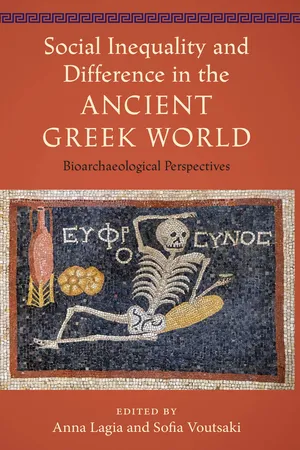
Social Inequality and Difference in the Ancient Greek World
eBook - ePub

Social Inequality and Difference in the Ancient Greek World

Bioarchaeological Perspectives

  1. English
  2. ePUB (mobile friendly)
  3. Available on iOS & Android
eBook - ePub

Social Inequality and Difference in the Ancient Greek World

Bioarchaeological Perspectives

About this book

Exploring the relationship between health and inequality in the societies of ancient Greece

In this volume, bioarchaeologists, osteologists, archaeologists, and paleopathologists examine the ways social inequalities and differences affected health and well-being in ancient Greece. Although the ancient Greek civilization is often associated with the ideals of democracy and social equality, the region was characterized by pervasive divisions. Moving beyond elitism and idealization, this book focuses on health-related disparities and difference.


Case studies cover a wide temporal range—from the eleventh century BCE through the sixth century CE, a period not usually examined in bioarchaeological studies of the region—and geographical areas including city-states in the Greek mainland, the Aegean islands, the Ionian coast, Albania, and southern Italy. Comparing health-related data across social groups and sociopolitical systems, contributors explore the relationships between colonists and Indigenous communities, strategies of inclusion and exclusion in mortuary practices, and the impact of urbanization and Romanization on health, diet, and growth. This book also discusses methodological questions such as the challenges posed by poor skeletal preservation, small sample sizes, and incomplete or legacy data.


With a focus on marginalized groups including ordinary people, women, children, and enslaved workers, Social Inequality and Difference in the Ancient Greek World shows how bioarchaeology can dialogue with the disciplines of archaeology and ancient history to explore subjects such as health, inequality, ethnicity, age, and gender. This book opens a new avenue for addressing questions concerning living standards in the ancient world.  

Contributors: Hannah Liedl | Lukas Waltenberger | Britney Kyle | Dimitra Ermioni Michael | Victoria Sabetai | Carrie L. Sulosky Weaver | Anna Lagia | Elena Vlachogianni | Sandra Garvie-Lok | Jane Buikstra | Reine-Marie Bérard | Christina Papageorgopoulou | Efthymia Nikita | Aliya R. Hoff | Eleni-Anna Prevedorou | Sofia Voutsaki | Lisa Steige | Sam Cleymans | Paraskevi Tritsaroli


A volume in the series Bioarchaeological Interpretations of the Human Past: Local, Regional, and Global Perspectives, edited by Clark Spencer Larsen

Frequently asked questions

Yes, you can cancel anytime from the Subscription tab in your account settings on the Perlego website. Your subscription will stay active until the end of your current billing period. Learn how to cancel your subscription.
No, books cannot be downloaded as external files, such as PDFs, for use outside of Perlego. However, you can download books within the Perlego app for offline reading on mobile or tablet. Learn more here.
Perlego offers two plans: Essential and Complete
  • Essential is ideal for learners and professionals who enjoy exploring a wide range of subjects. Access the Essential Library with 800,000+ trusted titles and best-sellers across business, personal growth, and the humanities. Includes unlimited reading time and Standard Read Aloud voice.
  • Complete: Perfect for advanced learners and researchers needing full, unrestricted access. Unlock 1.4M+ books across hundreds of subjects, including academic and specialized titles. The Complete Plan also includes advanced features like Premium Read Aloud and Research Assistant.
Both plans are available with monthly, semester, or annual billing cycles.
We are an online textbook subscription service, where you can get access to an entire online library for less than the price of a single book per month. With over 1 million books across 1000+ topics, we’ve got you covered! Learn more here.
Look out for the read-aloud symbol on your next book to see if you can listen to it. The read-aloud tool reads text aloud for you, highlighting the text as it is being read. You can pause it, speed it up and slow it down. Learn more here.
Yes! You can use the Perlego app on both iOS or Android devices to read anytime, anywhere — even offline. Perfect for commutes or when you’re on the go.
Please note we cannot support devices running on iOS 13 and Android 7 or earlier. Learn more about using the app.
Yes, you can access Social Inequality and Difference in the Ancient Greek World by Anna Lagia,Sofia Voutsaki in PDF and/or ePUB format, as well as other popular books in Social Sciences & Greek Ancient History. We have over one million books available in our catalogue for you to explore.

Table of contents

  1. Cover
  2. Title Page
  3. Copyright Page
  4. Dedication
  5. Contents
  6. List of Figures
  7. List of Tables
  8. 1. Introduction
  9. 2. In Sickness and in Health: Health-Related Quality of Life in Bioarchaeological Research
  10. 3. Stable Isotopes: Examining Ancient Greek Diet and Identity in Environmental and Biological Context
  11. 4. Reconstructing Population History through Paleogenomic Analysis
  12. 5. Untimely Death: Funerary Treatment and Status of the Subadults in the Cemeteries of Megara Hyblaea (Late 8th to Early 5th Century BCE)
  13. 6. At the Intersection of Biology and Identity: Nonmetric Traits as Indicators of Ethnicity in Greek Colonial Contexts
  14. 7. Unwritten Histories of Ancient Athens: The People of the Phaleron Cemetery
  15. 8. Using Stature, Long-Bone Length, and Sexual Stature Dimorphism to Evaluate Socioeconomic Inequalities in Ancient Athens
  16. 9. Kinship Patterns in Ancient Greece: Preliminary Bioarchaeological Insights from Boeotia
  17. 10. The Bioarchaeology of Health and Status in Roman Greece: State of Knowledge and Future Directions
  18. 11. Response: Anthropometry, Stature, and Social Inequality in Ancient Greece
  19. 12. Response: Bioarchaeology of the Eastern Mediterranean; Plans and Prospects
  20. List of Contributors
  21. Index