- English
- ePUB (mobile friendly)
- Available on iOS & Android
eBook - ePub
About this book
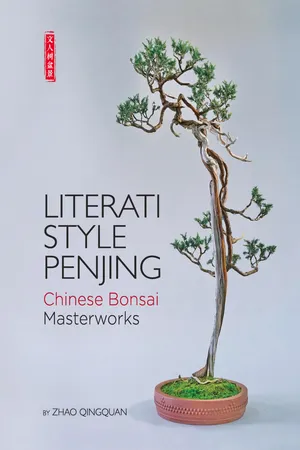
The art of bonsai is widely known in the West: from the Karate Kid to the American Bonsai Association and even local grocery stores, bonsai has become a common sight in the States. But bonsai, the Japanese art of creating miniature trees, actually originated in China, where it's called penjing. Penjing, meaning "tray scenery," is a traditional Chinese art of creating miniature potted landscapes including trees and other plants. Brought from China to Japan in ancient times before spreading to the West, bonsai/penjing is now popular throughout the world. In China, the art of creating miniature landscapes has evolved in several different ways. Literati Style Penjing: Chinese Bonsai Masterworks focuses on a special category of penjing associated with traditional Chinese culture, such as the painting of the literati, or elite scholar-bureaucrats, of imperial China. Like literati ink paintings, this style of penjing has a subtle elegance distinguished by a lone, lean trunk with sparse foliage exhibiting distinct lines and simplicity. The term "literati style penjing" has been widely accepted by the bonsai community and is becoming more common within the bonsai world. It is well suited to melding concepts from Chinese painting, poetry and Zen into a stunning bonsai work, making it of interest to a wide variety of gardening styles. Literati Style Penjing; Chinese Bonsai Masterworks explains the concept of penjing with a literati bent, exploring its rich history and aesthetics, as well as cultivation techniques, and care and maintenance. It includes 12 examples of literati style penjing creations, which incorporate a deep knowledge of the art form together with practical creativity and artistic beauty. Lovers of bonsai will find much to inspire and delight within these pages.
Information
Subtopic
HorticultureIndex
Biological SciencesTable of contents
- Cover
- Title Page
- Copyright
- Contents
- Foreword
- Preface
- Chapter One Aesthetics
- Chapter Two Cultural Origins
- Chapter Three Basic Techniques
- Chapter Four Projects
- Chapter Five Display Techniques
- Chapter Six Care and Maintenance
- Appendices
Trusted by 375,005 students
Access to over 1.5 million titles for a fair monthly price.
Study more efficiently using our study tools.
Frequently asked questions
Yes, you can cancel anytime from the Subscription tab in your account settings on the Perlego website. Your subscription will stay active until the end of your current billing period. Learn how to cancel your subscription
No, books cannot be downloaded as external files, such as PDFs, for use outside of Perlego. However, you can download books within the Perlego app for offline reading on mobile or tablet. Learn how to download books offline
Perlego offers two plans: Essential and Complete
- Essential is ideal for learners and professionals who enjoy exploring a wide range of subjects. Access the Essential Library with 800,000+ trusted titles and best-sellers across business, personal growth, and the humanities. Includes unlimited reading time and Standard Read Aloud voice.
- Complete: Perfect for advanced learners and researchers needing full, unrestricted access. Unlock 1.5M+ books across hundreds of subjects, including academic and specialized titles. The Complete Plan also includes advanced features like Premium Read Aloud and Research Assistant.
We are an online textbook subscription service, where you can get access to an entire online library for less than the price of a single book per month. With over 1.5 million books across 990+ topics, we’ve got you covered! Learn about our mission
Look out for the read-aloud symbol on your next book to see if you can listen to it. The read-aloud tool reads text aloud for you, highlighting the text as it is being read. You can pause it, speed it up and slow it down. Learn more about Read Aloud
Yes! You can use the Perlego app on both iOS and Android devices to read anytime, anywhere — even offline. Perfect for commutes or when you’re on the go.
Please note we cannot support devices running on iOS 13 and Android 7 or earlier. Learn more about using the app
Please note we cannot support devices running on iOS 13 and Android 7 or earlier. Learn more about using the app
Yes, you can access Literati Style Penjing by Qingquan Zhao in PDF and/or ePUB format, as well as other popular books in Biological Sciences & Horticulture. We have over 1.5 million books available in our catalogue for you to explore.