- English
- ePUB (mobile friendly)
- Available on iOS & Android
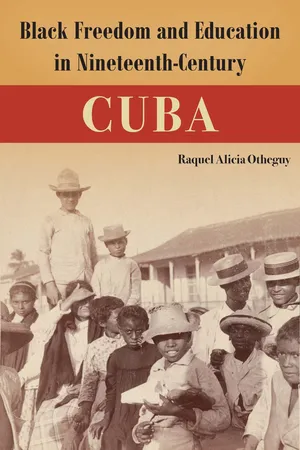
Black Freedom and Education in Nineteenth-Century Cuba
About this book
Examining the educational legacy of Afro-Cuban teachers and activists
In this book, Raquel Otheguy argues that Afro-descended teachers and activists were central to the development of a national education system in Cuba. Tracing the emergence of a Black Cuban educational tradition whose hallmarks were at the forefront of transatlantic educational currents, Otheguy examines how this movement pushed the island’s public school system to be more accessible to children and adults of all races, genders, and classes.
Otheguy describes Afro-Cuban education before public schools were officially desegregated in 1894, from the maestras amigas—Black and mulata women who taught in their homes—to teachers in the schools of mutual-aid societies for people of color. In the ways that Afro-descendants interacted with the Spanish colonial school system and its authorities, and in the separate schools they created, they were resisting the hardening racial boundaries that characterized Cuban life and developing alternative visions of possible societies, nations, and futures. Otheguy demonstrates that Black Cubans pioneered the region’s most progressive innovations in education and influenced the trajectory of public school systems in their nation and the broader Americas.
A volume in the series Caribbean Crossroads: Race, Identity, and Freedom Struggles, edited by Lillian Guerra, Devyn Spence Benson, April Mayes, and Solsiree del Moral
Publication of this work made possible by a Sustaining the Humanities through the American Rescue Plan grant from the National Endowment for the Humanities
Frequently asked questions
- Essential is ideal for learners and professionals who enjoy exploring a wide range of subjects. Access the Essential Library with 800,000+ trusted titles and best-sellers across business, personal growth, and the humanities. Includes unlimited reading time and Standard Read Aloud voice.
- Complete: Perfect for advanced learners and researchers needing full, unrestricted access. Unlock 1.4M+ books across hundreds of subjects, including academic and specialized titles. The Complete Plan also includes advanced features like Premium Read Aloud and Research Assistant.
Please note we cannot support devices running on iOS 13 and Android 7 or earlier. Learn more about using the app.
Information
Table of contents
- Cover
- Title Page
- Copyright Page
- Dedication
- Contents
- List of Figures
- Acknowledgments
- Introduction: The Black Cuban Educational Tradition
- 1. Maestras Amigas and the Shaping of a Black Cuban Educational Ideology in Early Nineteenth-Century Cuba
- 2. Rebellious Teachers, 1812–1844
- 3. Racial Segregation in Cuba’s First Law for Public Education
- 4. The 1878 Order to Build Schools for Children of Color, White Backlash, and the Effect on Black Teachers
- 5. Black Teachers, Sociedades de Color, and Separate Schools
- 6. The Directorio Central de las Sociedades de la Raza de Color and the 1890s Campaign for Equal School Rights
- 7. “No Division by Color”: US School Inspectors and the Aftermath of the War of Independence
- Epilogue: Race in Cuba’s Schools, 1910 and Beyond
- Notes
- Bibliography
- Index