eBook - PDF
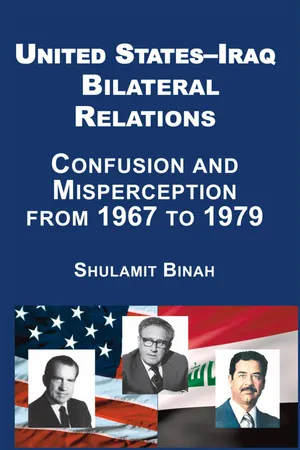
United States-Iraq Bilateral Relations
Confusion and Misperception from 1967 to 1979
- 305 pages
- English
- PDF
- Available on iOS & Android
eBook - PDF
About this book
How did United States-Iraq relations deteriorate into a double-feature war that destroyed Iraq's Ba'th regime, a secular sovereign government, and dragged the United States into an unforeseen chaos that has limited its willingness and ability to take part in other world affairs? The facts are well known, but until now there has been no serious academic study of the fundamental mutual misunderstandings between Iraq and the United States. Here Binah examines the perceptions, preconceptions and misunderstandings of both sides over a period of twelve years, from 1967 (the Six Day War) to 1979 (the emergence of the Khomeini Islamic Republic in Iran). This history provides the background to the fatal 1990 deaf-dialogue between Iraqi President Saddam Hussein and American ambassador April Glaspie, which led to the first Gulf war. The book deals with three main issues which are the Persian (or Arabian) Gulf, the Kurdish rebellion and the Arab-Israeli conflict-including the increasing political involvement of the American Jewish community in matters relating to Israel and Jews in the Arab lands, as the influence of their organizations grew. While examining these issues, Binah bears in mind the over-arching concerns at that time of the Cold War and the international oil market. This thorough study provides a detailed and exact report of 'what happened' alongside the broader discussion of 'why did it happen', giving the reader the framework for such an examination. [Subject: Politics, Middle East Studies, Foreign Relations, Public Policy, Israel, Iraq, History]
Information
Subtopic
Middle Eastern HistoryIndex
HistoryTable of contents
- Cover
- Front Matter
- Chapter 1
- Chapter 2
- Chapter 3
- Chapter 4
- Chapter 5
- Chapter 6
- Chapter 7
- Chapter 8
- Conclusion
- Appendix I
- Appendix II
- Bibliography
- Index
Trusted by 375,005 students
Access to over 1.5 million titles for a fair monthly price.
Study more efficiently using our study tools.
Frequently asked questions
Yes, you can cancel anytime from the Subscription tab in your account settings on the Perlego website. Your subscription will stay active until the end of your current billing period. Learn how to cancel your subscription
No, books cannot be downloaded as external files, such as PDFs, for use outside of Perlego. However, you can download books within the Perlego app for offline reading on mobile or tablet. Learn how to download books offline
Perlego offers two plans: Essential and Complete
- Essential is ideal for learners and professionals who enjoy exploring a wide range of subjects. Access the Essential Library with 800,000+ trusted titles and best-sellers across business, personal growth, and the humanities. Includes unlimited reading time and Standard Read Aloud voice.
- Complete: Perfect for advanced learners and researchers needing full, unrestricted access. Unlock 1.5M+ books across hundreds of subjects, including academic and specialized titles. The Complete Plan also includes advanced features like Premium Read Aloud and Research Assistant.
We are an online textbook subscription service, where you can get access to an entire online library for less than the price of a single book per month. With over 1.5 million books across 990+ topics, we’ve got you covered! Learn about our mission
Look out for the read-aloud symbol on your next book to see if you can listen to it. The read-aloud tool reads text aloud for you, highlighting the text as it is being read. You can pause it, speed it up and slow it down. Learn more about Read Aloud
Yes! You can use the Perlego app on both iOS and Android devices to read anytime, anywhere — even offline. Perfect for commutes or when you’re on the go.
Please note we cannot support devices running on iOS 13 and Android 7 or earlier. Learn more about using the app
Please note we cannot support devices running on iOS 13 and Android 7 or earlier. Learn more about using the app
Yes, you can access United States-Iraq Bilateral Relations by Shulamit Binah in PDF and/or ePUB format, as well as other popular books in History & Middle Eastern History. We have over 1.5 million books available in our catalogue for you to explore.