eBook - PDF
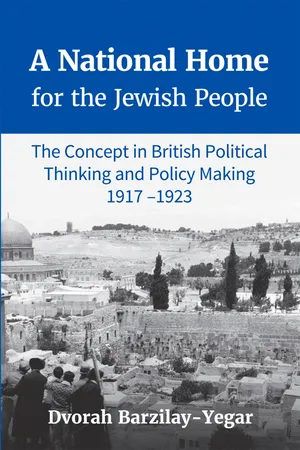
A National Home for the Jewish People
The Concept in British Political Thinking and Policy Making 1917-1923
- 385 pages
- English
- PDF
- Available on iOS & Android
eBook - PDF
A National Home for the Jewish People
The Concept in British Political Thinking and Policy Making 1917-1923
About this book
What was the concept of 'A National Home for the Jewish People,' where did it come from, and how was it defined? Barzilay-Yegar traces the shifting meanings of the phrase from its first coining in the Balfour Declaration of 1917, to international recognition when it was included in the League of Nations' Mandate for Britain to administer Palestine, granted in 1923. The concept remained elastic throughout this period, and interpretations were made to suit different political and philosophical standpoints. This was done on two levels: the theoretical thinking which followed the drafting of the Mandate, and the actual political practice in Palestine. The first part of the book deals with the various definitions given to 'A National Home' during the Military Administration in response to pressures applied to British politicians, the background of Jewish-Arab expectations, and the economic and administrative problems caused by the policy of keeping the status-quo. The second part deals with the period of the Civil Administration and describes the efforts to define the concept until the White Paper of 1922. This book is essential reading for anyone wanting to know more about how the Balfour Declaration went from ideal to actuality, and to understand the various pressures applied to British politicians to make it happen. [Subject: History, Jewish Studies, Politics, Middle East Studies]Ã?Â?Ã?Â?
Information
Subtopic
Middle Eastern HistoryIndex
HistoryTable of contents
- Cover
- Front Matter
- Chapter 1
- Chapter 2
- Chapter 3
- Chapter 4
- Chapter 5
- Formulating the Mandate and Defining Boundaries
- Chapter 6
- Chapter 7
- Summary
- Bibliography
- Index
Trusted by 375,005 students
Access to over 1.5 million titles for a fair monthly price.
Study more efficiently using our study tools.
Frequently asked questions
Yes, you can cancel anytime from the Subscription tab in your account settings on the Perlego website. Your subscription will stay active until the end of your current billing period. Learn how to cancel your subscription
No, books cannot be downloaded as external files, such as PDFs, for use outside of Perlego. However, you can download books within the Perlego app for offline reading on mobile or tablet. Learn how to download books offline
Perlego offers two plans: Essential and Complete
- Essential is ideal for learners and professionals who enjoy exploring a wide range of subjects. Access the Essential Library with 800,000+ trusted titles and best-sellers across business, personal growth, and the humanities. Includes unlimited reading time and Standard Read Aloud voice.
- Complete: Perfect for advanced learners and researchers needing full, unrestricted access. Unlock 1.5M+ books across hundreds of subjects, including academic and specialized titles. The Complete Plan also includes advanced features like Premium Read Aloud and Research Assistant.
We are an online textbook subscription service, where you can get access to an entire online library for less than the price of a single book per month. With over 1.5 million books across 990+ topics, we’ve got you covered! Learn about our mission
Look out for the read-aloud symbol on your next book to see if you can listen to it. The read-aloud tool reads text aloud for you, highlighting the text as it is being read. You can pause it, speed it up and slow it down. Learn more about Read Aloud
Yes! You can use the Perlego app on both iOS and Android devices to read anytime, anywhere — even offline. Perfect for commutes or when you’re on the go.
Please note we cannot support devices running on iOS 13 and Android 7 or earlier. Learn more about using the app
Please note we cannot support devices running on iOS 13 and Android 7 or earlier. Learn more about using the app
Yes, you can access A National Home for the Jewish People by Dvorah Barzilay-Yegar in PDF and/or ePUB format, as well as other popular books in History & Middle Eastern History. We have over 1.5 million books available in our catalogue for you to explore.