- 402 pages
- English
- PDF
- Available on iOS & Android
eBook - PDF
About this book
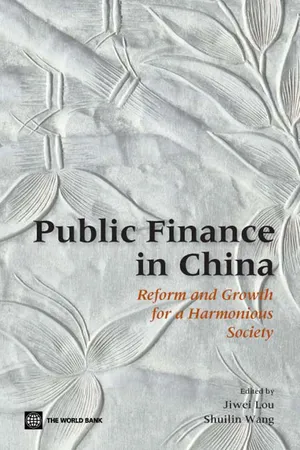
Since 1980, China's economy has been the envy of the world. Is annual growth rate of more than 9 percent during this period makes China today the world's fourth-largest economy. And this sustained growth has reduced the poverty rate from 60 percent of the population to less than 10 percent. However, such rapid growth has also increased inequalities in income and access to basic services and stressed natural resources. The government seeks to resolve these and other issues by creating a 'harmonious society' -- shifting priorities from the overriding pursuit of growth to more balanced economic and social development. This volume compiles analyses and insights from high-level Chinese policy makers and prominent international scholars that address the changes needed in public finance for success in the government's new endeavor. It examines such key policy issues as public finance and the changing role of the state; fiscal reform and revenue and expenditure assignments; intergovernmental relations and fiscal transfers; and financing and delivery of basic public goods such as compulsory education, innovation, public health, and social protection. And it offers concrete recommendations for immediate policy changes and for China's future reform agenda. 'Public Finance in China' is a must-read for specialists in public finance and for those seeking an understanding of the complex and daunting challenges China is facing.
Information
Subtopic
Public FinanceIndex
EconomicsTable of contents
- Contents
- Foreword by James W.Adams
- Preface
- Acknowledgments
- Contributors
- Abbreviations
- 1 Overview
- Part I: Role of the State and Public Finances
- Part II: Fiscal Reform and Revenue Assignments
- Part III: Intergovernmental Relations and Fiscal Transfers
- Part IV: Education and Innovation Financing
- Part V: The Public Health System: Access, Service Delivery, and Financing
- Part VI: Social Security
- Part VII: Growth, Inequality, and Fiscal Reform
- Box 6.1 Piggy backing versus Tax Sharing
- Box 10.1 Deepening the Reform of Financing Mechanisms for Compulsory Rural Education
- Box 10.2 Characteristics of an Effective Legal and Regulatory Framework for Education and Training
- Box 10.3 Expanding Enrollment in Zhejiang Province through Education Vouchers
- Box 10.4 Characteristics of Good Student Loan Schemes
- Box 14.1 Measuring the Performance of Multipillar Reforms
- Figure 2.1 Rural/Urban Income Inequality, 1978–2005
- Figure 3.1 Within-Province Disparities in per Capita Expenditure across Counties, 2003
- Figure 3.2 Per Capita Expenditures by Province, and Minimum National Standards under Current and Perfect Equalization, 2003
- Figure 3.3 Relation between Investment Climate and Social and Environmental Conditions in China, 2005
- Figure 4.1 Central Government Fiscal Revenues, Expenditures, and Balances, 1998–2005
- Figure 6.1 Central, Local, and Total Government Revenues, 1980–2005
- Figure 6.2 Provincial Revenue Losses from C-VAT Reform, Base-Case Scenario
- Figure 6.3 Provincial Revenue Losses from Extension of VAT to Services
- Figure 6.4 Incremental VAT Shares, by Province
- Figure 6.5 Provincial Revenue Losses from C-VAT Reform, Allowing for Revenue Returned
- Figure 7.1 China’s Layer-Cake Model of Intergovernmental Grant Flows
- Figure 7.2 Distribution of Total per Capita Transfers from the Central Government, by Province, 2004
- Figure 7.3 Central-Provincial Transfers, 1995–2004
- Figure 7.4 Composition of Transfers at Different Levels of Government, 2003
- Figure 8.1 Central Government Revenue as a Percentage of Total Government Revenue and Total Government Revenueas a Percentage of GDP, 1984–92
- Figure 8.2 Total Government Revenue as a Percentage of GDP and Central Government Revenue as a Percentage of Total Government Revenue, 1993–2005
- Figure 8.3 Percentage of Government Expenditure Made by Centraland Local Governments, 1994–2005
- Figure 8.4 Regional Distribution of Income Tax Revenues and General-Purpose Transfers, 2005
- Figure 8.5 Intergovernmental Fiscal Transfer System
- Figure 8.6 Year-on-Year Increases in General Transfer Payments,1994–2005
- Figure 8.7 Transfer Payments from the Central Government to Local Governments, 1994–2005
- Figure 8.8 Equalization Effect of Transfer Payments, 2005
- Figure 8.9 Tax Returns as a Percentage of Total Returns and Subsidies from the Central Government to Local Governments, 1994–2005
- Figure 8.10 Change in Increment of Returned VAT and Excise Duty Revenues as a Percentage of Total Increment of Revenues of These Two Taxes, 1994–2010
- Figure 8.11 Ratio of Central Government to Local Government Revenues, in Selected Countries
- Figure 8.12 Ratio of Central Government to Local Government Expenditures, in Selected Countries
- Figure 8.13 Percentage of Public Servants Employed by the Central Government and Local Governments, in Selected Countries, 2002
- Figure 10.1 Percentage of Population in China and OECD that Completed Upper-Secondary or Tertiary Education, 2001
- Figure 10.2 Tertiary Enrollment Rates in Selected Countries, 1991–2004
- Figure 10.3 Per Student Expenditure as a Percentage of per Capita GDP, in Selected Countries, by Level, 2002
- Figure 12.1 Per Capita Out-of-Pocket Health Expenditure in Urban and Rural China, 1990–2002
- Figure 13.1 Out-of-Pocket Health Spending in China, 1990–2000
- Figure 13.2 Out-of-Pocket Expenses and Cost of Inpatient Care in Selected Countries
- Figure 13.3 Prevalence of Tuberculosis and Government Expenditureon Public Health, by Province, 2003
- Figure 13.4 Government Spending on and Business Income of Disease Control Institutes and Maternal and Child Health Centers,1990–2003
- Figure 14.1 Actual and Projected Population Growth and Old-Age Dependency Ratio in China, 2005–2050
- Figure 14.2 Projected Financial Flows of Current Urban Pension System,2001–2071
- Figure 17.1 Share of Pretax Income of Top 5 Percent and Top 20 Percent of Households in the United Kingdom, 1760–1970
- Figure 17.2 Gini Coefficient of Household per Capita Income in Argentina, 1980–2002
- Figure 17.3 Gini Coefficient of Gross Monthly Household per Capita Income in Brazil, 1980–2004
- Figure 17.4 Income Inequality in China, 1980–2002
- Figure 17.5 Income Inequality in China Relative to Selected Countries, 1981–2003
- Table 2.1 Government Revenue and Expenditure as a Percentage of GDP, 1978–2004
- Table 2.2 Off-Budget Revenues and Expenditures as a Percentage of Total Budget Revenues and Expenditures, 1989–2003
- Table 2.3 Central Government Share of Budgetary Revenue and Expenditure, 1978–2004
- Table 2.4 Composition of Government Budgetary Expenditure,1978–2004
- Table 2.5 Government Expenditure on Education and Health as a Percentage of Total Expenditure, 2000–03
- Table 3.1 Subnational Government Share of Total Government Revenue and Expenditure, in China and Groups of Other Countries
- Table 3.2 Revenues and Expenditures, by Level of Governmentin China, 1993–2003
- Table 4.1 Value Added Tax Rates in Selected Countries
- Table 4.2 Corporate Income Tax Rates, Yields, and Productivity in Selected Economies, 2002
- Table 4.3 Main Differences between Enterprise Income Tax Lawson Domestic and Foreign-Invested Enterprises
- Table 4.4 Personal Income Tax Rates, Yields, and Productivity in Selected Economies, 2002
- Table 4.5 Shares of Central and Local Government Spending, by Expenditure Category, 2004
- Table 4.6 Spending on Education and Health in Selected Economies, 2004
- Table 5.1 Shares of Total Expenditure by Governments at Different Levels, by Expenditure Category, 2003
- Table 5.2 Extrabudgetary Spending by Subnational Governments,1998–2002
- Table 5.3 Extrabudgetary and Budgetary Expenditure for Consolidated Local Governments, 1985–2002
- Table 5.4 Per Capita Expenditure Disparities across Provinces, 1990–2003
- Table 5.5 Public per Capita Expenditure for Selected Items, by Province, 2003
- Table 6.1 Sources of Tax Revenues of Local Governments in Selected Federal Countries, 2001
- Table 6.2 Sources of Tax Revenues of Local Governments in Selected Unitary Countries, 2001
- Table 6.3 Taxing Powers of Subnational Governments in Selected OECD Countries, 1995
- Table 6.4 Effect of Revising VAT Revenue-Sharing Rules
- Table 6.5 Collected and Returned Revenue, 1996–2001
- Table 6.6 “Half-Life” of Revenue-Returned Formula
- Table 6.7 Local Discretion over Taxes in China, 2001
- Table 6.8 Marginal Income Tax Rates by Subnational Governments in Canada and the United States, 2002
- Table 6.9 Property Tax Revenues in China, by Type of Tax, 2001
- Table 6.10 Importance of Property Taxes in Selected Countries
- Table 7.1 Intergovernmental Transfers in China, 2003 and 2004
- Table 7.2 Central Government Transfers, by Region, 2004
- Table 7.3 Correlation between Various Types of Intergovernmental Transfers and Provincial Economic Indicators, 2004
- Table 7.4 Equalization Impact of Central Government Transferson Provincial Revenue, by Type of Transfer, 2004
- Table 7.5 Principles and Better Practices in Grant Design
- Table 7.6 Vertical Fiscal Gap, 2003
- Table 10.1 Education Levels of the Labor Force, by Region, 2004
- Table 10.2 Traditional and New Roles of Government in Education and Training
- Table 10.3 Gross Primary, Secondary, and Tertiary Enrollment Rates,by Country Income Level, 2005
- Table 10.4 Public Education Expenditure in Selected Countries and Regions, 2000–03
- Table 10.5 Interprovincial Differences in per Student Spending on Primary and Lower-Secondary Education, 1989, 1997, and 2003
- Table 10.6 Public Expenditure on Education, by Level, 1998 and 2003
- Table 10.7 Share of Nongovernmental Education Expenditure in Selected Countries, by Level, 2002
- Table 10.8 Sources of Investment Funding for Formal Education, 2003
- Table 10.9 Shares of Public, Private, and Household Expenditures onTertiary Education in Selected Countries, 2003
- Table 11.1 China’s Top 25 Exports, 2004
- Table 11.2 Number of Patents Filed by and Granted to Chinese Companies
- Table 11.3 Top 10 Patent Classes as a Percentage of All Patents in Selected Economies, 2001–05
- Table 11.4 Top 10 Patent Classes by Residents of Selected Economies, 2001–05
- Table 11.5 National Programs with an Impact on University Research in China
- Table 11.6 Industrial Promotion Policies in the United States
- Table 14.1 Actual (2005) and Projected (2050) Old-Age Dependency Ratios in Selected Countries and Regions
- Table 16.1 Leakage and Coverage of Di Bao Program, Based on Observed Incomes
- Table 16.2 Impact of Di Bao on Aggregate Poverty Measures for Urban China
- Table 16.3 Leakage and Coverage Using Propensity Score as an Indicator of Di Bao Gap
- Table 16.4 Targeting Performance Based on Self-Rated Welfare
- Table 17.1 Dependency Rate and Public Old-Age Spending in Selected OECD Countries, 1980 and 2003
Trusted by 375,005 students
Access to over 1.5 million titles for a fair monthly price.
Study more efficiently using our study tools.
Frequently asked questions
Yes, you can cancel anytime from the Subscription tab in your account settings on the Perlego website. Your subscription will stay active until the end of your current billing period. Learn how to cancel your subscription
No, books cannot be downloaded as external files, such as PDFs, for use outside of Perlego. However, you can download books within the Perlego app for offline reading on mobile or tablet. Learn how to download books offline
We are an online textbook subscription service, where you can get access to an entire online library for less than the price of a single book per month. With over 1.5 million books across 990+ topics, we’ve got you covered! Learn about our mission
Look out for the read-aloud symbol on your next book to see if you can listen to it. The read-aloud tool reads text aloud for you, highlighting the text as it is being read. You can pause it, speed it up and slow it down. Learn more about Read Aloud
Yes! You can use the Perlego app on both iOS and Android devices to read anytime, anywhere — even offline. Perfect for commutes or when you’re on the go.
Please note we cannot support devices running on iOS 13 and Android 7 or earlier. Learn more about using the app
Please note we cannot support devices running on iOS 13 and Android 7 or earlier. Learn more about using the app
Yes, you can access Public Finance in China by Jiwei Lou,Shuilin Wang in PDF and/or ePUB format, as well as other popular books in Economics & Public Finance. We have over 1.5 million books available in our catalogue for you to explore.