- 306 pages
- English
- PDF
- Available on iOS & Android
eBook - PDF
About this book
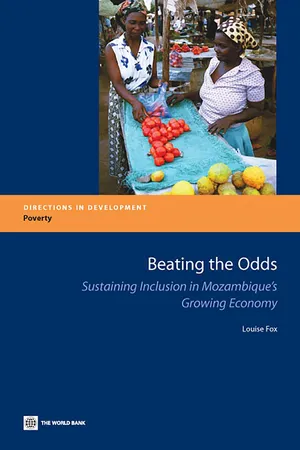
The story of Mozambique is one of successful transformation. Since 1994, when it faced a decimated infrastructure, a weak economy, and fragile institutions, it has sustained high economic growth and has made tangible reductions in poverty. Its recovery from civil conflict and extreme poverty make it a showcase for other nations embarking on similar transitions. Still, more than half of the population lives in poverty. Gaps persist between city dwellers and farmers, men and women, rich and poor. And although growth continues, there is concern that Mozambique's drive to reduce poverty may lose momentum as happens in many countries recovering from conflict. If the successes of the past are to be extended into the future, policy makers must take stock of what has worked and what has not as they develop new ways of improving the living standards of all Mozambicans. 'Beating the Odds: Sustaining Inclusion in Mozambique's Growing Economy' focuses on changes in poverty and household community welfare from 1997 through 2003. It uses monetary, human, and social indicators in combination with quantitative and qualitative approaches to understand poverty trends within the country and the dynamics that shaped them. Intended to support the development and implementation of pro-poor policies, its integration of poverty, gender, and social analysis will be of particular interest to policy makers, development practitioners, academics, and researchers.
Information
Subtopic
Development EconomicsIndex
EconomicsTable of contents
- Contents
- Preface
- Abbreviations
- Overview
- Chapter 1 Poverty’s Many Dimensions in Mozambique
- Chapter 2 The Mechanisms of Shared Growth
- Chapter 3 Agricultural Growth, Diversification, and Mobility
- Chapter 4 Government Expenditure Policies and the Poor
- Chapter 5 Getting the State Closer to Its Poor Citizens
- Chapter 6 The Impact of HIV/AIDS in Mozambique
- Chapter 7 The Poverty Reduction Strategy
- Notes
- References
- Index
- Box 1 The Government’s Poverty Reduction Strategies: PARPA I and PARPA II
- Box 2 Improving Participation in Planning and Monitoring Government Programs
- Box 1.1 About Mozambique
- Box 1.2 Data Used in the Report’s Analysis
- Box 2.1 Who Is in the Labor Force in Mozambique?
- Box 2.2 Analyzing Household Livelihood Dynamics
- Box 2.3 Perceptions of Unemployment in Urban Communities
- Box 2.4 Local Employment Effects of Parastatal Downsizing in Angoche, Nampula
- Box 2.5 Who Does What in Mozambique?
- Box 2.6 When Women Select Them, Community Infrastructure Investments Raise the Productivity of Women
- Box 3.1 Seasonality of Vulnerability in Two Localities in Mozambique
- Box 4.1 Nutritional Paradox: Consumption Growth and Malnutrition in Mozambique
- Box 4.2 PROAGRI and Smallholders
- Box 4.3 Quality of Water in Erati-Namapa, Nampula
- Box 5.1 Institutional Reform Is a Long Process, and Results Are Often Slow in Coming
- Box 5.2 Municipalization Experience on the Ground
- Box 5.3 Community Scorecards in Malawi and Maputo
- Box 5.4 National Identification Cards and Claiming Citizenship Rights
- Box 5.5 The Family Law and Intrahousehold Relations, 2006
- Box 5.6 Traditional Authorities and Their Historical Role in Dispute Resolution
- Box 6.1 Data Used in the Analysis
- Box 6.2 Monitoring the HIV/AIDS Epidemic in Mozambique
- Figure 1 Percentage of Urban and Rural Poverty
- Figure 2 Poverty Rates, by Province, 2003
- Figure 3 Access to Services
- Figure 4 Urban Employment
- Figure 1.1 Poverty Rates, by Area, 1997 and 2003
- Figure 1.2 Population and Poverty, by Province, 2003
- Figure 1.3 Human Development in Mozambique, by Province, 1999
- Figure 1.4 Regression Results: Determinants of Consumption, 2003
- Figure 2.1 Agriculture’s Share of Labor Force Remains above the Share of GDP, but That of Industry or Private Services Does not
- Figure 2.2 Average Annual Growth Rates of Output and Employment, by Sector, 1997 and 2003
- Figure 2.3 Employment in Urban Areas
- Figure 2.4 More Rural Households Have Income from High-Value Sources
- Figure 2.5 Education Is the Most Important Determinant of Wages, 2003
- Figure 2.6 All Sectors Are Still Growing Rapidly in Mozambique, 2000–08
- Figure 3.1 Growth of Agricultural GDP, 1992–2003
- Figure 3.2 Average Annual Growth of Rural Household Income per Adult Equivalent, by Income per Adult Equivalent Quintile, 1996–2002 and 2002–05
- Figure 3.3 Seasonal Variation in Well-Being and Vulnerability, 2006
- Figure 3.4 Rural Poverty Transition Status and Welfare Perceptions, 2002–05
- Figure 4.1 Total Expenditure in PARPA Priority Areas as a Percentage of GDP and Total Expenditure, 1999–2007
- Figure 4.2 Number of EP1 Schools in Urban and Rural Areas, 1996–2005
- Figure 4.3 Number of EP2 Schools in Urban and Rural Areas, 1996–2005
- Figure 4.4 Total Number of Teachers and Proportion of Trained Teachers in EP1, 1996–2005
- Figure 4.5 Pupil-Teacher Ratios in EP1 Rural and Urban Areas, 1996–2005
- Figure 4.6 Enrollment of Boys and Girls, by Age, 2003
- Figure 4.7 Total Household Education Expenditure and Share of Education Expenditure in Total Cash Expenditure, by Area of Residence, 2003
- Figure 4.8 Perceptions of Change in the Education Sector, by Area, 2006
- Figure 4.9 Health Expenditure Shares, by Source, 1997–2002
- Figure 4.10 Number of Inhabitants per Physician and per Health Worker, by Region, 2003
- Figure 4.11 Health Expenditure per Capita and Poverty Incidence, by Province, 2003 and 2004
- Figure 4.12 Total Household Health Expenditure and Share of Health Expenditure in Total Cash Expenditure, by Area of Residence, 2003
- Figure 4.13 Concentration of Health Service Use, by Type of Facility, 2003
- Figure 4.14 Total PROAGRI Budget and Share Allocated to Provinces, 1999–2005
- Figure 4.15 Access to Extension Advice by Income Level and Extension Budget, by Province, 2002
- Figure 4.16 Percentage Population with Access to Safe Water, by Region and Quintile, 1997 and 2003
- Figure 5.1 Structure of Conflict Resolution in Erati-Namapa, Nampula
- Figure 6.1 Adult Prevalence Rates, by Province, 2002 and 2004
- Figure 6.2 Number of HIV/AIDS-Infected People, by Gender, 1998–2010
- Figure 6.3 Population Projections for South Africa, with and without HIV/AIDS, 2000 and 2025
- Figure 6.4 Expected AIDS Deaths, Age 15 and Older, 1999–2010
- Figure 6.5 Number of Orphans, Age 0 to 17, 1998–2010
- Table 1 All Three Standard Measures of Poverty Declined Significantly
- Table 2 Annual Growth Rates of GDP, Consumption, Investment, Exports, and Imports, 2000–08
- Table 3 Importance of Household Constraints on Access to Justice
- Table 1.1 Poverty Measures, by Area, 1997 and 2003
- Table 1.2 Coping Strategies in Communities Visited, 2006
- Table 1.3 School Attendance by Orphan Status, Area, and Wealth Tercile, 2006
- Table 1.4 Self-Assessment of Welfare Relative to Others in the Community, 2006
- Table 1.5 Number of Meals Consumed during Previous Day, 2006
- Table 1.6 Perceptions of Change in Household Poverty in Rural Areas over Past Five Years, 2006
- Table 1.7 Perceptions of Change in Household Poverty in Urban Areas over Past Five Years, 2006
- Table 2.1 GDP by Expenditure Category, Share, and Growth Rate, 1997–2003
- Table 2.2 Decomposition of Change in Poverty by Location and Sector, 1997 and 2003
- Table 2.3 GDP, Labor Force, Productivity, and Poverty by Sector, 1997 and 2003
- Table 2.4 Type of Employment, by Area, 1997–2003
- Table 2.5 Distribution of the Labor Force by Sector, Type of Employment, and Area, 2003
- Table 2.6 Highest Level of Education Completed, by Type of Employment, 1997 and 2003
- Table 3.1 Estimated Actual and Potential Crop Yields, 1998
- Table 3.2 Sources of Growth in Rural Household Income, by Quintile, 1996–2002
- Table 3.3 Rural Income Poverty Incidence and Transition Matrix, 2002 and 2005
- Table 3.4 Alternative Rural Income Poverty Incidence and Poverty Transition Matrix, 2002 and 2005
- Table 3.5 Rural Poverty Dynamics and Off-Farm Income Diversification, 2002–05
- Table 4.1 Sectoral Expenditures as a Percentage of Total Expenditures, 1999–2006
- Table 4.2 Gross and Net Enrollment Rates, by Education Level, 1996–2005
- Table 4.3 EP1 Completion and Dropout Rates, by Province, 1997 and 2003
- Table 4.4 Benefit Incidence: Education Expenditure Allocation by Quintile, 2003
- Table 4.5 Benefit Incidence: Expenditure Allocation by Quintile and Gender, 2003
- Table 4.6 Number of Live Births Attended at Health Facility and Vaccination Coverage, by Province, 1997 and 2003
- Table 4.7 Regional Comparison of Welfare Indicators
- Table 4.8 Selected Social Outcome Indicators
- Table 4.9 Perceptions of Change in Health Services, by Area of Residence and Gender of Household Head, 2006
- Table 4.10 PROAGRI Budget by Expenditure Component, 1999–2005
- Table 4.11 Extension Worker Density in Mozambique, 2004
- Table 5.1 Household Constraints in Access to Justice
- Table 5.2 Resolution of Problems in Urban Areas, by Gender of Household Head, 2006
- Table 5.3 Resolution of Problems in Rural Areas, by Gender of Household Head, 2006
- Table 5.4 Awareness of How to Obtain Land Title, by Area, Gender of Household Head, and Tercile, 2006
- Table 5.5 Reasons for Lack of Title, by Area and Gender of Household Head, 2006
- Table 6.1 Awareness of HIV/AIDS and Prevention Methods, 2003
- Table 6.2 Ratio of Current School Attendance of Orphans to Nonorphans, by Type of Orphan, 2003
- Table 6.3 Difference-in-Differences Analysis of Rural Household Composition by Gender of Deceased Prime-Age Adults in Mozambique, 2002–05
- Table 6.4 ART Coverage in Mozambique and Neighboring Countries, 2005
- Table 6.5 Number of People Receiving HAART in Mozambique, 2006
- Table 6.6 People Receiving HAART in Mozambique, by Gender and Region, October 2005
- Table 7.1 Key Features of PARPA I and II
Trusted by 375,005 students
Access to over 1.5 million titles for a fair monthly price.
Study more efficiently using our study tools.
Frequently asked questions
Yes, you can cancel anytime from the Subscription tab in your account settings on the Perlego website. Your subscription will stay active until the end of your current billing period. Learn how to cancel your subscription
No, books cannot be downloaded as external files, such as PDFs, for use outside of Perlego. However, you can download books within the Perlego app for offline reading on mobile or tablet. Learn how to download books offline
Perlego offers two plans: Essential and Complete
- Essential is ideal for learners and professionals who enjoy exploring a wide range of subjects. Access the Essential Library with 800,000+ trusted titles and best-sellers across business, personal growth, and the humanities. Includes unlimited reading time and Standard Read Aloud voice.
- Complete: Perfect for advanced learners and researchers needing full, unrestricted access. Unlock 1.5M+ books across hundreds of subjects, including academic and specialized titles. The Complete Plan also includes advanced features like Premium Read Aloud and Research Assistant.
We are an online textbook subscription service, where you can get access to an entire online library for less than the price of a single book per month. With over 1.5 million books across 990+ topics, we’ve got you covered! Learn about our mission
Look out for the read-aloud symbol on your next book to see if you can listen to it. The read-aloud tool reads text aloud for you, highlighting the text as it is being read. You can pause it, speed it up and slow it down. Learn more about Read Aloud
Yes! You can use the Perlego app on both iOS and Android devices to read anytime, anywhere — even offline. Perfect for commutes or when you’re on the go.
Please note we cannot support devices running on iOS 13 and Android 7 or earlier. Learn more about using the app
Please note we cannot support devices running on iOS 13 and Android 7 or earlier. Learn more about using the app
Yes, you can access Beating the Odds by M. Louise Fox in PDF and/or ePUB format, as well as other popular books in Economics & Development Economics. We have over 1.5 million books available in our catalogue for you to explore.