- 250 pages
- English
- PDF
- Available on iOS & Android
eBook - PDF
About this book
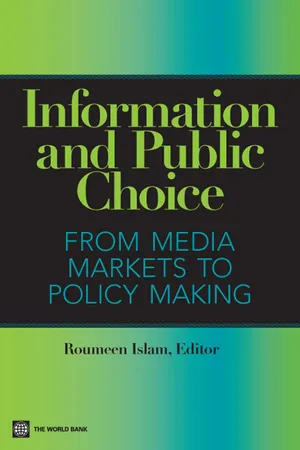
The ability of the media to affect outcomes in economic and political markets has been well documented. News reporting and advertising influence consumer behavior in goods and services markets by revealing (or selectively revealing) information about a product, acting as agenda setters to influence consumer demand, or enhancing competition in markets by alerting consumers to substitutes. In political markets, they can affect behavior by informing voters about a politician's views or actions, enlightening citizens to outcomes of public policy, or taking a stance on political, social, or economic issues. For businesses, households, and most others, the media is the main source of information on public policy choices and current social and economic conditions. As a result, what news the media chooses to gather, analyze and disseminate--and the slant they choose to put on what they report--is of consequence. 'Information and Public Choice' addresses the factors that affect the content and reach of news coverage as well as its impact on public policy. The book addresses both market constraints that affect media--particularly news content--and the impact that news reporting has on economic and political choices. The authors examine a range of issues, including bias or slant in media reporting, the impact of markets and nonmarket factors on news reporting, and the role of government regulation of the media sector in developing countries. The studies in this volume provide new evidence and a good summary of previous research on the power of the media. An invaluable guide for those concerned about the impact of media on economic and political outcomes, 'Information and Public Choice' draws attention to an under-researched yet important area of economics.
Information
Subtopic
Political ProcessIndex
Social SciencesTable of contents
- Contents
- Acknowledgments
- About the Editor and Authors
- Abbreviations
- 1 Overview: From Media Markets to Policy
- 2 The Media’s Influence on Public Policy Decisions
- 3 National Media and Local Political Participation: The Case of the New York Times
- 4 Minority-Targeted Local Media and Voter Turnout: A Summary
- 5 I’m News, Are You? Newspaper Coverage of Elected vs. Appointed Officials
- 6 The Political Impact of Media Bias
- 7 Market Forces and News Media in Muslim Countries
- 8 Political Economy of Media Capture
- 9 Fostering an Independent Media with a Diversity of Views
- 10 Media Regulation in the United States
- 11 Aspects of Two Media Models: France and the United Kingdom and EU Media Governance
- 12 Three Countries: Three Stories
- Table 2.1 Newsworthiness of Disasters
- Table 3.1 Sample Statistics
- Table 3.2 Does the New York Times Depress Voting among the College Educated?
- Table 3.3 Robustness of Voting Results (Statewide Elections, Residency, and Internet)
- Table 3.4 Does the New York Times Affect Knowledge of Congressional Candidates?
- Table 4.1 Hispanic and Non-Hispanic Voter Turnout and the Presence of Spanish-Language Local Television News
- Table 4.2 Percent of Black and White Voter Turnout in Locales with and without Black Weekly Newspapers, 1998
- Table 4.3 Percent of Black and White Voter Turnout in Locales with and without Black Radio Stations, 1994 and 1998
- Table 5.1 Average Newspaper Coverage of Elected vs. Appointed Superintendents
- Table 5.2 Newspaper Coverage of Elected vs. Appointed Superintendents
- Table 5.3 Newspaper Coverage of Education Superintendents and Governors
- Table 5.4 Election-Time Newspaper Coverage of Elected Education Superintendents
- Table 5.5 Newspaper Coverage of Elected vs. Appointed Superintendents
- Table 6.1 Survey of Studies on Effect of Media Bias on Political Decisions
- Table 6.2 Impact of Fox News on Voting
- Table 6.3 Persuasion and Mobilization Rates
- Table 7.1 Consumer Beliefs and Satellite Television Viewership
- Table 7.2 Consumer Beliefs and Assessments of Quality
- Table 7.3 Consumption of Local Media
- Table 8.1 Regional Media Freedom and Advertisement Revenues, Russian Media
- Table 8.2 Description of Variables and Data Sources
- Table 12.1 Freedom of the Press in Indonesia
- Table 12.2 Global Corruption Perception Index
- Table 12.3 Number of Complaints to the Press Council
- Table 12.4 Number of Publications in Indonesia
- Figure 7.1 Country-by-Country Newspaper Coefficients
- Figure 8.1 Inequality and Media Freedom (Freedom House) for Democratic Countries
- Figure 8.2 Inequality and Media Freedom (Freedom House) for Autocracies
- Figure 8.3 Media Freedom (Freedom House) and Public Spending on Education for Democracies
- Figure 8.4 Media Freedom (Freedom House) and Public Spending on Education for Democracies
- Figure 8.5 Media Freedom (Freedom House) and Public Spending on Health for Democratic Countries
- Figure 8.6 Media Freedom (Freedom House) and Public Spending on Health for Autocracies
- Figure 8.7 Fraction of Independent Newspapers in U.S. Counties as a Function of Advertising Rates in 1881
Trusted by 375,005 students
Access to over 1.5 million titles for a fair monthly price.
Study more efficiently using our study tools.
Frequently asked questions
Yes, you can cancel anytime from the Subscription tab in your account settings on the Perlego website. Your subscription will stay active until the end of your current billing period. Learn how to cancel your subscription
No, books cannot be downloaded as external files, such as PDFs, for use outside of Perlego. However, you can download books within the Perlego app for offline reading on mobile or tablet. Learn how to download books offline
Perlego offers two plans: Essential and Complete
- Essential is ideal for learners and professionals who enjoy exploring a wide range of subjects. Access the Essential Library with 800,000+ trusted titles and best-sellers across business, personal growth, and the humanities. Includes unlimited reading time and Standard Read Aloud voice.
- Complete: Perfect for advanced learners and researchers needing full, unrestricted access. Unlock 1.5M+ books across hundreds of subjects, including academic and specialized titles. The Complete Plan also includes advanced features like Premium Read Aloud and Research Assistant.
We are an online textbook subscription service, where you can get access to an entire online library for less than the price of a single book per month. With over 1.5 million books across 990+ topics, we’ve got you covered! Learn about our mission
Look out for the read-aloud symbol on your next book to see if you can listen to it. The read-aloud tool reads text aloud for you, highlighting the text as it is being read. You can pause it, speed it up and slow it down. Learn more about Read Aloud
Yes! You can use the Perlego app on both iOS and Android devices to read anytime, anywhere — even offline. Perfect for commutes or when you’re on the go.
Please note we cannot support devices running on iOS 13 and Android 7 or earlier. Learn more about using the app
Please note we cannot support devices running on iOS 13 and Android 7 or earlier. Learn more about using the app
Yes, you can access Information and Public Choice by Roumeen Islam in PDF and/or ePUB format, as well as other popular books in Social Sciences & Political Process. We have over 1.5 million books available in our catalogue for you to explore.