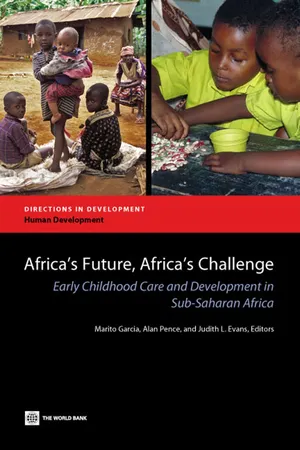
eBook - PDF
Africa's Future, Africa's Challenge
Early Childhood Care and Development in Sub-Saharan Africa
- 558 pages
- English
- PDF
- Available on iOS & Android
eBook - PDF
Africa's Future, Africa's Challenge
Early Childhood Care and Development in Sub-Saharan Africa
About this book
Early childhood, from birth through school entry, was largely invisible worldwide as a policy concern for much of the twentieth century. Children, in the eyes of most countries, were 'appendages' of their parents or simply embedded in the larger family structure. The child did not emerge as a separate social entity until school age (typically six or seven). 'Africa's Future, Africa's Challenge: Early Childhood Care and Development in Sub-Saharan Africa' focuses on the 130 million children south of the Sahel in this 0-6 age group. This book, the first of its kind, presents a balanced collection of articles written by African and non-African authors ranging from field practitioners to academicians and from members of government organizations to those of nongovernmental and local organizations. 'Africa's Future, Africa's Challenge' compiles the latest data and viewpoints on the state of Sub-Saharan Africa's children. Topics covered include the rationale for investing in young children, policy trends in early childhood development (ECD), historical perspectives of ECD in Sub-Saharan Africa including indigenous approaches, new threats from HIV/AIDS, and the importance of fathers in children's lives. The book also addresses policy development and ECD implementation issues; presents the ECD programming experience in several countries, highlighting best practices and challenges; and evaluates the impact of ECD programs in a number of countries.
Information
Subtopic
Business DevelopmentIndex
BusinessTable of contents
- Contents
- Foreword
- Acknowledgments
- Contributors
- Abbreviations
- Introduction
- SECTION 1 Contexts
- SECTION 2 Sociohistorical Contexts
- SECTION 3 Policy Development
- SECTION 4 Programming
- SECTION 5 Evaluations and Research
- SECTION 6 Challenges and Ways Forward
- Index
- Box 17.1 Cultural, Social, and Religious Context
- Box 22.1 Key Family and Community Practices to Promote Child Survival, Growth, and Development (Complete List of 17 Core and 2 Additional ESAR Practices)
- Figure 1.1 Higher National Income Does Not Always Translate into Better Conditions for Children
- Figure 1.2 Countries with Better Human Development Indexes Tend to Have Stronger Child Welfare Indexes
- Figure 1.3 More Children Suffer from Severe Deprivation in Sub-Saharan Africa than in Any Region except South Asia (2000)
- Figure 1.4 The Proportion of Children in Sub-Saharan Africa Suffering from Severe Shelter and Water Deprivation Is the Highest in the World (2000)
- Figure 1.5 Prevalence of Stunting among Children Under 5 in Sub-Saharan Africa (2005)
- Figure 1.6 Sub-Saharan Africa Is the Only Region in the World Where the Number of Orphans is Growing
- Figure 1.7 The Number of AIDS Orphans in Sub-Saharan Africa Skyrocketed between 1990 and 2003 and Is Projected to Continue to Do So
- Figure 1.8 The Association Is Positive between Preprimary Enrollment and Primary Completion Rates
- Figure 3.1 Grade Repetition Rate in Primary Education and Preschool Coverage
- Figure 3.2 Survival Rate to Primary Grade 5 and Preschool Coverage
- Figure 3.3 Proportion of Underweight Children Under 5 and Preschool Coverage
- Figure 3.4 The Hypothesized Relationship between Preschool, Learning Repetition, and Survival to Primary Grade 5
- Figure 3.5 The Effect of Preschool on Repetition Rates (R2) and Survival (Using Bivariate Data Analysis)
- Figure 3.6 Direct and Indirect Effect of Preschool upon Repetition and Survival in Primary Education in 24 SSA Countries
- Figure 4.1 The Relationship between Life Expectancy and Proportion of the Population at Low Literacy Levels in Developed Countries
- Figure 4.2 Socioeconomic Gradients for Literacy Scores
- Figure 8.1 Fathers Absent and Deceased
- Figure 13.1 The Path from Exclusion to Inclusion for Special Education Needs (SEN) in Mauritius
- Figure 13.2 Goals to Absorb More Children in the Educational Systems in Mauritius, 2004–08
- Figure 13.3 Goals to Provide Educational Services for All Children with Disabilities in Mauritius by 2015
- Figure 20.1 Learning Environment Scores in MRC and Non-MRC Preschools in Kenya, Uganda, and Zanzibar
- Figure 20.2 Rate of Change in Cognitive Measures of Children in Preschool and Those at Home
- Figure 22.1 Children Exclusively Breastfed up to Age 6 Months in Five ESAR Programs, before and after Intervention
- Figure 22.2 Children Breastfed within One Hour of Delivery in Three ESAR Programs, before and after Intervention
- Figure 22.3 Children Supplemented with Vitamin A in Six ESAR Programs, before and after Intervention
- Figure 22.4 Children Age 12–23 Months Immunized for Measles in Five ESAR Programs, before and after Intervention
- Figure 22.5 Children Age 0–59 Months Who Slept under a Bednet the Night Previous to Study in Three ESAR Programs, before and after Intervention
- Figure 22.6 Caregivers Giving Food and Fluids (ORT) to Children during Fever and Acute Respiratory Infection (ARI) in Ntungamo District, Uganda, before and after Intervention
- Table 1.1 Selected National Health and Education Indicators in Sub-Saharan Africa
- Table 1.2 Gross Enrollment Rates in Preschools Grew in Sub-Saharan Africa, but the Rates Are Far Below the Rest of the World
- Table 1.3 Higher Preprimary Gross Enrollment Rates Are Associated with Lower Repetition Rates
- Table 3.1 Status of Millennium Development Goals by Region
- Table 3.2 Preschool, Primary Education, and Proportion of Children Underweight by World Region Country-Weighted Averages)
- Table 3.3 Gross Enrollment Ratio (GER) in Standard Preschool, Proportion of Children Under 5 That Are Underweight, and Under-5 and Infant Mortality in Sub-Saharan African Countries (1999)
- Table 3.4 Evolution in Preschool GER by Region (1990–99) and Projection of the Trend (to 2015)
- Table 3.5 The Prospects for Achieving Various Target Levels of Preschool Coverage in 133 Developing Countries, Given Current Trends (by 2015)
- Table 3.6 Simulation of the Grade Repetition Rate and Survival Rate to Grade 5, according to Preschool Coverage in 24 SSA Countries
- Table 4.1 Literacy Rates, Ages 16–65, 1994–98
- Table 5.1 Annual Costs of Programs to Mitigate the Household Impacts of AIDS in Kagera,Tanzania
- Table 8.1 Fathers Alive and Resident by Expenditure Patterns in South Africa
- Table 12.1 Students Training to Be ECD Teachers in Zimbabwe
- Table 15.1 Policy Environment in Ghana, Malawi, Rwanda,Tanzania, and Zambia
- Table 17A.1 Five Communication Management Decisions Template
- Table 17A.2 Five Communication Management Decisions Applied in NECDP
- Table 19.1 Maternal Employment and ECD Use: Simultaneous Estimation of the Equations for the System of Household Demand
- Table 19.2 Simulation of the Effects of Various Policies and Changes in Demographic Characteristics on Household Behavior (SPFIML Estimation)
- Table 19.3 Simulation of the Effects of Various Policies on School Attendance (SPFIML Estimation)
- Table 20.1 Primary Beneficiaries of the Madrasa Resource Center Program as of 2005
- Table 22.1 18 Countries in the UNICEF/ESAR Implementing the IMCI Household and Community Component in at Least Three Districts
- Table 22.2 Access to Sanitation Facilities, Clean Water Sources, and Handwashing Facilities in Five ESAR Programs, before and after Interventions
- Table 22.3 Caregivers Giving Food and Fluids (ORT) during Diarrhea in Five ESAR Sites
- Table 22.4 Caregiver Reasons for Delaying Care Seeking for Sick Children in Malawi Implementing Sites
- Table 22.5 Changes in Reported Practices That Are Likely to Have the Greatest Impact on Preventing Childhood Deaths
- Table 23.1 Selected Data on the Cost of Public Preschool and Primary School in Four Countries
- Table 23.2 Simulation of the Survival Rate to Grade 5 and Repetition Rate according to Preschool Coverage in 24 Sub-Saharan African Countries
- Table 23.3 Per-Child Public Spending in Public and Community-Based Preschool Programs in Four Countries
- Table 23.4 Policy Box: Elements That Contribute to Defining an ECD Policy
- Table 23.5 Unit Cost Policy Box for Fully and Partly Subsidized Systems for the 0–3 Population
- Table 23.6 Unit Cost Policy Box for Fully and Partly Subsidized Systems for the 4–5 Population
- Table 23.7 Costing Model for Government-Funded ECD Programs
- Table 24.1 First, Second, and Third African International Conferences on ECD, Compared by Size and Scope
Trusted by 375,005 students
Access to over 1.5 million titles for a fair monthly price.
Study more efficiently using our study tools.
Frequently asked questions
Yes, you can cancel anytime from the Subscription tab in your account settings on the Perlego website. Your subscription will stay active until the end of your current billing period. Learn how to cancel your subscription
No, books cannot be downloaded as external files, such as PDFs, for use outside of Perlego. However, you can download books within the Perlego app for offline reading on mobile or tablet. Learn how to download books offline
Perlego offers two plans: Essential and Complete
- Essential is ideal for learners and professionals who enjoy exploring a wide range of subjects. Access the Essential Library with 800,000+ trusted titles and best-sellers across business, personal growth, and the humanities. Includes unlimited reading time and Standard Read Aloud voice.
- Complete: Perfect for advanced learners and researchers needing full, unrestricted access. Unlock 1.5M+ books across hundreds of subjects, including academic and specialized titles. The Complete Plan also includes advanced features like Premium Read Aloud and Research Assistant.
We are an online textbook subscription service, where you can get access to an entire online library for less than the price of a single book per month. With over 1.5 million books across 990+ topics, we’ve got you covered! Learn about our mission
Look out for the read-aloud symbol on your next book to see if you can listen to it. The read-aloud tool reads text aloud for you, highlighting the text as it is being read. You can pause it, speed it up and slow it down. Learn more about Read Aloud
Yes! You can use the Perlego app on both iOS and Android devices to read anytime, anywhere — even offline. Perfect for commutes or when you’re on the go.
Please note we cannot support devices running on iOS 13 and Android 7 or earlier. Learn more about using the app
Please note we cannot support devices running on iOS 13 and Android 7 or earlier. Learn more about using the app
Yes, you can access Africa's Future, Africa's Challenge by Marito H. Garcia,Alan Pence,Judith Evans in PDF and/or ePUB format, as well as other popular books in Business & Business Development. We have over 1.5 million books available in our catalogue for you to explore.