eBook - PDF
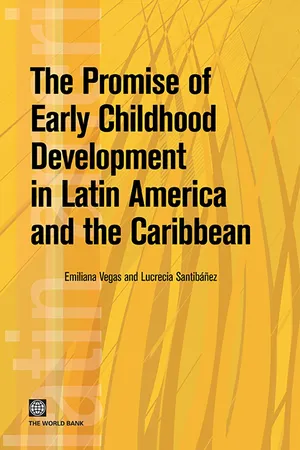
The Promise of Early Childhood Development in Latin America and the Caribbean
- 222 pages
- English
- PDF
- Available on iOS & Android
eBook - PDF
The Promise of Early Childhood Development in Latin America and the Caribbean
About this book
Early childhood development outcomes play an important role throughout a person's life, affecting one's income-earning capacity and productivity, longevity, health, and cognitive ability. The deleterious effects of poor early childhood development outcomes can be long-lasting, affecting school attainment, employment, wages, criminality, and social integration of adults. The authors first take stock of early childhood development indicators in the region and explore access to early childhood development services for children of different backgrounds. They review recent evidence on the impact of early childhood development interventions in the region and investigate more deeply a selection of programs in Latin America and the Caribbean to distill lessons related to their design, implementation and institutionalization processes. The book concludes with a discussion of the challenges of scaling up and presents policy options to develop national early childhood development policies and programs that may be effective and sustained over time.
Information
Subtopic
Business EducationIndex
BusinessTable of contents
- Contents
- About the Authors
- Acknowledgments
- Abbreviations
- Introduction
- 1. An Analytical Framework for Early Childhood Development
- 2. Overview of Early Childhood Development in Latin America and the Caribbean Today
- 3. Evidence on Early Childhood Interventions from around the World
- 4. Early Childhood Development Programs in Latin America and the Caribbean
- 5. Increasing Early Childhood Development Program Coverage in the Region: The Need for Comprehensive Approaches
- 6. Conclusion
- Appendixes
- References
- Index
- Box 3.1 Interpreting Existing Studies of ECD Interventions
- Box 4.1 Curriculum of an Early Stimulation Program in Jamaica
- Box 4.2 Program Evaluation: Hogares Comunitarios de Bienestar Familiar, Colombia
- Box 4.3 Program Quality of Hogares Comunitarios, Guatemala
- Box 5.1 Multilevel Funding of ECD in OECD Countries
- Box 5.2 The Emergence of the Swedish Preschool System
- Box 5.3 Impact Evaluation and ECD Expansion in Rio de Janeiro
- Figure 1.1 Early Childhood Development: Analytical Framework
- Figure 2.1 Percentage of Children Less Than Five Years Old Who Are Poor, by Region, 2004
- Figure 2.2 Poverty Rates Measured by GDP per Capita, 2007
- Figure 2.3 Percentage of the Nonpoor Population Aged 25 Years That Has Completed Secondary School, by Country and GDP per Capita, 2005–06
- Figure 2.4 Percentage of the Poor Population Aged 25 Years That Has Completed Secondary School, by Country and GDP per Capita, 2005–06
- Figure 2.5 Percentage of Employed Women in the Informal Sector, by Country and GDP per Capita
- Figure 2.6 Prevalence of Underweight Children Aged 0 to 5 Years, by Country and GDP per Capita, 2002
- Figure 2.7 Distribution of Stunted Children Aged 0 to 5 Years, by Country and GDP per Capita, 2002
- Figure 2.8 Infant Mortality Rates (Deaths per 1,000 Live Births) by Country and GDP per Capita, 2005
- Figure 2.9 Percentage of Children Aged 0 to 6 Years Living in Poor Housing Conditions
- Figure 2.10 Variance in Student Learning Outcomes Explained by Family Circumstances, 2000 PISA
- Figure 2.11 Percentage of Children under Six Years in the Region with Access to Health Insurance, by Country and GDP Per Capita
- Figure 2.12 Gross Enrollment in Preprimary Education Worldwide, 1999–2004
- Figure 2.13 Gross Preprimary Education Enrollment by Country and GDP per Capita, 2004
- Figure 2.14 Expected Years of Preprimary Education by Country, 2004
- Figure 3.1 Diverse Multisectoral Policies That Can Affect ECD
- Figure 4.1 Preprimary Education Expenditure as Share of Total Educational Expenditure, 2004 (Percent)
- Figure 4.2 Public Expenditure on Preprimary Education as a Share of GNP, 2004 (Percent)
- Figure 4.3 Public Investment in ECD as a Percentage of GDP in OECD Countries, 2007
- Figure 4.4 Baseline Measurements for Roving Caregivers Program in St. Lucia
- Figure A1.1 Children Aged 18 Years or Younger Living below the Relative Poverty Line (Percent)
- Figure A1.2 Poverty Rates by Country (Percent)
- Figure A1.3 Households and Children Living in Poor Housing Conditions, by Country (Percent)
- Figure A1.4 Children with Access to Electricity, Water, and Hygienic Restrooms at Home (Percent)
- Figure A1.5 Children Aged 0–6 Years by Income Decile (Percent)
- Figure A1.6 Indigenous Children and Population, by Country (Percent)
- Figure A1.7 Socioeconomic Differences on Child Development in St. Lucia
- Figure A1.8 Women Employed in the Informal Sector, by Country (Percent)
- Figure A1.9 Preprimary Gross Enrollment Rates, by Country, 2004 (Percent)
- Figure A1.10 Children Who Enter Grade 1 and Reach Grade 5, by Region (Percent)
- Figure A1.11 Enrollment Rates by Income Quintile (1st and 5th), Children under Six Years Old
- Figure A1.12 Ratio of School Enrollment Rates, First to Fifth Quintile
- Figure A1.13 ECD Enrollment Rates by Age and Ethnic Group, Ecuador
- Figure A1.14 Children Younger than Six Years with Access to Health Insurance, by Country (Percent)
- Figure A1.15 Ratio of Health Insurance Coverage Rates of the First to the Fifth Quintile, by Country
- Figure A1.16 Prenatal Care and Breastfeeding Indicators, by Country (Percent)
- Figure A1.17 Children Younger than Six Years Receiving Vaccinations, by Country (Percent)
- Figure A1.18 Households That Benefit from Poverty Alleviation Programs, by Income Quintile and Country (Percent)
- Table 1.1 Most Commonly Used Psychometric Tests in ECD Evaluations
- Table 2.1 Comparative Nutrition Indicators for Developing Regions, 2005 (Percent)
- Table 2.2 Infant and Child Mortality Rates by Country (per Thousand Live Births), 1960–2007
- Table 2.3 Summary of Contextual and ECD Features in Latin America and the Caribbean, by Country (2005, 2006 or Latest Available Year)
- Table 5.1 Early Childhood Education Services, Select OECD Countries
- Table 5.2 ECD Policies in Selected OECD Countries
- Table A1.1 Poverty around the World (Percent of Population)
- Table A1.2 Poverty and Education Indicators, by Country
- Table A1.3 Prevalence of Selected Nutritional Deficiencies in Children Aged 0–4, by Region
- Table A1.4 Employment Indicators for Women, by Country
- Table A2.1 Selected Programs
- Table A2.2 Key Features of Selected Programs
Trusted by 375,005 students
Access to over 1.5 million titles for a fair monthly price.
Study more efficiently using our study tools.
Frequently asked questions
Yes, you can cancel anytime from the Subscription tab in your account settings on the Perlego website. Your subscription will stay active until the end of your current billing period. Learn how to cancel your subscription
No, books cannot be downloaded as external files, such as PDFs, for use outside of Perlego. However, you can download books within the Perlego app for offline reading on mobile or tablet. Learn how to download books offline
Perlego offers two plans: Essential and Complete
- Essential is ideal for learners and professionals who enjoy exploring a wide range of subjects. Access the Essential Library with 800,000+ trusted titles and best-sellers across business, personal growth, and the humanities. Includes unlimited reading time and Standard Read Aloud voice.
- Complete: Perfect for advanced learners and researchers needing full, unrestricted access. Unlock 1.5M+ books across hundreds of subjects, including academic and specialized titles. The Complete Plan also includes advanced features like Premium Read Aloud and Research Assistant.
We are an online textbook subscription service, where you can get access to an entire online library for less than the price of a single book per month. With over 1.5 million books across 990+ topics, we’ve got you covered! Learn about our mission
Look out for the read-aloud symbol on your next book to see if you can listen to it. The read-aloud tool reads text aloud for you, highlighting the text as it is being read. You can pause it, speed it up and slow it down. Learn more about Read Aloud
Yes! You can use the Perlego app on both iOS and Android devices to read anytime, anywhere — even offline. Perfect for commutes or when you’re on the go.
Please note we cannot support devices running on iOS 13 and Android 7 or earlier. Learn more about using the app
Please note we cannot support devices running on iOS 13 and Android 7 or earlier. Learn more about using the app
Yes, you can access The Promise of Early Childhood Development in Latin America and the Caribbean by Emiliana Vegas,Lucrecia Santibáñez in PDF and/or ePUB format, as well as other popular books in Business & Business Education. We have over 1.5 million books available in our catalogue for you to explore.