eBook - PDF
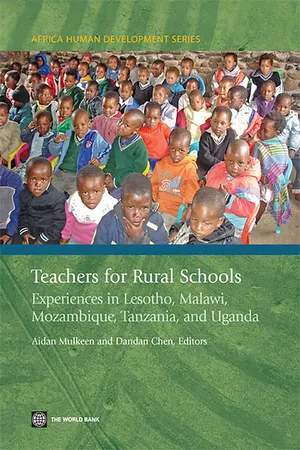
Teachers for Rural Schools
Experiences in Lesotho, Malawi, Mozambique, Tanzania, and Uganda
- 138 pages
- English
- PDF
- Available on iOS & Android
eBook - PDF
Teachers for Rural Schools
Experiences in Lesotho, Malawi, Mozambique, Tanzania, and Uganda
About this book
Much is going well with the effort to provide universal primary education in Sub-Saharan Africa. Gross enrollment rates have increased from 78 percent in 1998/99 to 91 percent in 2002/03; sizable investments have greatly improved school infrastructure and access; and large numbers of new teachers have been recruited. But educating the children in remote rural areas continues to be a challenge. Schools in hard-to-reach locations find it difficult to attract and retain teachers. Therefore, the deployment, effectiveness, management, and support of teachers in these areas require special attention and action. Such issues are thoroughly examined in this book, which also includes case studies from Lesotho, Malawi, Mozambique, Tanzania, and Uganda. The country studies give rich insights into the potential and drawbacks of specific policy options. 'Teachers for Rural Schools' provides information that will be invaluable in its practicality to policy makers and practitioners responsible for educating rural populations. It will also appeal to anyone interested in Africa, development, education, public policy, and social welfare.
Information
Subtopic
Economic TheoryIndex
EconomicsTable of contents
- Contents
- Foreword
- Acknowledgments
- Abbreviations
- EXECUTIVE SUMMARY
- CHAPTER 1. TEACHER DEPLOYMENT, UTILIZATION, AND MANAGEMENT: POLICY AND PRACTICE
- CHAPTER 2. COUNTRY REPORT: LESOTHO
- CHAPTER 3. COUNTRY REPORT: MALAWI
- CHAPTER 4. COUNTRY REPORT: MOZAMBIQUE
- CHAPTER 5. COUNTRY REPORT: TANZANIA
- CHAPTER 6. COUNTRY REPORT: UGANDA
- References
- Index
- Box 1.1 Example of a Teacher Deployment Dilemma
- Box 1.2 The Challenge of Efficient Utilization in Small Schools
- Figure 1.1 Gross Enrollment Rate in Primary Education in Sub-Saharan Africa, 1960–2002
- Figure 2.1 Number of Teachers Recruited Annually, 1985–2004
- Figure 3.1 Estimated Demand for and Supply of Trained Teachers, 2005–15
- Figure 4.1 Student Distribution by Level of Education, 1992–99
- Figure 4.2 Teacher Salaries at the N4 Level, 1992–99
- Table 1.1 Summary of Rural-Urban Differences in Schooling in Five Countries
- Table 1.2 Teachers and Training in Mozambique, by Province, 2004
- Table 1.3 School Data in Malawi, by Urban or Rural Location, 2004
- Table 1.4 School Data for Six Rural Zones in Malawi, 2004
- Table 1.5 Percentage of Unqualified Teachers in Lesotho, by Gender and Ecological Zone, 2004
- Table 1.6 Teacher Data for Nine Rural Schools in Lesotho, 2005
- Table 1.7 Incentives to Encourage Teachers to Move to Rural Areas, 2005
- Table 2.1 Projected Demand for Teachers in Lesotho, 2005–30
- Table 2.2 Percentage of Teachers and Pupils Who Are Female, by Location, 2004
- Table 2.3 Attrition of Primary School Teachers, by Cause and Data Source, 2004
- Table 2.4 HIV Infection Rates in Lesotho
- Table 2.5 Qualified Teachers, 1999–2003
- Table 2.6 Size of Primary Schools, by District, 2004
- Table 2.7 Percentage of Unqualified Teachers, by Gender and Location, 2004
- Table 2.8 Teacher Supply in Nine Rural Schools, 2004
- Table 2.9 Percentage of Repeaters, by Gender and Location, 2004
- Table 2.10 Test Scores for Lesotho, by Location, 2001
- Table 2.11 Annual Salaries for Primary School Teachers, 2005
- Table 2.12 National Expenditure on Education, 2004
- Table 2.13 Composition of Management and Advisory School Committees
- Table 3.1 Projected Demand for Teachers in Malawi, 2004–15
- Table 3.2 Teachers’ Level of Educational Attainment, 2004
- Table 3.3 Teachers Qualified under the Malawi Integrated In-service Teacher Education Programme
- Table 3.4 Number and Training of Qualified Teachers, 2004
- Table 3.5 Estimated Supply of Trained Teachers, 2004–10
- Table 3.6 Teacher Attrition, 2004
- Table 3.7 Teacher Death Rate, 1995–2004
- Table 3.8 Teaching Posts and Training, 2000–04
- Table 3.9 Estimated Supply of Trained Teachers, 2005–15
- Table 3.10 Estimated Supply of and Demand for Qualified Teachers, 2005–15
- Table 3.11 Teacher Salaries (Annual) by Pay Grade, 2005
- Table 3.12 Breakdown of Teachers by Grade, 2004
- Table 3.13 Teacher Salaries and the National Budget, 2005
- Table 3.14 Schools, Teachers, and Pupil-Teacher Ratios, by Location, 2004
- Table 3.15 Location of Teachers, by Level of Education, 2004
- Table 3.16 Gender of Teachers, by Location, 2004
- Table 3.17 Differences in Characteristics among Select Rural Zones, 2004
- Table 3.18 Main Languages of Malawi
- Table 3.19 Double- and Single-Shift School Sessions, 2004
- Table 4.1 Gross and Net Enrollment Rates at EP1 in Mozambique, by Province, 2004
- Table 4.2 Three Scenarios for Teacher Demand at EP1, 2005–15
- Table 4.3 Training Status of EP1 Teachers, 2004
- Table 4.4 Teacher Training Intakes, 2004
- Table 4.5 Teacher Deaths in Service, 2000–04
- Table 4.6 Salary Levels by Qualification and Assignment, 2005
- Table 4.7 Teacher Salaries at Levels N3–N5, 2004
- Table 4.8 National Expenditure on Education, 2004
- Table 4.9 Incentive Payment for Teachers, by Location, 2005
- Table 4.10 Monthly Income of Teachers, by Qualification, Location of School, and School Schedule
- Table 4.11 Trained and Untrained EP1 Teachers, 2004
- Table 4.12 Pupil-Teacher Ratio and Pupil–Qualified Teacher Ratio, by Province, 2004
- Table 4.13 Grades 1 and 2 Completion and Survival, by Province, 2004
- Table 4.14 Student Achievement in Reading and Mathematics, by Location
- Table 4.15 Student Achievement, by Location and Teacher Characteristics
- Table 4.16 Primary Enrollment by Grade and Class, 2004
- Table 4.17 Primary Enrollment by Province and Class Structure, 2004
- Table 4.18 Teachers’ Disciplinary Records, 1999–2004
- Table 5.1 Breakdown of School Population and Staffing in Tanzania by Gender and Region, 2004
- Table 5.2 Teachers Being Upgraded in Qualification in Three Regions, by Gender and Location, 2005
- Table 5.3 Distribution of Primary School Teachers in Three Regions, by Gender and Location, 2005
- Table 5.4 Calculation of Number of Teachers Required, 2005 and 2010
- Table 5.5 Housing for Teachers, by Region, 2005
- Table 5.6 Housing for Teachers in Rural and Urban Schools, by Region, 2005
- Table 6.1 Enrollment, Pupil-Teacher Ratio, and Teacher Demand in Uganda, 2005
- Table 6.2 Projected Supply of Teachers, 2004–15
- Table 6.3 Student Achievement in English, Mathematics, and Physics, 2001–04
- Table 6.4 Outputs of Primary Teacher Colleges, 1989 and 1995–2002
Trusted by 375,005 students
Access to over 1.5 million titles for a fair monthly price.
Study more efficiently using our study tools.
Frequently asked questions
Yes, you can cancel anytime from the Subscription tab in your account settings on the Perlego website. Your subscription will stay active until the end of your current billing period. Learn how to cancel your subscription
No, books cannot be downloaded as external files, such as PDFs, for use outside of Perlego. However, you can download books within the Perlego app for offline reading on mobile or tablet. Learn how to download books offline
Perlego offers two plans: Essential and Complete
- Essential is ideal for learners and professionals who enjoy exploring a wide range of subjects. Access the Essential Library with 800,000+ trusted titles and best-sellers across business, personal growth, and the humanities. Includes unlimited reading time and Standard Read Aloud voice.
- Complete: Perfect for advanced learners and researchers needing full, unrestricted access. Unlock 1.5M+ books across hundreds of subjects, including academic and specialized titles. The Complete Plan also includes advanced features like Premium Read Aloud and Research Assistant.
We are an online textbook subscription service, where you can get access to an entire online library for less than the price of a single book per month. With over 1.5 million books across 990+ topics, we’ve got you covered! Learn about our mission
Look out for the read-aloud symbol on your next book to see if you can listen to it. The read-aloud tool reads text aloud for you, highlighting the text as it is being read. You can pause it, speed it up and slow it down. Learn more about Read Aloud
Yes! You can use the Perlego app on both iOS and Android devices to read anytime, anywhere — even offline. Perfect for commutes or when you’re on the go.
Please note we cannot support devices running on iOS 13 and Android 7 or earlier. Learn more about using the app
Please note we cannot support devices running on iOS 13 and Android 7 or earlier. Learn more about using the app
Yes, you can access Teachers for Rural Schools by Aidan G Mulkeen,Dandan Chen in PDF and/or ePUB format, as well as other popular books in Economics & Economic Theory. We have over 1.5 million books available in our catalogue for you to explore.