eBook - PDF
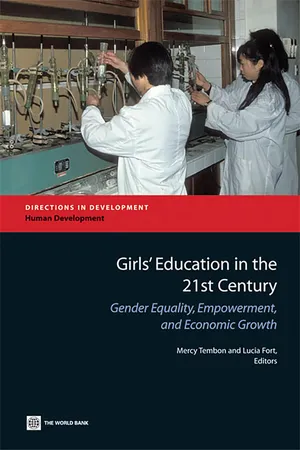
Girls' Education in the 21st Century
Gender Equality, Empowerment and Growth
- 346 pages
- English
- PDF
- Available on iOS & Android
eBook - PDF
About this book
Persuasive evidence demonstrates that gender equality in education is central to economic development. Despite more than two decades of accumulated knowledge and evidence of what works in improving gender equality, progress on the ground remains slow and uneven across countries. What is missing? Given that education is a critical path to accelerate progress toward gender equality and the empowerment of women, what is holding us back? These questions were discussed at the global symposium 'Education: A Critical Path to Gender Equality and Women's Empowerment', which was sponsored by the World Bank in October 2007. 'Girls' Education in the 21st Century' is based on background papers developed for the symposium. The book's chapters reflect the current state of knowledge on education from a gender perspective and highlight the importance of, and challenges to, female education, as well as the interdependence of education and development objectives. The last chapter presents five strategic directions for advancing gender equality in education and their implications for World Bank operations. 'Girls' Education in the 21st Century' will be of particular interest to researchers, educators, school administrators, and policy makers at the global, national, regional, and municipal levels.
Information
Subtopic
Gender StudiesIndex
Social SciencesTable of contents
- Contents
- Foreword
- Preface
- Acknowledgments
- Contributors
- Abbreviations
- Part I Education Quality, Skills Development, and Economic Growth
- Part II Equity in Education: What Is Holding Countries Back?
- Part III Experiences from the Field: How Was It Done?
- Index
- Figure 2.1 Improved GDP with Moderately Strong Knowledge Improvement
- Figure 2.2 Inequality of Educational Quality and Earnings
- Figure 3.1 Growth in Baseline Qualifications
- Figure 3.2 Gender Differences in University Attainment, in Percentage Points
- Figure 3.3 Performance of Males and Females on the Mathematics Scale in PISA, 2006
- Figure 3.4 Performance of Males and Females on the Reading Scale in PISA, 2006
- Figure 3.5 Gender Differences in Mathematics and Other Learning Characteristics as Measured by Effect Sizes
- Figure 4.1 Typical Age-Earnings Profiles
- Figure 4.2 Rate of Return to Additional Years of Schooling in Selected Countries
- Figure 4.3 Returns to Education in Developing Countries, by Level of Education
- Figure 4.4 Returns to Schooling, by Region
- Figure 4.5 Declining Returns to Schooling, 1970–2000
- Figure 4.6 Returns to Schooling in Selected Countries, by Gender
- Figure 4.7 Gender Differences in Years of Schooling in Developing and Industrial Countries
- Figure 4.8 Returns to Schooling, by Level and Gender
- Figure 4.9 Average Scores on Subject Examinations of the 2003 Programme for International Student Assessment (PISA) in OECD Countries, by Gender
- Figure 5.1 Kernel Densities of Log Earnings, by Employment Status and Gender, 1999
- Figure 5.2 Estimated Probability of Occupation and Education for Young Men and Women in Pakistan
- Figure 5.3 Estimated Probability of Occupation and Age for Young Men and Women in Pakistan
- Figure 5.4 Estimated Probability of Occupation and Education for Men and Women in Ghana
- Figure 5.5 Estimated Probability of Occupation and Education for Young Men, 1999 and 2007
- Figure 5.6 Estimated Probability of Occupation and Education for Young Women, 1999 and 2007
- Figure 5.7 Predicted Earnings and Level of Education for Wage Employment
- Figure 6.1 School Completion through Grade 6, by Richest and Poorest Quintiles in Selected Countries
- Figure 6.2 Grade Survival Profiles: Proportion of Cohort from Each Income Quintile That Has Completed Grades 1–9 in Selected Countries
- Figure 6.3 Inequalities in School Completion through Grade 6, by Household Economic Status, Urban or Rural Residence, and Gender
- Figure 6.4 Inequalities in School Completion through Grade 6 in the Richest and Poorest Quintiles, by Gender
- Figure 6.5 Differences in Enrollment of Children Ages 7–14, by Orphan Status
- Figure 6.6 Differences in Enrollment of Children Ages 7–14, by Orphan Status and Economic Status, Conditional on Individual and Household Characteristics
- Figure 6.7 Differences in Enrollment of Children Ages 7–14, by Orphan Status and Gender, Conditional on Individual and Household Characteristics
- Figure 6.8 Deficit in Current Enrollment Associated with Disability, Gender, Rural Residence, and Economic Status in Selected Countries
- Figure 13.1 Growth of Secular Schools and Modern Madrassas, 1947–2003
- Figure 13.2 Gender Orientation of Aliyah Madrassas Established before and after 1980 Reforms, 2003
- Figure 14.1 Sub-Saharan Africa: Enrollments in the Agricultural Sciences in Ethiopia, by Gender, 1991 and 2000
- Table 2.1 Private Rates of Return to Investment in Education, by Level and Region
- Table 2.2 Enrollment Rates by Development Status, 2004
- Table 4.1 Nonmarket and External Benefits of Education
- Table 4.2 Returns to Schooling and Cognitive Ability, by Gender, in Chile
- Table 5.1 Employment and Education Characteristics of Persons Ages 16–70 Who Are Not Enrolled in School in Pakistan, by Gender, 1999
- Table 5.2 Employment and Education Characteristics of Persons Ages 16–70 Who Are Not Enrolled in School in Pakistan, by Gender and Occupational Status, 1999
- Table 5.3 Employment and Education Characteristics of Persons Ages 16–60 Who Are Not Enrolled in School in Punjab and North West Frontier Province, by Gender, 1999 and 2007
- Table 5.4 Effects of Literacy and Numeracy on Occupational Outcome, by Gender and Age Group
- Table 5.5 Effect of Age and Education on Earnings, by Employment Status and Gender
- Table 5.6 Effect of Literacy and Numeracy on Earnings, by Employment Status and Gender
- Table 7.1 Elasticities of Primary Completion Rates and Learning and Ethnolinguistic Fractionalization
- Table 8.1 Gender, Education, and Development: Contrasting Frameworks
- Table 10.1 Conflict-Affected Fragile States and Education
- Table 13.1 Profile of Recognized Postprimary Madrassas in Bangladesh, 2003
- Table 13.2 Profile of Recognized Secondary Schools and Postprimary Madrassas in Bangladesh, by Location, 2003
- Table 13.3 Distribution of Aliyah Madrassas by Year of Establishment and Recognition
- Table 13.4 Ratio of Girls to Boys in Secondary Schools and Madrassas, 2003
- Table 13.5 Gender Composition of Students and Teachers in Postprimary Schools and Madrassas in Bangladesh, 1970–2003
- Table 13.6 Determinants of Regional Enrollment Growth, 1999–2003
- Table 13A.1 Descriptive Statistics
- Table 13A.2 Determinants of Regional Enrollment Growth— Alternative Specification, Ordinary Least Squares Estimates, 1999–2003
- Table 13A.3 Determinants of Regional Enrollment Growth, 1999–2003: Sample of Older Schools
- Table 13A.4 Determinants of Gender Parity in Secondary School Enrollment, 2003: Linear Probability Model Estimates
- Table 15.1 Primary Gross Enrollment Rates
- Table 15.2 FAWE’s Key Interventions and Initiatives
- Table 15.3 Impact in FAWE’s Four Pilot COEs
- Table 16.1 Gaps in Basic Education
- Table 16.2 Construction Projects in 2006/07
- Table 16.3 Enrollment Growth between 2005/06 and 2006/07
- Box 1.1 Interventions That Have Worked to Improve Girls’ Education
- Box 9.1 A Developing Democracy
- Box 9.2 Defining Violence
- Box 9.3 Recommendations from Girls to Schools and Teachers to Prevent Problems the Girls Face
- Box 14.1 A Promising Example of Gender Integration in Training from Benin
- Box 14.2 Examples of Gender Mainstreaming in the Agricultural Professions
- Box 17.1 Externalities of Girls’ Education
- Box 17.2 The Safe Schools Program: Preventing Gender-Based Violence and the Spread of HIV/AIDS
- Box 17.3 Loreto Day School, Calcutta, India: A Safe Haven for Street Children
- Box 17.4 Dar Tailba de Qualité Project, Morocco: Boarding Facilities for Rural Girls
- Box 17.5 10,000 Women: A Goldman Sachs Initiative
- Box 17.6 What Is UNGEI and What Does It Do?
- Box 17.7 Alam Simsim: Promoting Gender Equity in Education from an Early Age in Egypt
- Box 17.8 Giving Mothers a Voice in Their Children’s Education
Trusted by 375,005 students
Access to over 1.5 million titles for a fair monthly price.
Study more efficiently using our study tools.
Frequently asked questions
Yes, you can cancel anytime from the Subscription tab in your account settings on the Perlego website. Your subscription will stay active until the end of your current billing period. Learn how to cancel your subscription
No, books cannot be downloaded as external files, such as PDFs, for use outside of Perlego. However, you can download books within the Perlego app for offline reading on mobile or tablet. Learn how to download books offline
Perlego offers two plans: Essential and Complete
- Essential is ideal for learners and professionals who enjoy exploring a wide range of subjects. Access the Essential Library with 800,000+ trusted titles and best-sellers across business, personal growth, and the humanities. Includes unlimited reading time and Standard Read Aloud voice.
- Complete: Perfect for advanced learners and researchers needing full, unrestricted access. Unlock 1.5M+ books across hundreds of subjects, including academic and specialized titles. The Complete Plan also includes advanced features like Premium Read Aloud and Research Assistant.
We are an online textbook subscription service, where you can get access to an entire online library for less than the price of a single book per month. With over 1.5 million books across 990+ topics, we’ve got you covered! Learn about our mission
Look out for the read-aloud symbol on your next book to see if you can listen to it. The read-aloud tool reads text aloud for you, highlighting the text as it is being read. You can pause it, speed it up and slow it down. Learn more about Read Aloud
Yes! You can use the Perlego app on both iOS and Android devices to read anytime, anywhere — even offline. Perfect for commutes or when you’re on the go.
Please note we cannot support devices running on iOS 13 and Android 7 or earlier. Learn more about using the app
Please note we cannot support devices running on iOS 13 and Android 7 or earlier. Learn more about using the app
Yes, you can access Girls' Education in the 21st Century by Mercy Tembon,Lucia Fort in PDF and/or ePUB format, as well as other popular books in Social Sciences & Gender Studies. We have over 1.5 million books available in our catalogue for you to explore.