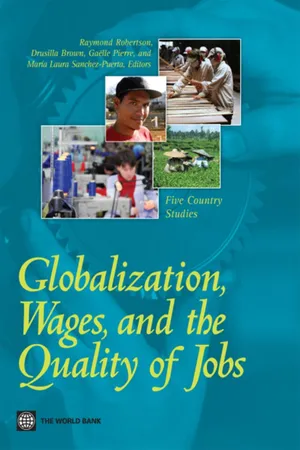
eBook - PDF
Globalization, Wages, and the Quality of Jobs
Five Country Studies
- 304 pages
- English
- PDF
- Available on iOS & Android
eBook - PDF
Globalization, Wages, and the Quality of Jobs
Five Country Studies
About this book
Since the early 1990s, most developing economies have become more integrated with the world's economy. Trade and foreign investment barriers have been progressively lifted and international trade agreements signed. These reforms have led to important changes in the structures of these economies. The labor markets have adjusted to these major changes, and workers were required to adapt to them in one way or another. In 2006, the Social Protection Unit of the World Bank launched an important research program to understand the impact that these profound structural changes have had on workers in developing countries. 'Globalization, Wages, and the Quality of Jobs: Five Country Studies' presents the findings and insights of this important research program. In particular, the authors present the similar experiences of low-income countries with globalization and suggest that low-income countries' working conditions have improved in the sectors exposed to globalization. However, 'Globalization, Wages, and the Quality of Jobs' also highlights concerns about the sustainability of these improvements and that the positive demonstration effects on the rest of the economy are unclear. The empirical literature that exists, although vast, does not lead to a consensus view on globalization's eventual impact on labor markets. Understanding the effects of globalization is crucial for governments concerned about employment, working conditions, and ultimately, poverty reduction. Beyond job creation, improving the quality of those jobs is an essential condition for achieving poverty reduction. 'Globalization, Wages, and the Quality of Jobs' adds to the existing literature in two ways. First, the authors provide a comprehensive literature review on the current wisdom on globalization and present a micro-based framework for analyzing globalization and working conditions in developing countries. Second, the authors apply this framework to five developing countries: Cambodia, El Salvador, Honduras, Indonesia, and Madagascar. This volume will be of interest to government policy makers, trade officials, and others working to expand the benefits of globalization to developing countries.
Information
Table of contents
- Contents
- Preface
- Acknowledgments
- Contributors
- Abbreviations
- 1. Overview: The Promises and Perils of Globalization
- 2. A Review of the Globalization Literature: Implications for Employment, Wages, and Labor Standards
- 3. Globalization and Working Conditions: A Framework for Country Studies
- 4. Globalization and Working Conditions: Evidence from Cambodia
- 5. The Effects of Globalization on Working Conditions: El Salvador, 1995–2005
- 6. Globalization and Working Conditions: Evidence from Honduras
- 7. Globalization and Working Conditions: Evidence from Indonesia
- 8. Export Processing Zones in Madagascar: The Impact of the Dismantling of Clothing Quotas on Employment and Labor Standards
- Index
- Box 1.1 Why Textiles and Apparel Matter: A Brief History of the MFA
- Box 3.1 Quantities or Prices?
- Box 3.2 Export Studies Find Mixed Effects
- Box 3.3 FDI Studies Generate Conflicting Results
- Box 3.4 An Example Comparing Trade, Migration, and FDI on Absolute Wages
- Box 3.5 Wage Inequality
- Box 3.6 Globalization and Nonwage Working Conditions
- Box 3.7 Example: Short-Run, Industry-Specific Wages
- Box 3.8 Example: Medium-Run Effects, Wage Inequality
- Box 4.1 Evolution of Cambodian Trade Policy
- Box 4.2 About Better Factories Cambodia
- Figure 1.1 The Development Path (Time Series)
- Figure 1.2 The Development Path (Cross Section)
- Figure 1.3 National Income and Fatal Injuries
- Figure 3.1 Effects of FDI in Low-Income Countries
- Figure 3.2 Effects of Rising Export Opportunities in Low-Income Countries
- Figure 3.3 The Effects on Manufacturing of an Increase in Relative Labor Demand
- Figure 4.1 Trade as Percentage of GDP
- Figure 4.2 FDI in Cambodia as Percentage of GDP
- Figure 4.3 FDI Stock by Sector through 2005
- Figure 4.4 Structure of Employment, 1993–04
- Figure 4.5 Trade Unions and Strikes in the Cambodian Garment Industry
- Figure 4.6 Trade Unions and Trade Union Membership in the Hotel Industry, 2002–05
- Figure 4.7 Educational Distribution in Cambodia Socio-Economic Survey, 2003–04
- Figure 5.1 Tariff Revenue, 1990–2006
- Figure 5.2 Exports and Imports of Goods, 1990–2006
- Figure 5.3 Composition of Exports and Imports, 1990–2006
- Figure 5.4 Remittances, 1991–2006
- Figure 5.5 Evolution of Real Wages in the Tradable Sector, 1991–2004
- Figure 5.6 Evolution of Real Wages in the Nontradable Sector, 1991–2004
- Figure 5.7 El Salvador: Unemployment Rate by Gender, 1992–2005
- Figure 6.1 Honduran Real Exchange Rate, 1991–2006
- Figure 6.2 Honduran Imports by Sector, 1995–2005
- Figure 6.3 Honduran Exports by Sector, 1991–2005
- Figure 6.4 Textiles Share of Total Honduran Exports and FDI Inflows, 1993–2005
- Figure 6.5 Labor Force Statistics by Gender, 1990–2004
- Figure 7.1 Average Tariffs: Indonesia and the World
- Figure 7.2 Indonesian FDI and Exports
- Figure 7.3 Investment and Manpower Absorption, 2001 through November 2006
- Figure 7.4 Mean Log Real Wage, 1989–2004
- Figure 7.5 Labor Force Survey of Industry Employment Shares
- Figure 7.6 Within-Manufacturing Employment Shares
- Figure 7.7 Apparel Sector Employment Share and Wage Premium, Indonesia, 1991–2004
- Figure 8.1 Malagasy Exports, 1995–2006
- Figure 8.2 Change in Relative Wages and Wage Premium in the Zone Franche from 1995 to 2006: Zone Franche versus Non-Zone Franche Formal Industrial Private Sector
- Figure 8.3 Change in Relative Earnings and Earnings Premium in the Zone Franche from 1995 to 2006: Zone Franche versus Restof the Economy
- Table 4.1 Merchandise Trade in Cambodia, 1996–2005
- Table 4.2 Fundamental ILO Conventions Ratified by Cambodia
- Table 4.3 Evolution of the Garment Industry in Cambodia
- Table 4.4 Hotel Industry in Cambodia
- Table 4.5 Survey Demographic Characteristics
- Table 4.6 Monthly Wage Differentials without and with Demographic Characteristics
- Table 4.7 Interindustry Differences in Hours Worked
- Table 4.8 Hourly Wage Differentials without and with Demographic Characteristics
- Table 4.9 Accidents by Industry
- Table 5.1 El Salvador’s Free Trade Agreements
- Table 5.2 FDI Stocks in El Salvador by Country of Origin, 1996–2006
- Table 5.3 FDI Stocks in El Salvador by Industry, 1997–2005
- Table 5.4 ILO Conventions Ratified by El Salvador
- Table 5.5 Sample Characteristics for Employed Workers
- Table 5.6 Industry Employment Shares
- Table 5.7 Share of Women’s Employment by Industry, and Average Years of Education by Gender
- Table 5.8 Heckman’s Selection Model
- Table 5.9 Percentage Interindustry Wage Differentials with Controls for Demographic Characteristics, 2000, 2004, 2005
- Table 5.10 Working Conditions and Benefits for Wage Laborers in El Salvador, 2005
- Table 5.11 Percentage of Employed with Signed Contract and with Social Security, by Industry
- Table 5.12 Percentage of Workers Who Reported Special Physical Conditions in the Workplace, by Industry
- Table 5.13 Probit Models for Signed Contract and Social Security Registration for Employed Workers
- Table 5.14 Probit Models of Workers Who Declared Special Physical Conditions in the Workplace, by Industry after Controlling for Individual Characteristics
- Table 6.1 Basic Indicators of International Integration
- Table 6.2 Principal U.S. Imports from Honduras, 2002–06
- Table 6.3 Adoption of Core ILO Labor Standards by Honduras
- Table 6.4 Additional ILO Conventions Ratified by Honduras
- Table 6.5 Mean Responses of Manufacturing Firms to Productivity and Investment Climate Survey, 2003
- Table 6.6 Remittances and Labor Force Participation: Probit Results, 2004
- Table 6.7 Employment by Sector, 2004
- Table 6.8 Interindustry Wage Differentials
- Table 6.9 Interindustry Wage Differentials, Earlier Years
- Table 6.10 Employment in Textiles Manufacturing
- Table 6.11 Descriptive Statistics: Garment Finishers and Other Manufacturing Workers
- Table 6.12 Wage Regressions Restricted to Manufacturing Workers, 2004
- Table 7.1 Subsectoral Composition of Foreign Manufacturing Establishments, 1990–98
- Table 7.2 Employment, Firm Size, and Value Added per Worker by Ownership, 1990–98
- Table 7.3 Change in Tariff Protection in Sensitive Sectors, 1996–2002
- Table 7.4 Sample Characteristics
- Table 7.5 Sample Characteristics by Industry, 1991 and 2004
- Table 7.6 Interindustry Wage Differentials without and with Controls for Demographic Characteristics, Indonesia, 1991 and 2004
- Table 7.7 Approved FDI by Industry
- Table 7.8 Estimation of Correlation between Interindustry Wage Differentials and FDI Approvals
- Table 7.9 Ordered Probit Estimation of Working Conditions
- Table 7.10 Comparison of Wages and Working Conditions
- Table 8.1 Clothing Exports of Major African Exporters Compared with Selected Asian Countries, 2003–06
- Table 8.2 Change in the Employment Breakdown by Institutional Sector in Antananarivo, 1995–2006
- Table 8.3 ILO Conventions Ratified by Madagascar
- Table 8.4 Labor Force Characteristics in the Zone Franche Compared with the Other Sectors, Antananarivo, 2006
- Table 8.5 Equation of Zone Franche Hourly Wages Compared with the Rest of the Formal Industrial Sector, 1995–2006
- Table 8.6 Equation of Hourly Earnings in Zone Franche Compared with the Rest of Labor Market, 1995–2006
- Table 8.7 Share of Employees with Job Benefits in the Zone Franche Compared with the Other Sectors, Antananarivo, 2006
Trusted by 375,005 students
Access to over 1.5 million titles for a fair monthly price.
Study more efficiently using our study tools.
Frequently asked questions
Yes, you can cancel anytime from the Subscription tab in your account settings on the Perlego website. Your subscription will stay active until the end of your current billing period. Learn how to cancel your subscription
No, books cannot be downloaded as external files, such as PDFs, for use outside of Perlego. However, you can download books within the Perlego app for offline reading on mobile or tablet. Learn how to download books offline
Perlego offers two plans: Essential and Complete
- Essential is ideal for learners and professionals who enjoy exploring a wide range of subjects. Access the Essential Library with 800,000+ trusted titles and best-sellers across business, personal growth, and the humanities. Includes unlimited reading time and Standard Read Aloud voice.
- Complete: Perfect for advanced learners and researchers needing full, unrestricted access. Unlock 1.5M+ books across hundreds of subjects, including academic and specialized titles. The Complete Plan also includes advanced features like Premium Read Aloud and Research Assistant.
We are an online textbook subscription service, where you can get access to an entire online library for less than the price of a single book per month. With over 1.5 million books across 990+ topics, we’ve got you covered! Learn about our mission
Look out for the read-aloud symbol on your next book to see if you can listen to it. The read-aloud tool reads text aloud for you, highlighting the text as it is being read. You can pause it, speed it up and slow it down. Learn more about Read Aloud
Yes! You can use the Perlego app on both iOS and Android devices to read anytime, anywhere — even offline. Perfect for commutes or when you’re on the go.
Please note we cannot support devices running on iOS 13 and Android 7 or earlier. Learn more about using the app
Please note we cannot support devices running on iOS 13 and Android 7 or earlier. Learn more about using the app
Yes, you can access Globalization, Wages, and the Quality of Jobs by Raymond Robertson,Drusilla Brown,Gaëlle Le Borgne Pierre,Maria Laura Sanchez-Puerta in PDF and/or ePUB format, as well as other popular books in Politics & International Relations & International Economics. We have over 1.5 million books available in our catalogue for you to explore.