eBook - PDF
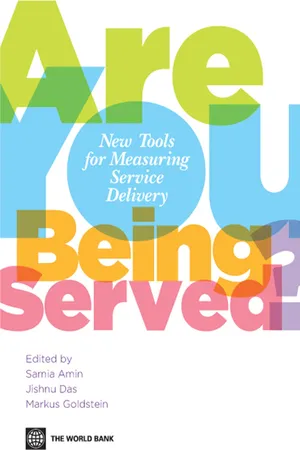
Are You Being Served?
New Tools for Measuring Service Delivery
- 454 pages
- English
- PDF
- Available on iOS & Android
eBook - PDF
Are You Being Served?
New Tools for Measuring Service Delivery
About this book
This publication presents tools and techniques for measuring service delivery in health and education and people's experiences from the field in deploying these methods. It begins by providing an introduction to the different methodological tools available for evaluating the performance of the health and education sectors. Country specific experiences are then explored to highlight lessons on the challenges, advantages and disadvantages of using different techniques to measure quality in a variety of different contexts and of using the resulting data to affect change. This book is a valuable resource for those who seek to enhance capacity for the effective measurement of service delivery in order to improve accountability and governance and enhance the quality of service delivery in developing countries.
Information
Table of contents
- Contents
- Foreword
- Acknowledgments
- About the Editors and Authors
- Abbreviations
- Part One Overview
- Part Two Use of Administrative Data
- Part Three Public Expenditure Tracking Surveys
- Part Four Facility Surveys
- Part Five Combined Household and Facility Surveys
- Part Six Conclusion
- Box 12.1 Incidence and Nature of Health Worker Absenteeism
- Box 12.2 Health Worker Employment Conditions
- Box 12.3 Limitations and Risks in Employment
- Box 12.4 Challenges to Measuring Absenteeism Quantitatively
- Figure 1.1 Association between Outcomes and Public Spending
- Figure 1.2 Key Relationships of Power
- Figure 2.1 Provider-Household Links
- Figure 2.2 Provider Performance
- Figure 3.1 Scope of the Instrument
- Figure 3.2 Framework of Accountability Relationships
- Figure 5.1 Proportion of Sites That Joined the Seecaline Programover Time, 1999–2003
- Figure 5.2 Differential Treatment Effects
- Figure 6.1 Learning Patterns
- Figure 6.2 Distribution of the Length of Program Exposure
- Figure 7.1 Financial and Resource Flows to Primary Facilities
- Figure 8.1 Budgeted Versus Effective Regional Public Spending and Production in Health
- Figure 8.2 Structure of Patient Costs in Primary Health Centers, 2003
- Figure 9.1 Student Enrollment in Primary and Lower-Secondary Schools, 1995/96–1999/2000
- Figure 9.2 School Funding by Grant Receipts and Public or Private Status, 2000
- Figure 9.3 Delays in Subsidy Receipt, 2001
- Figure 9.4 Depletion in the Effective Supply of Teachers, 2002
- Figure 10.1 Northern End of Sumatra
- Figure 11A.1 Formation of the Territorial Sample for the Household Living Conditions Survey, 2004–08
- Figure 13.1 Information by Vignette and Country
- Figure 14.1 Mean Time Spent Traveling, Waiting, and in Consultation, 2004
- Figure 14.2 What Did the Health Care Worker Do during the Consultation Today?
- Table 3.1 Public Expenditure on Education in Bolivia by Household Income Quintile, 2002
- Table 3.2 Evaluating Data Needs
- Table 4.1 Distribution of FISE Projects by Type, 1993–96
- Table 4.2 Access to Toilets and Latrines by Quintile of Per Capita Household Consumption
- Table 4.3 Standard Errors Based on 100 Simulated Samples of the Palanpur 1983–84 Population
- Table 5.1 Differential Program Treatment Effects, by Age Group
- Table 6.1 Municipalities with ECD-Related Programs, by Regionand Survey Round
- Table 6.2 Service Providers Who Have Received Program Training, by Type of Training
- Table 6.3 Distribution of Children across Program Exposure Categories, by Age
- Table 6.4 Distribution of Significant Positive Effects, by Ageand Months of Exposure
- Table 7.1 Examples of Allocation Rules
- Table 7.2 Summary of the Findings of the Mozambique Tracking Survey
- Table 7.3 Key Survey Findings beyond Leakage
- Table 8.1 Ministry of Health Budget, 2003
- Table 8.2 Receipt of Resources at Regions and Health Facilities,2003
- Table 10.1 Disruptions in Service Provision in the Aftermath of the Tsunami, December 26, 2004
- Table 10.2 Communities Experiencing Changes in the Availability of Elementary Schools and Public Health Centers
- Table 10.3 Facilities Reporting Worse Conditions after the Tsunami,by Service Area
- Table 10.4 Enrollments and Staffing before the Tsunami and at the Time of the Survey
- Table 10.5 Condition of Electricity and Water Connections in Community Health Posts
- Table 11A.1 Distribution of Sampled Institutions, by Oblast and Type of Settlement
- Table 11B.2 Composition of the Economic Regions
- Table 12.1 Explanatory Factors of Absenteeism from Theory and Empirical Analysis
- Table 12.2 Focus Groups and Focus Group Participants in Ethiopia and Rwanda
- Table 12.3 An Expanded Model of Absenteeism
- Table 14.1 Sample Size of Wave 1 of the Uganda Primary Health Contracting Study
- Table 14.2 What Did You Pay for the Care You Received Here Today?
- Table 14.3 Share of Respondents Expressing a Positive Opinion of Care at a Facility
- Table 14.4 Correlates of Overall Satisfaction with the Care Experience
- Table 14.5 Characteristics of Clients, by Facility Type
- Table 14.6 Changes in Perceived Quality after the Introduction of the Bonus Scheme
- Table 14.7 Differences between Facilities with and without Yellow Star Certification
- Table 14.8 Differences in Perceived Quality and Treatment Characteristics between Household Surveys and Exit Polls
- Table 14.9 Proportion of Respondents Reporting Paying Non-Zero Amounts, Matched Sample
- Table 14A.1 Summary Statistics for Observations Included in and Excluded from the Final Sample
- Table 15.1 IFLS Health Care Facility and School Samples
- Table 15.2 IFLS1 Matching Rates: Health Facility and School Surveys and the Household Questionnaire
- Table 15.3 IFLS Cross-Wave Facility Interviews, by Facility Type
- Table 15A.1 IFLS2–3 Health Care and School Facility Samples
- Table 16.1 Topics Covered in a Typical LSMS Household Questionnaire
- Table 16.2 Facility Surveys in the LSMS by Country and Year
- Table 16.3 Features of the Facility Surveys in the LSMS
- Table 16.4 Health Facilities and Health Outcomes in Panama, by Corregimiento
Trusted by 375,005 students
Access to over 1.5 million titles for a fair monthly price.
Study more efficiently using our study tools.
Frequently asked questions
Yes, you can cancel anytime from the Subscription tab in your account settings on the Perlego website. Your subscription will stay active until the end of your current billing period. Learn how to cancel your subscription
No, books cannot be downloaded as external files, such as PDFs, for use outside of Perlego. However, you can download books within the Perlego app for offline reading on mobile or tablet. Learn how to download books offline
We are an online textbook subscription service, where you can get access to an entire online library for less than the price of a single book per month. With over 1.5 million books across 990+ topics, we’ve got you covered! Learn about our mission
Look out for the read-aloud symbol on your next book to see if you can listen to it. The read-aloud tool reads text aloud for you, highlighting the text as it is being read. You can pause it, speed it up and slow it down. Learn more about Read Aloud
Yes! You can use the Perlego app on both iOS and Android devices to read anytime, anywhere — even offline. Perfect for commutes or when you’re on the go.
Please note we cannot support devices running on iOS 13 and Android 7 or earlier. Learn more about using the app
Please note we cannot support devices running on iOS 13 and Android 7 or earlier. Learn more about using the app
Yes, you can access Are You Being Served? by Samia Amin,Jishnu Das,Markus Goldstein in PDF and/or ePUB format, as well as other popular books in Politics & International Relations & American Government. We have over 1.5 million books available in our catalogue for you to explore.