eBook - PDF
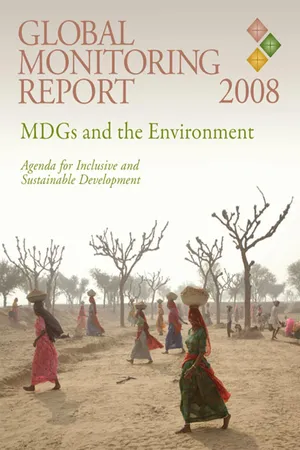
Global Monitoring Report 2008
MDGs and the Environment -- Agenda for Inclusive and Sustainable Development
- 290 pages
- English
- PDF
- Available on iOS & Android
eBook - PDF
Global Monitoring Report 2008
MDGs and the Environment -- Agenda for Inclusive and Sustainable Development
About this book
'Global Monitoring Report 2008', the fifth in an annual series, is essential reading for those who wish to follow the global development agenda and debate in 2008. The year marks the midpoint toward the 2015 deadline for achieving the Millennium Development Goals (MDGs). It is also an important year to work toward a consensus on how the world is going to respond to the challenge of climate change, building on the foundation laid at the Bali climate change conference in December 2007. The report spans this agenda. It provides a comprehensive assessment of progress toward the MDGs and related policies and actions. It addresses the challenge of climate change and environmental sustainability and assesses its implications for development. The report's assessment of MDGs at midpoint presents a mixed picture, one of both significant progress and formidable challenges. The first MDG, reducing extreme poverty by half, is likely to be met at the global level, thanks to a remarkable surge in global economic growth over the past decade. But, on current trends, the human development MDGs are unlikely to be met. Prospects are gravest for the goals of reducing child and maternal mortality, but shortfalls are also likely in the primary school completion. nutrition, and sanitation MDGs. The potential effects of climate change compound the challenge of achieving the development goals and sustaining progress. The report's messages are clear: urgent action is needed to help the world get back on track to achieve the MDGs; and urgent action is also needed to combat climate change that threatens the well-being of all countries, but particularly of poor countries and poor people. The goals of development and environmental sustainability are closely related, and the paths to those goals have important synergies.
Information
Subtopic
Development EconomicsIndex
EconomicsTable of contents
- Contents
- Foreword
- Acknowledgments
- Abbreviations
- Executive Summary
- Overview
- Part I Monitoring the Development Agenda
- Part II Special Theme: Environmental Sustainability
- References
- ANNEX Monitoring the MDGs: Selected Indicators
- Box 0.1 MDGs and the environment
- Box 1 Assessing whether countries are on or off track
- Box 2 Statistical capacity building: furthering progress
- Box 1.1 Recent revisions of purchasing power parities
- Box 1.2 The recent financial market turbulence
- Box 1.3 Growth in Africa: rising but uneven
- Box 1.4 Management of natural resource revenues
- Box 1.5 Impact of oil price increases on low-income countries
- Box 1.6 Rising food prices and their policy implications
- Box 1.7 Vietnam: Growth with equality leads to dramatic success in reducing poverty
- Box 1.8 Private remittances: positive effects and risks
- Box 1.9 The Commission on Growth and Development
- Box 1.10 Institutions, inequality, and growth
- Box 2.1 Comparing inequality in health in India and Mali
- Box 2.2 The Education for All Fast-Track Initiative
- Box 2.3 Improving educational quality and stimulating growth
- Box 2.4 Indicators of environmental risk factors—DALYs
- Box 2.5 Exposure to indoor air pollution: Evidence from Bangladesh
- Box 3.1 Improving the predictability of aid: Ghana and Tanzania
- Box 3.2 Debt Management Performance Assessment Tool
- Box 4.1 Trade data and trade restrictiveness indicators
- Box 4.2 The World Bank Logistics Performance Index
- Box 4.3 WTO negotiations and climate change
- Box 4.4 Will carbon labeling help or hinder developing-country trade?
- Box 5.1 Bank-Fund Collaboration: Joint Management Action Plan
- Box 5.2 Lending by the IMF
- Box 5.3 Global Emerging Markets Local Currency Bond Initiative
- Box 5.4 Supporting the preparation of poverty reduction strategies: The case of Mozambique
- Box 5.5 The IMF’s programs for improving statistical capacity
- Box 5.6 Malaysia-Africa Knowledge Exchange Seminar: An example of South-South knowledge sharing
- Box 5.7 Coordination among donors in Bolivia
- Box 5.8 Recent examples of country-level harmonization with regional development banks
- Box 5.9 The Africa Action Plan: progress in implementation
- Box 5.10 World Bank country systems pilot
- Box 5.11 Carbon Partnership Facility and Forest Carbon Partnership Facility
- Box 6.1 The importance of environmental income to the poor
- Box 6.2 MDG 7 indicators
- Box 6.3 Assessing the performance of subsidies
- Box 6.4 Adjusted net savings as a sustainability indicator
- Box 7.1 Weather-index insurance
- Box 7.2 Adaptation to climate change
- Box 7.3 Sources of carbon finance under the UNFCCC
- Figure 1 At the global level, progress and prospects vary widely across MDGs
- Figure 2 Progress toward MDGs is slowest in fragile states
- Figure 3 Most countries are off track to meet most MDGs
- Figure 1.1 Poverty head count
- Figure 1.2 Per capita GDP growth rates by country group, 2003–07
- Figure 1.3 Number of emerging-market and developing countries by annual real GDP per capita growth rates, 2003–07
- Figure 1.4 Commodity price indexes, 1991–2007
- Figure 1.5 Terms-of-trade changes by country group, 1991–2007
- Figure 1.6 Real per capita GDP growth rate for low-growth fragile states, adjusted for terms-of-trade changes, 1991–2007
- Figure 1.7 Annual change in Gini coefficient in 59 developing countries
- Figure 1.8 Decompositions of change in the Gini coefficient
- Figure 1.9 Average ranking of “ease of doing business,” by region and income group
- Figure 1.10 Aggregate labor productivity gains in Latin America, by firm size
- Figure 1.11 CPIA governance indicators, 2000–06
- Figure 1.12 GDP growth vs. adjusted net savings
- Figure 1.13 Adjusted net saving trends, 1990–2005
- Figure 2.1 Regional disparities in primary school completion and participation, 1990–2005
- Figure 2.2 Incidence of public health spending on poorest and richest quintiles, 1989–2001
- Figure 2.3 Incidence of public education spending on poorest and richest quintiles, 1985–2001
- Figure 2.4 Differences in Laotian education achievement across age, gender, and ethnic group, 2002–03
- Figure 2.5 Relationship between health and education inequality and income inequality
- Figure 2.6 Relationship between health and education inequality and per capita income
- Figure 2.7 Absenteeism among primary health care workers, 2002–03
- Figure 2.8 Relationship of health quality to income and public health care expenditures
- Figure 2.9 Stunting and wasting for under-five children, 2000–present
- Figure 2.10 The relationship between malnutrition, poverty, and education
- Figure 2.11 Relation of reductions in under-five malnutrition to increases in income
- Figure 2.12 Environmental disease burden in DALYs per 1,000 population, 2002
- Figure 2.13 Environmental contribution to disease burden
- Figure 2.14 Economic burden associated with poor environmental health
- Figure 2.15 Trends and projections of access to water and sanitation in developing countries, 1990–2015
- Figure 2.16 Access to clean water and sanitation by expenditure quintile, 32 African countries
- Figure 3.1 DAC members' net ODA flows and 2010 target
- Figure 3.2 DAC members’ ODA
- Figure 3.3 Distribution of DAC members’ ODA by type
- Figure 3.4 Top 10 recipients of the increase in net ODA, 2002–06
- Figure 3.5 Rising trend in aid from non-DAC bilaterals and NGOs
- Figure 3.6 Net ODA to Sub-Saharan Africa
- Figure 3.7 Conflict risk, aid, and peacekeeping
- Figure 3.8 Humanitarian aid, 1970–2006
- Figure 3.9 Concentration of DAC donors and multilaterals in selected countries, measured by programmable aid
- Figure 3.10 In-year predictability is improving
- Figure 3.11 Strong growth in assistance for health, 2000 and 2006
- Figure 3.12 Ethiopia: Distribution of aid within the health sector
- Figure 3.13 Reduction of debt stock for the 33 post-decision-point HIPCs
- Figure 3.14 Risk of debt distress in post-completion-point HIPCs
- Figure 4.1 Change in OTRI, 2000–06
- Figure 4.2 Producer support estimates for OECD members, 1999–2006
- Figure 4.3 Nominal rate of assistance to farmers in high-income and developing countries, 1960 to 2004
- Figure 4.4 Nominal rate of assistance to farmers in developing countries, 1960 to 2004
- Figure 4.5 Gross subsidy equivalents of assistance to farmers in developing and high-income countries, 1960–2004
- Figure 4.6 Change in the average MA-OTRI for all exports, 2000–06
- Figure 4.7 Higher growth is associated with lower trade restrictiveness
- Figure 4.8 Countries with better trade logistics have higher trade-to-GDP growth
- Figure 4.9 Restrictiveness of services trade policies, 2007
- Figure 4.10 Services trade restrictiveness indices, by sector
- Figure 4.11 Distribution of aid for trade by income group and region,and by category, average 2002–06
- Figure 4.12 Environmental goods confront significant trade restrictiveness
- Figure 5.1 MDBs’ gross disbursements, by type of flow and region, 2000–07
- Figure 5.2 World Bank knowledge service inputs, by type, 2002–07
- Figure 5.3 World Bank portfolio of global partnership funds by theme and host institution
- Figure 5.4 Progress toward operational development strategies in low-income countries
- Figure 5.5 Policy and poverty selectivity of concessional assistance by the MDBs
- Figure 5.6 IBRD and IDA disbursements by sector and themes
- Figure 5.7 Active World Bank environment and natural resource portfolio, by thematic distribution, as of June 30, 2007
- Figure 5.8 ADB projects with environmental elements by theme, 2006
- Figure 1 Framework for monitoring environmental sustainability
- Figure 6.1 Annual deforestation by region and for top 10 countries, 2000–05
- Figure 6.2 Internal freshwater resources per capita, by region and income group, 2005
- Figure 6.3 Trends and projections in freshwater availability, West Asia
- Figure 6.4 Annual freshwater withdrawals, by region and income group, 2002
- Figure 6.5 Total water withdrawal relative to renewable water resources, selected countries
- Figure 6.6 Sustainability in energy- and mineral-rich economies
- Figure 6.7 Annual particulate matter (PM10) concentrations, 1990–2004
- Figure 6.8 Use of biomass products and waste, by income, 1990–2004
- Figure 6.9 Adjustments to the saving rate: The case of Bolivia in 2002 and 2005
- Figure 6.10 Relative importance and composition of natural capital, 2005
- Figure 6.11 Natural capital per capita across regions of the world, 2005
- Figure 6.12 Evolution of the value of natural capital
- Figure 6.13 Environmental Performance Index, by income group and region, 2008
- Figure 6.14 Evolution of the CPIA environment score, 1999–2006
- Figure 6.15 CPIA environment score and its subcomponents, 2006
- Figure 7.1 Projections of surface temperatures for three IPCC scenarios
- Figure 7.2 Impacts of increases in temperature and precipitation on agricultural yields, 2079–99
- Figure 7.3 Estimated death rate from climate change in 2000, by WHO subregion
- Figure 7.4 Vulnerability to sea level rise
- Figure 7.5 World GHG emissions, by sector, 2000
- Figure 7.6 Per capita GHG emissions in 2000, including emissions from land use change
- Figure 7.7 Annual CO2 emissions under the A1FI scenario, 1965–2035
- Figure 7.8 Cumulative atmospheric CO2 under the A1FI scenario, 1965–2035
- Figure 7.9 Change in annual CO2 emissions by carbon intensity class, 1994–2004
- Figure 7.10 Energy intensity by region, 2004
- Figure 7.11 CO2 emissions from land use changes, 1850–2000
- Figure 7.12 Kyoto targets and changes in GHG emissions for Annex B countries
- Figure 7.13 Proportion of terrestrial and marine area protected
- Figure 7.14 Living Planet Index, 1970–2003
- Figure 7.15 Living Planet Indexes for terrestrial, marine, and freshwater organisms
- Figure 7.16 Global trends in the world’s marine stocks since 1974
- Table 1.1 Summary of world output
- Table 1.2 Net financial flows to developing countries
- Table 1.3 International remittances
- Table 1.4 The quality of macroeconomic policies in low-income countries, 2003–07
- Table 1.5 Status of investment climate reform, 2003–07
- Table 1.6 Low coverage and high cost of Africa’s infrastructure
- Table 1.7 Total per capita wealth and its components, by developing region and economy type, 2005
- Table 1.8 Per capita natural wealth and its components, by developing region and economy type, 2005
- Table 1.9 Adjustments to savings, 2005
- Table 2.1 Selected measures of health inequality, by region and income group, 2000–present
- Table 2.2 Selected proximate measures of health care quality for selected countries
- Table 2.3 Downward trends in under-five malnutrition, 1990–2005
- Table 2.4 Deaths and DALYs lost due to solid fuel use
- Table 2.5 Projected health effects of climate change
- Table 2.6 Cost per DALY of alternative interventions for addressing environmental hazards, US$ per healthy year gained
- Table 4.1 OTRI and TTRI, by income group, 2006
- Table 4.2 OTRI and TTRI, by developing country region, 2006
- Table 4.3 OTRI and TTRI for the four largest traders, 2006
- Table 4.4 Gross subsidy equivalents of assistance to farmers, by region, 1960–2004
- Table 4.5 MA-OTRI and MA-TTRI by income group, 2006
- Table 4.6 Aid for trade, 2006, and annual average, 2002–06
- Table 4.7 Increase in trade volumes from liberalizing clean energy technologies
- Table 5.1 Strategic shifts by IFIs
- Table 5.2 IBRD cofinancing by types of cofi nancier, 1998–2007
- Table 5.3 Record expansion of IDA
- Table 5.4 Reports posted by agency at Country Analytical Work Web site, 2007
- Table 5.5 MDB gross disbursements to fragile states, 2002–07
- Table 5.6 A comparison of MDB assessment systems
- Table 6.1 The targets under MDG 7
- Table 6.2 Environmental links to the MDGs
- Table 6.3 Top 10 emitters of industrial water pollution, 2001
- Table 6.4 Access to electricity, by region, 2005
- Table 6.5 Top 10 users of biomass products and waste, 1990–2004
- Table 7.1 Likelihood of various CO2e concentrations exceeding various increases in global mean surface temperature
- Table 7.2 Changes in mean global temperature and sea level associated with various IPCC scenarios
- Table 7.3 Possible impacts of climate change in the mid-to-late-21st century
- Table 7.4 Estimated DALYs attributed to climate change in 2000
- Table 7.5 Ten countries most affected by a one meter rise in sea level
- Table 7.6 Weather damage index (WDI), by country and region
- Table 7.7 GHG emissions, by sector and region, 2000, metric tons of CO2e
- Table 7.8 Comparison of GHG emissions for Annex I and non-Annex I countries
- Table 7.9 Comparison of industrial energy efficiency across countries
- Table 7.10 Availability of renewable resources relative to current consumption, by World Bank region
Trusted by 375,005 students
Access to over 1.5 million titles for a fair monthly price.
Study more efficiently using our study tools.
Frequently asked questions
Yes, you can cancel anytime from the Subscription tab in your account settings on the Perlego website. Your subscription will stay active until the end of your current billing period. Learn how to cancel your subscription
No, books cannot be downloaded as external files, such as PDFs, for use outside of Perlego. However, you can download books within the Perlego app for offline reading on mobile or tablet. Learn how to download books offline
Perlego offers two plans: Essential and Complete
- Essential is ideal for learners and professionals who enjoy exploring a wide range of subjects. Access the Essential Library with 800,000+ trusted titles and best-sellers across business, personal growth, and the humanities. Includes unlimited reading time and Standard Read Aloud voice.
- Complete: Perfect for advanced learners and researchers needing full, unrestricted access. Unlock 1.5M+ books across hundreds of subjects, including academic and specialized titles. The Complete Plan also includes advanced features like Premium Read Aloud and Research Assistant.
We are an online textbook subscription service, where you can get access to an entire online library for less than the price of a single book per month. With over 1.5 million books across 990+ topics, we’ve got you covered! Learn about our mission
Look out for the read-aloud symbol on your next book to see if you can listen to it. The read-aloud tool reads text aloud for you, highlighting the text as it is being read. You can pause it, speed it up and slow it down. Learn more about Read Aloud
Yes! You can use the Perlego app on both iOS and Android devices to read anytime, anywhere — even offline. Perfect for commutes or when you’re on the go.
Please note we cannot support devices running on iOS 13 and Android 7 or earlier. Learn more about using the app
Please note we cannot support devices running on iOS 13 and Android 7 or earlier. Learn more about using the app
Yes, you can access Global Monitoring Report 2008 by World Bank in PDF and/or ePUB format, as well as other popular books in Economics & Development Economics. We have over 1.5 million books available in our catalogue for you to explore.