- English
- ePUB (mobile friendly)
- Available on iOS & Android
eBook - ePub
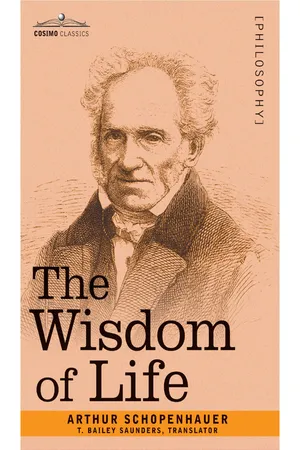
The Wisdom of Life
About this book
A disciple of Kant and a significant factor in shaping Nietzsche's thinking, Arthur Schopenhauer worked from the foundation that all knowledge derives from our experience of the world, but that our experience is necessarily subjective and formed by our own intellect and biases: reality, therefore, is but an extension of our own will. In this essay, translated by THOMAS BAILEY SAUNDERS (1860-1928) and first published in English in the 1890s, Schopenhauer explores concepts of what internal driving forces and external interpersonal dynamics contribute to the individual's happiness, from our own personalities to our wealth and social standing. The datedness of some of Schopenhauer's ideas—including a decidedly prefeminist interpretation of women's choices and a connection between fame and reputation that is no longer always active in our celebrity culture—only serve to highlight the philopher's basic assumption of human life: that it is characterized chiefly by misery. Students of philosophy and of 19th-century intellectualism will find this a fascinating read.
Information
Topic
PhilosophySubtopic
Ethics & Moral PhilosophyTable of contents
- INTRODUCTION
- CHAPTER I DIVISION OF THE SUBJECT
- CHAPTER II PERSONALITY, OR WHAT A MAN IS
- CHAPTER III PROPERTY, OR WHAT A MAN HAS
- CHAPTER IV POSITION, OR A MAN'S PLACE IN THE ESTIMATION OF OTHERS
Trusted by 375,005 students
Access to over 1.5 million titles for a fair monthly price.
Study more efficiently using our study tools.
Frequently asked questions
Yes, you can cancel anytime from the Subscription tab in your account settings on the Perlego website. Your subscription will stay active until the end of your current billing period. Learn how to cancel your subscription
No, books cannot be downloaded as external files, such as PDFs, for use outside of Perlego. However, you can download books within the Perlego app for offline reading on mobile or tablet. Learn how to download books offline
We are an online textbook subscription service, where you can get access to an entire online library for less than the price of a single book per month. With over 1.5 million books across 990+ topics, we’ve got you covered! Learn about our mission
Look out for the read-aloud symbol on your next book to see if you can listen to it. The read-aloud tool reads text aloud for you, highlighting the text as it is being read. You can pause it, speed it up and slow it down. Learn more about Read Aloud
Yes! You can use the Perlego app on both iOS and Android devices to read anytime, anywhere — even offline. Perfect for commutes or when you’re on the go.
Please note we cannot support devices running on iOS 13 and Android 7 or earlier. Learn more about using the app
Please note we cannot support devices running on iOS 13 and Android 7 or earlier. Learn more about using the app
Yes, you can access The Wisdom of Life by Arthur Schopenhauer in PDF and/or ePUB format, as well as other popular books in Philosophy & Ethics & Moral Philosophy. We have over 1.5 million books available in our catalogue for you to explore.