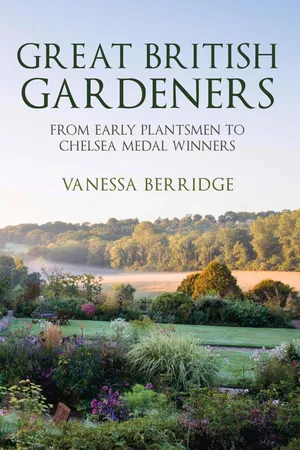
eBook - ePub
Great British Gardeners
From the Early Plantsmen to Chelsea Medal Winners
- English
- ePUB (mobile friendly)
- Available on iOS & Android
eBook - ePub
About this book
The British have always been a nation of gardeners. Our gardening history began even before the Romans, who brought Mediterranean plants which still flourish across Britain. Gardening grew in the sixteenth century and a distinctively British style became a major export in the eighteenth century. Today, the annual Chelsea Flower Show is an international festival, and our garden designers are in demand all over the world. This book traces the history of British gardening over 450 years through the stories of twenty-six key figures, showing what drove them, and their role in the evolution of Britain's gardens. Their work reveals changes in taste and society down the centuries. Familiar names are featured, such as 'Capability' Brown, Humphry Repton, Gertrude Jekyll, Vita Sackville-West and Christopher Lloyd, together with less generally known figures such as John Gerard, whose Herballof 1597 inspired generations of plantsmen, the Tradescants, pioneer plant hunters, and J. C. Loudon, nineteenth-century champion of smaller gardens. In the present day, we meet Beth Chatto, advocate of the right plant in the right place, and John Brookes, who did for gardening what Elizabeth David did for cooking. Their achievements provide a colourful history and inspiration to every gardening enthusiast.
Frequently asked questions
Yes, you can cancel anytime from the Subscription tab in your account settings on the Perlego website. Your subscription will stay active until the end of your current billing period. Learn how to cancel your subscription.
No, books cannot be downloaded as external files, such as PDFs, for use outside of Perlego. However, you can download books within the Perlego app for offline reading on mobile or tablet. Learn more here.
Perlego offers two plans: Essential and Complete
- Essential is ideal for learners and professionals who enjoy exploring a wide range of subjects. Access the Essential Library with 800,000+ trusted titles and best-sellers across business, personal growth, and the humanities. Includes unlimited reading time and Standard Read Aloud voice.
- Complete: Perfect for advanced learners and researchers needing full, unrestricted access. Unlock 1.4M+ books across hundreds of subjects, including academic and specialized titles. The Complete Plan also includes advanced features like Premium Read Aloud and Research Assistant.
We are an online textbook subscription service, where you can get access to an entire online library for less than the price of a single book per month. With over 1 million books across 1000+ topics, we’ve got you covered! Learn more here.
Look out for the read-aloud symbol on your next book to see if you can listen to it. The read-aloud tool reads text aloud for you, highlighting the text as it is being read. You can pause it, speed it up and slow it down. Learn more here.
Yes! You can use the Perlego app on both iOS or Android devices to read anytime, anywhere — even offline. Perfect for commutes or when you’re on the go.
Please note we cannot support devices running on iOS 13 and Android 7 or earlier. Learn more about using the app.
Please note we cannot support devices running on iOS 13 and Android 7 or earlier. Learn more about using the app.
Yes, you can access Great British Gardeners by Vanessa Berridge in PDF and/or ePUB format, as well as other popular books in History & Social History. We have over one million books available in our catalogue for you to explore.
Information
Table of contents
- Cover
- Introduction
- PART I: The Early Plantsmen
- PART II: A Growing Concern
- PART III: The Great Designers
- PART IV: The Industrial Age
- PART V: The Flower Garden
- PART VI: Classical and Modern
- PART VII: The Later Plantsmen
- Plates
- Notes
- Bibliography
- Acknowledgements