eBook - ePub
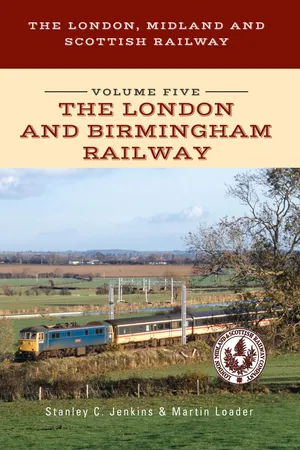
The London, Midland and Scottish Railway Volume Five The London and Birmingham Railway
- English
- ePUB (mobile friendly)
- Available on iOS & Android
eBook - ePub
The London, Midland and Scottish Railway Volume Five The London and Birmingham Railway
About this book
Authorised on 8 May 1833, the London & Birmingham Railway was one of Britain's first great trunk lines. Engineered by Robert Stephenson (1803-1859), the L&BR line was regarded at the time of its construction as 'the Eighth Wonder of the World'. The route was opened in stages; the first section from Euston to Boxmoor was brought into use on 20 June 1837. The route was extended to Tring on 16 October 1837, and on 9 April 1838 further sections were opened from Tring to Denbigh Hall and between Rugby, Coventry and Birmingham. Finally, on 17 September 1838, the L&BR route was completed throughout its 112-mile length.In its original form, the L&BR functioned as a transport link between London and Birmingham, but the establishment of long-distance railway communication between London and Scotland was regarded as a matter of national importance, and further companies such as the Grand Junction Railway and the Lancaster & Carlisle line were brought into existence to facilitate this ambitious aspiration. Although the L&BR was, at first, suspicious of these new companies, the London & Birmingham directors eventually decided to co-operate, and by 1846 the major west coast companies had amalgamated to form the 'London & North Western Railway' with the West Coast Main Line from Euston to Glasgow being one of the busiest railways in Britain, if not the world.
Frequently asked questions
Yes, you can cancel anytime from the Subscription tab in your account settings on the Perlego website. Your subscription will stay active until the end of your current billing period. Learn how to cancel your subscription.
No, books cannot be downloaded as external files, such as PDFs, for use outside of Perlego. However, you can download books within the Perlego app for offline reading on mobile or tablet. Learn more here.
Perlego offers two plans: Essential and Complete
- Essential is ideal for learners and professionals who enjoy exploring a wide range of subjects. Access the Essential Library with 800,000+ trusted titles and best-sellers across business, personal growth, and the humanities. Includes unlimited reading time and Standard Read Aloud voice.
- Complete: Perfect for advanced learners and researchers needing full, unrestricted access. Unlock 1.4M+ books across hundreds of subjects, including academic and specialized titles. The Complete Plan also includes advanced features like Premium Read Aloud and Research Assistant.
We are an online textbook subscription service, where you can get access to an entire online library for less than the price of a single book per month. With over 1 million books across 1000+ topics, we’ve got you covered! Learn more here.
Look out for the read-aloud symbol on your next book to see if you can listen to it. The read-aloud tool reads text aloud for you, highlighting the text as it is being read. You can pause it, speed it up and slow it down. Learn more here.
Yes! You can use the Perlego app on both iOS or Android devices to read anytime, anywhere — even offline. Perfect for commutes or when you’re on the go.
Please note we cannot support devices running on iOS 13 and Android 7 or earlier. Learn more about using the app.
Please note we cannot support devices running on iOS 13 and Android 7 or earlier. Learn more about using the app.
Yes, you can access The London, Midland and Scottish Railway Volume Five The London and Birmingham Railway by Stanley C. Jenkins,Martin Loader in PDF and/or ePUB format, as well as other popular books in History & World History. We have over one million books available in our catalogue for you to explore.
Information
Table of contents
- Cover
- Acknowledgements
- Historical Introduction