- English
- ePUB (mobile friendly)
- Available on iOS & Android
eBook - ePub
About this book
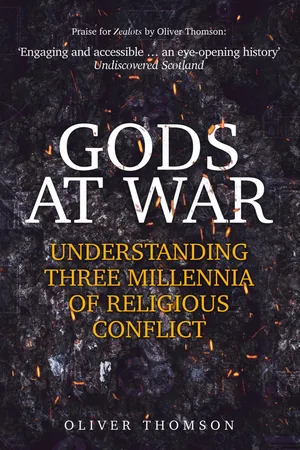
Gods at War examines the role played by religions in starting or supporting wars from ancient Egypt and Israel to the current conflicts in Yemen and the Ukraine. It not only analyses the traditionally recognised wars of religion such as the Crusades and the Thirty Years War and the many Islamic jihads, but also addresses the role played by nearly all religions in encouraging warrior kings, dictators and even democracies to wage wars, supporting them with money, promises of paradise in the after-life, guarantees of victory (God is on their side) and ceremonial to keep up morale. Onward Christian Soldiers. Oliver Thomson assesses the level of religious involvement in wars, including less obvious ones such as the attempted invasion of the Spanish Armada, the French Revolutionary Wars, and the Japanese War in the Pacific; the prime minister of Japan who launched the attack on Pearl Harbor was a devout Buddhist. There are examples of wars inspired by Judaism, rival Christian and Muslim sects, Sikhism and Japanese Shinto. The first section of the book discusses several different types of religious influence in conflicts, ranging from almost purely religious wars like the French or German wars of religion, to the many others where religion only played a supportive but still significant role. It also explores the reasons why religious sanction has been welcomed by war leaders and why religions chose to cooperate. Distinctions are drawn between the documented faith of each religion and its manipulation by its leaders when it suited them. Four main sections cover wars from the pre-Christian era, the Middle Ages, the early modern period and finally the conflicts of the twenty-first century, including the use made of the Russian church by Vladimir Putin, of Sunni Islam by Mohammed bin Salman - even of Pentecostalism in Guatemala.
Frequently asked questions
Yes, you can cancel anytime from the Subscription tab in your account settings on the Perlego website. Your subscription will stay active until the end of your current billing period. Learn how to cancel your subscription.
No, books cannot be downloaded as external files, such as PDFs, for use outside of Perlego. However, you can download books within the Perlego app for offline reading on mobile or tablet. Learn more here.
Perlego offers two plans: Essential and Complete
- Essential is ideal for learners and professionals who enjoy exploring a wide range of subjects. Access the Essential Library with 800,000+ trusted titles and best-sellers across business, personal growth, and the humanities. Includes unlimited reading time and Standard Read Aloud voice.
- Complete: Perfect for advanced learners and researchers needing full, unrestricted access. Unlock 1.4M+ books across hundreds of subjects, including academic and specialized titles. The Complete Plan also includes advanced features like Premium Read Aloud and Research Assistant.
We are an online textbook subscription service, where you can get access to an entire online library for less than the price of a single book per month. With over 1 million books across 1000+ topics, we’ve got you covered! Learn more here.
Look out for the read-aloud symbol on your next book to see if you can listen to it. The read-aloud tool reads text aloud for you, highlighting the text as it is being read. You can pause it, speed it up and slow it down. Learn more here.
Yes! You can use the Perlego app on both iOS or Android devices to read anytime, anywhere — even offline. Perfect for commutes or when you’re on the go.
Please note we cannot support devices running on iOS 13 and Android 7 or earlier. Learn more about using the app.
Please note we cannot support devices running on iOS 13 and Android 7 or earlier. Learn more about using the app.
Yes, you can access Gods at War by Oliver Thomson in PDF and/or ePUB format, as well as other popular books in History & World History. We have over one million books available in our catalogue for you to explore.
Information
Table of contents
- Cover
- Preface
- Introduction
- PART ONE: THE ANCIENT WORLD
- PART TWO: THE MIDDLE AGES
- PART THREE: THE EARLY MODERN PERIOD
- PART FOUR: THE LATE TWENTIETH AND TWENTY-FIRST CENTURIES
- Plates
- Conclusion
- Appendices
- Bibliography