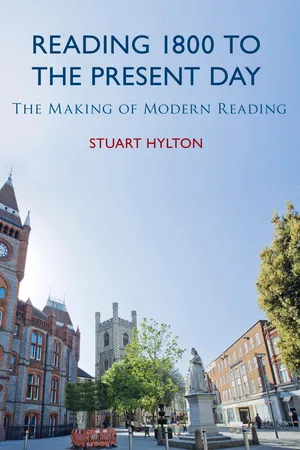
Reading has been transformed in the last century or so. It has gone from being a Victorian manufacturing town to a major centre for service industries and cutting-edge technology. It was, and still is, an important railway town, but both its appearance and its operation have been dramatically changed by the motorcar and the aeroplane. Most of the High Street names that would have been familiar to Edwardian residents have now disappeared, and many of its retail opportunities are now to be found indoors. New suburbs have popped up around its traditional boundaries, and the neighbouring settlement of Caversham became (with varying degrees of enthusiasm from its citizens) part of the borough. Reading 1800 to The Present Day: The Making of Modern Reading is a fresh look at the town's history, focusing on the factors that make the town what it is today: how it grew, how it faced the challenges of the twentieth century, how the leisure and shopping habits of its residents have changed, the emergence of key institutions like the university, its changing physical appearance and the impact of major events of the last century, such as the First and Second World Wars and the General Strike.
- English
- ePUB (mobile friendly)
- Available on iOS & Android
eBook - ePub
About this book
Information
Topic
ArtSubtopic
British HistoryTable of contents
- Cover
- Introduction
- Reading and the Motor Car
- Office Town
- Fun, Fun, Fun
- Sickness and Health
- Crime and Punishment
- Workhouse to Welfare State: Reading and its Poor
- Travel and (Public) Transport
- Shop! Shop! Shop!
- Earth Hunger – Reading’s Boundaries
- The Rivers
- Monuments, Memorials and Parks
- The Royals
- Seats of Learning
- Who Governs Reading?
- Picture Section
- Acknowledgements
- Bibliography
Trusted by 375,005 students
Access to over 1.5 million titles for a fair monthly price.
Study more efficiently using our study tools.
Frequently asked questions
Yes, you can cancel anytime from the Subscription tab in your account settings on the Perlego website. Your subscription will stay active until the end of your current billing period. Learn how to cancel your subscription
No, books cannot be downloaded as external files, such as PDFs, for use outside of Perlego. However, you can download books within the Perlego app for offline reading on mobile or tablet. Learn how to download books offline
Perlego offers two plans: Essential and Complete
- Essential is ideal for learners and professionals who enjoy exploring a wide range of subjects. Access the Essential Library with 800,000+ trusted titles and best-sellers across business, personal growth, and the humanities. Includes unlimited reading time and Standard Read Aloud voice.
- Complete: Perfect for advanced learners and researchers needing full, unrestricted access. Unlock 1.5M+ books across hundreds of subjects, including academic and specialized titles. The Complete Plan also includes advanced features like Premium Read Aloud and Research Assistant.
We are an online textbook subscription service, where you can get access to an entire online library for less than the price of a single book per month. With over 1.5 million books across 990+ topics, we’ve got you covered! Learn about our mission
Look out for the read-aloud symbol on your next book to see if you can listen to it. The read-aloud tool reads text aloud for you, highlighting the text as it is being read. You can pause it, speed it up and slow it down. Learn more about Read Aloud
Yes! You can use the Perlego app on both iOS and Android devices to read anytime, anywhere — even offline. Perfect for commutes or when you’re on the go.
Please note we cannot support devices running on iOS 13 and Android 7 or earlier. Learn more about using the app
Please note we cannot support devices running on iOS 13 and Android 7 or earlier. Learn more about using the app
Yes, you can access Reading 1800 to the Present Day by Stuart Hylton in PDF and/or ePUB format, as well as other popular books in Art & British History. We have over 1.5 million books available in our catalogue for you to explore.