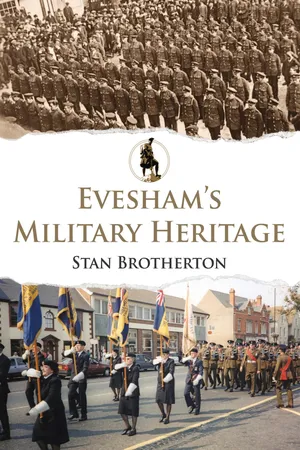
The picturesque Worcestershire town of Evesham, famous for gardening and its long-lost abbey, has a fascinating military heritage. It was the scene of the Battle of Evesham in 1265 where Simon de Montfort (the father of Parliament) suffered a violent death. During the English Civil War, in 1644, Charles I held court in the town, while in 1645 there was a fierce engagement between a Royalist garrison and Parliamentary forces. Like many other English towns, Evesham served and suffered during two world wars. While few bombs fell on the town during the Second World War, there was significant local activity including a Home Guard, anti-tank defence, a military hospital, barracks, local auxiliary units (maquis) and, later on, POWs. In this book author Stan Brotherton looks at some of the key moments in Evesham's military history, highlighting their impact on the town.
- English
- ePUB (mobile friendly)
- Available on iOS & Android
eBook - ePub
Evesham's Military Heritage
About this book
Information
Subtopic
British HistoryIndex
HistoryTable of contents
- Cover
- Introduction
- 1. The Battle of Evesham (1265)
- 2. English Civil Wars (1642–51)
- 3. Victorian Memorials of the Battle of Evesham
- 4. The First World War (1914–18)
- 5. The Second World War (1939–45)
- 6. Modern Commemoration of the World Wars
- 7. Modern Remembrance of the Battle of Evesham
- 8. Closing Thoughts
- Acknowledgements
Trusted by 375,005 students
Access to over 1.5 million titles for a fair monthly price.
Study more efficiently using our study tools.
Frequently asked questions
Yes, you can cancel anytime from the Subscription tab in your account settings on the Perlego website. Your subscription will stay active until the end of your current billing period. Learn how to cancel your subscription
No, books cannot be downloaded as external files, such as PDFs, for use outside of Perlego. However, you can download books within the Perlego app for offline reading on mobile or tablet. Learn how to download books offline
We are an online textbook subscription service, where you can get access to an entire online library for less than the price of a single book per month. With over 1.5 million books across 990+ topics, we’ve got you covered! Learn about our mission
Look out for the read-aloud symbol on your next book to see if you can listen to it. The read-aloud tool reads text aloud for you, highlighting the text as it is being read. You can pause it, speed it up and slow it down. Learn more about Read Aloud
Yes! You can use the Perlego app on both iOS and Android devices to read anytime, anywhere — even offline. Perfect for commutes or when you’re on the go.
Please note we cannot support devices running on iOS 13 and Android 7 or earlier. Learn more about using the app
Please note we cannot support devices running on iOS 13 and Android 7 or earlier. Learn more about using the app
Yes, you can access Evesham's Military Heritage by Stan Brotherton in PDF and/or ePUB format, as well as other popular books in History & British History. We have over 1.5 million books available in our catalogue for you to explore.