eBook - ePub
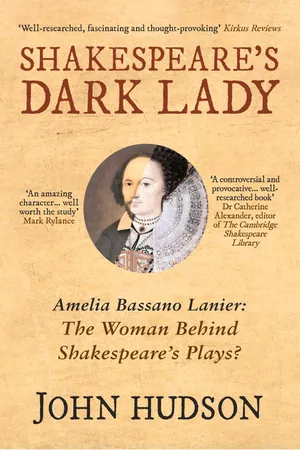
Shakespeare's Dark Lady
Amelia Bassano Lanier The Woman Behind Shakepeare's Plays?
- English
- ePUB (mobile friendly)
- Available on iOS & Android
eBook - ePub
About this book
Amelia Bassano was born in 1569 into a family of Venetian Jews who were court musicians to Queen Elizabeth I. At about the age of thirteen, she became mistress to the fiftysix-year-old Lord Hunsdon, Henry VIII's reputed son by Mary Boleyn. As Lord Chamberlain, Hunsdon was in charge of the English theatre and would become the patron of the company that performed the Shakespearean plays. Amelia lived with him for a decade, during which time she also had an affair with the playwright Christopher Marlowe. When she became pregnant, Amelia was exiled from court and next surfaces as the mysterious 'dark lady' in Shakespeare's sonnets. At the age of forty-two, she became the first woman to publish a book of original poetry, employing linguistic features resembling the later Shakespearean plays. Amelia died in poverty in 1645. Drawing upon a wealth of documentary evidence, this controversial and provocative book unites Tudor history, feminism, and Shakespeare scholarship to demonstrate that Amelia Bassano was in all the right places and had all the right knowledge, skills, and contacts to have produced the Shakespearean canon.
Frequently asked questions
Yes, you can cancel anytime from the Subscription tab in your account settings on the Perlego website. Your subscription will stay active until the end of your current billing period. Learn how to cancel your subscription.
No, books cannot be downloaded as external files, such as PDFs, for use outside of Perlego. However, you can download books within the Perlego app for offline reading on mobile or tablet. Learn more here.
Perlego offers two plans: Essential and Complete
- Essential is ideal for learners and professionals who enjoy exploring a wide range of subjects. Access the Essential Library with 800,000+ trusted titles and best-sellers across business, personal growth, and the humanities. Includes unlimited reading time and Standard Read Aloud voice.
- Complete: Perfect for advanced learners and researchers needing full, unrestricted access. Unlock 1.4M+ books across hundreds of subjects, including academic and specialized titles. The Complete Plan also includes advanced features like Premium Read Aloud and Research Assistant.
We are an online textbook subscription service, where you can get access to an entire online library for less than the price of a single book per month. With over 1 million books across 1000+ topics, we’ve got you covered! Learn more here.
Look out for the read-aloud symbol on your next book to see if you can listen to it. The read-aloud tool reads text aloud for you, highlighting the text as it is being read. You can pause it, speed it up and slow it down. Learn more here.
Yes! You can use the Perlego app on both iOS or Android devices to read anytime, anywhere — even offline. Perfect for commutes or when you’re on the go.
Please note we cannot support devices running on iOS 13 and Android 7 or earlier. Learn more about using the app.
Please note we cannot support devices running on iOS 13 and Android 7 or earlier. Learn more about using the app.
Yes, you can access Shakespeare's Dark Lady by John Hudson in PDF and/or ePUB format, as well as other popular books in Historia & Historia del Renacimiento europeo. We have over one million books available in our catalogue for you to explore.
Information
Table of contents
- Cover
- Foreword by Michael Posner
- Introduction
- 1 – Elizabethan London: City, Court and Theatre
- 2 – Shakespeare’s Remarkable Mind: A Shopping List
- 3 – The Man from Stratford: A Bad Buy
- 4 – Some Rotten Alternatives
- 5 – Amelia’s Early Life: 1569–1582
- 6 – Amelia at Court: 1582–1593
- 7 – Amelia, a Poet in Exile: 1594–1610
- 8 – A Poet in Her Own Right: 1611–1617
- 9 – The Final Years, School Teacher, Litigant and More: 1617–1645
- 10 – Conclusion
- Picture Section
- Appendices
- Notes
- Bibliography
- Acknowledgements
- List of Illustrations