Subsequent siblings, who are sometimes referred to as replacement children, are people who were born after the death of a brother or sister. Little has been written about them or from their perspective. This non-fiction, self-help, psychology book breaks new ground by assembling rich and heartfelt life stories from a diverse group of subsequent siblings while also weaving in clinical literature and discussion. It is based upon more than one hundred subsequent sibling interviews, which, to the authors' knowledge, currently comprises the largest and most diverse sample of this group. Through the subjects' engaging narratives the reader can understand some of the common obstacles and repercussions of the subsequent sibling role. Additional testimonies from parents and surviving siblings illuminate the multilayered impacts of loss upon a family system.
Those who are born after a deceased sibling enter a family that has been forever changed by loss. This book provides a brief overview of the research on subsequent children and the concept of the replacement child. It examines the parental experience of the death of a child, the complexity of pregnancy after loss, and the intrauterine and attachment experiences of children born after loss. The death of a child causes immense parental pain and impacts parenting approaches, perhaps resulting in impaired bonding or overprotectiveness of subsequent children. Some subsequent siblings are expected, consciously or unconsciously, to serve as a replacement for their lost sibling and to fill the void of loss. A variety of replacement dynamics can occur, and in some instances the subsequent child is viewed as an inadequate substitute for a deceased and idealized sibling. This book explores common issues that are faced by subsequent siblings, which include impaired bonding with parents, a sense of pressure to heal their families, survivor guilt, phobias, difficulties with identity formation, and the shouldering of caretaker roles. Their loss and experiences are often unrecognized because they were born after their sibling's death. Like most mourners, many subsequent siblings need to make meaning of their loss. It is often complex for them to grieve for an unmet sibling, or to integrate their sibling's death into their life story. Many subsequent siblings also recognize strengths that they have gained because of their role. This book includes chapters about surviving siblings and children who were born after a sibling with special needs.
eBook - PDF
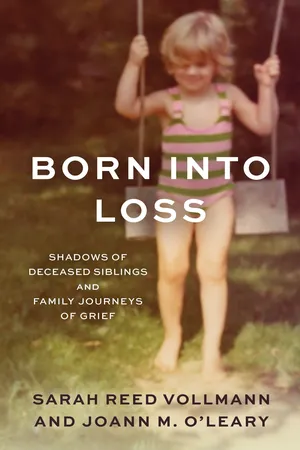
Born Into Loss
Shadows of a Deceased Sibling and Family Journeys of Grief
- 301 pages
- English
- PDF
- Available on iOS & Android
eBook - PDF
Born Into Loss
Shadows of a Deceased Sibling and Family Journeys of Grief
About this book
Information
Edition
1Table of contents
- Contents
- Acknowledgments
- Foreword
- Preface
- Chapter 1
- Chapter 2
- Chapter 3
- Chapter 4
- Chapter 5
- Chapter 6
- Chapter 7
- Chapter 8
- Chapter 9
- Chapter 10
- Chapter 11
- Chapter 12
- Chapter 13
- Chapter 14
- Chapter 15
- Chapter 16
- Chapter 17
- Chapter 18
- Chapter 19
- Chapter 20
- Notes
- Bibliography
- Index
- About the Authors
- 21
Trusted by 375,005 students
Access to over 1.5 million titles for a fair monthly price.
Study more efficiently using our study tools.