Focusing on the issue of the Oromo national struggle for liberation, statehood, and democracy, this book critically examines the dialectical relationship between Ethiopian colonialism and Oromo culture, epistemology, politics, and ideology in the context of the accumulated collective grievances of the Oromo nation. Specifically, the book identifies chains of sociological and historical factors that facilitated the development of Oromummaa (Oromo nationalism) and the Oromo national movement. It demonstrates how the Oromo national movement has been challenging and transforming Ethiopian imperial politics, tracks the different forms and phases of the movement, and maps out its future direction.
Currently, the Oromo are the largest ethno-national group and political minority in the Ethiopian Empire. They were colonized and incorporated into Ethiopia as colonial subjects in the last decades of the 19th century through the alliance of Abyssinian/Ethiopian colonialism and European imperialism. Since their colonization, the Oromo people have been treated as second-class citizens and have been economically exploited and culturally and politically suppressed. Despite the fact that Oromo resistance to Ethiopian colonialism existed during the process of their colonization and subjugation, it was only in the 1960s and 1970s that Oromo nationalists initiated organized efforts to liberate their people. Presently, Oromo nationalism plays a central role in Ethiopian politics.
eBook - PDF
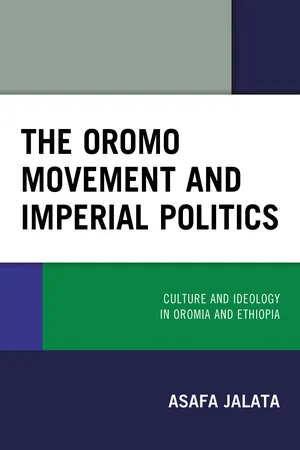
The Oromo Movement and Imperial Politics
Culture and Ideology in Oromia and Ethiopia
- 211 pages
- English
- PDF
- Available on iOS & Android
eBook - PDF
About this book
Information
Table of contents
- Contents
- Preface
- Acknowledgments
- Chapter One: Introduction
- Chapter Two: The Oromo Epistemology, Agency, and Movement
- Chapter Three: The Oromo Nation
- Chapter Four: The Oromo National Movement and Gross Human Rights Violations
- Chapter Five: Theorizing Oromummaa
- Chapter Six: Gadaa/Siqqee as the Fountain of Oromummaa and the Theoretical Base of Oromo Liberation
- Chapter Seven: The Oromo Movement
- Chapter Eight: Politico-Cultural Prerequisites for Protecting the Oromo National Interest
- Chapter Nine: The Challenges of Building Oromo National Institutions
- References
- Index
- About the Author
Trusted by 375,005 students
Access to over 1.5 million titles for a fair monthly price.
Study more efficiently using our study tools.
Frequently asked questions
Yes, you can cancel anytime from the Subscription tab in your account settings on the Perlego website. Your subscription will stay active until the end of your current billing period. Learn how to cancel your subscription
No, books cannot be downloaded as external files, such as PDFs, for use outside of Perlego. However, you can download books within the Perlego app for offline reading on mobile or tablet. Learn how to download books offline
Perlego offers two plans: Essential and Complete
- Essential is ideal for learners and professionals who enjoy exploring a wide range of subjects. Access the Essential Library with 800,000+ trusted titles and best-sellers across business, personal growth, and the humanities. Includes unlimited reading time and Standard Read Aloud voice.
- Complete: Perfect for advanced learners and researchers needing full, unrestricted access. Unlock 1.5M+ books across hundreds of subjects, including academic and specialized titles. The Complete Plan also includes advanced features like Premium Read Aloud and Research Assistant.
We are an online textbook subscription service, where you can get access to an entire online library for less than the price of a single book per month. With over 1.5 million books across 990+ topics, we’ve got you covered! Learn about our mission
Look out for the read-aloud symbol on your next book to see if you can listen to it. The read-aloud tool reads text aloud for you, highlighting the text as it is being read. You can pause it, speed it up and slow it down. Learn more about Read Aloud
Yes! You can use the Perlego app on both iOS and Android devices to read anytime, anywhere — even offline. Perfect for commutes or when you’re on the go.
Please note we cannot support devices running on iOS 13 and Android 7 or earlier. Learn more about using the app
Please note we cannot support devices running on iOS 13 and Android 7 or earlier. Learn more about using the app
Yes, you can access The Oromo Movement and Imperial Politics by Asafa Jalata in PDF and/or ePUB format, as well as other popular books in Politics & International Relations & African History. We have over 1.5 million books available in our catalogue for you to explore.