Journalists are trained to tell the stories of others and leave themselves out of their writing. Student journalists are no different. They spend their days on their college newspaper writing about what happens to others, especially when what is happening involves protests, sit-ins, riots, hunger strikes and other unrest on the very campuses where they also attend school. Now some of these former student reporters and editors tell their own stories of some of the challenges all student journalists face in reporting events that most administrators would rather see not covered at all.
For some, this is the first time the stories of what happened in the newsrooms and behind the scenes will appear in print. Some of the issues they discuss include censorship, the role of the newspaper as the conscience of the community, objective and activist journalism and the challenges of reporting crises. The protests covered here represent the many concerns college student protesters have tackled through the decades: integration in 1962, the free speech movement of 1964, racial issues and the Vietnam War in 1968 and 1970, and continuing racial issues in the present.
Many of these former student journalists look back decades to their work in the 1960s. Some discuss a more recent protest. Looking back, they admit they might have done things differently if they had to do it again, yet all are fiercely proud of the work they did in recording the first version of history.
- 217 pages
- English
- PDF
- Available on iOS & Android
eBook - PDF
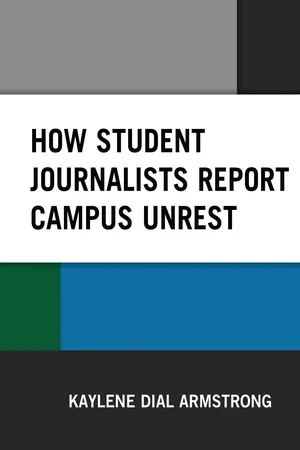
How Student Journalists Report Campus Unrest
About this book
Information
Table of contents
- Contents
- Introduction
- 1 In the Beginning
- 2 Nobody Told Us What to Write
- 3 The Campus Conscience
- 4 Two Faces of Journalism
- 5 Lessons from Reporting Crisis
- 6 Different Decade, Same Challenges
- 7 Telling Their Own Stories
- References
- Index
- About the Author
Trusted by 375,005 students
Access to over 1.5 million titles for a fair monthly price.
Study more efficiently using our study tools.
Frequently asked questions
Yes, you can cancel anytime from the Subscription tab in your account settings on the Perlego website. Your subscription will stay active until the end of your current billing period. Learn how to cancel your subscription
No, books cannot be downloaded as external files, such as PDFs, for use outside of Perlego. However, you can download books within the Perlego app for offline reading on mobile or tablet. Learn how to download books offline
Perlego offers two plans: Essential and Complete
- Essential is ideal for learners and professionals who enjoy exploring a wide range of subjects. Access the Essential Library with 800,000+ trusted titles and best-sellers across business, personal growth, and the humanities. Includes unlimited reading time and Standard Read Aloud voice.
- Complete: Perfect for advanced learners and researchers needing full, unrestricted access. Unlock 1.5M+ books across hundreds of subjects, including academic and specialized titles. The Complete Plan also includes advanced features like Premium Read Aloud and Research Assistant.
We are an online textbook subscription service, where you can get access to an entire online library for less than the price of a single book per month. With over 1.5 million books across 990+ topics, we’ve got you covered! Learn about our mission
Look out for the read-aloud symbol on your next book to see if you can listen to it. The read-aloud tool reads text aloud for you, highlighting the text as it is being read. You can pause it, speed it up and slow it down. Learn more about Read Aloud
Yes! You can use the Perlego app on both iOS and Android devices to read anytime, anywhere — even offline. Perfect for commutes or when you’re on the go.
Please note we cannot support devices running on iOS 13 and Android 7 or earlier. Learn more about using the app
Please note we cannot support devices running on iOS 13 and Android 7 or earlier. Learn more about using the app
Yes, you can access How Student Journalists Report Campus Unrest by Kaylene Dial Armstrong in PDF and/or ePUB format, as well as other popular books in Politics & International Relations & History of Education. We have over 1.5 million books available in our catalogue for you to explore.