- 247 pages
- English
- PDF
- Available on iOS & Android
eBook - PDF
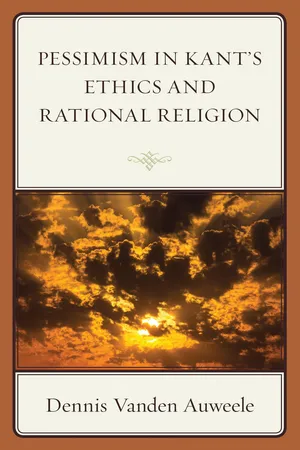
Pessimism in Kant's Ethics and Rational Religion
About this book
The historical period of the Enlightenment is usually thought of as the high point of philosophical optimism. By breaking the chains of traditional heteronomous morality, the tutelage of dogmatic religion and the oppression of authoritarian politics, the Enlightenment created the space for a new, self-critical and autonomous frame of reference for human effort. Immanuel Kant is undoubtedly the greatest philosopher in the German Enlightenment. And Kant was a pessimist? In this book, the author explores Kant's moral and religious philosophy and shows that a pessimistic undercurrent pervades these. This provides a new vantage point not only to assess comprehensively Kantian philosophy but also to provide much needed context and reading assistance to the general premises of Kant's philosophy of autonomy and rationality. For Kant, to be autonomous and rational is not something human nature naturally pursues; instead, reason but must reframe, rethink and reshape human nature. Human nature is a problem, autonomy and rationality are the solution. Kant's subsequent attempts to establish a rational religion can be explained in extension of this problem. Since human beings are not naturally prone to act autonomously, they have to be educated through historical institutions that are reformed appropriately so as to provide the incentives for human beings to become autonomous. This is where Kant believed religion could play an important pedagogical function.
Information
Topic
PhilosophySubtopic
PhilosophersTable of contents
- Cover
- Pessimism in Kant’sEthics and RationalReligion
- Pessimism in Kant’s Ethics and Rational Religion
- Copyright page
- Contents
- List of Abbreviations
- Acknowledgments
- Introduction
- Chapter 1
- Pessimism, Theodicy, and the Protestant Factor
- Chapter 2
- Grounding Morality in Duty and Autonomy
- Chapter 3
- Motivating Morality by Respect
- Chapter 4
- Natural (In)Aptitude for Morality
- Interlude
- Chapter 5
- Religious Assistance through Moral Education
- Chapter 6
- Kantian Christianity, Sincerity, and Pessimism
- Conclusion
- Bibliography
- Index
- About the Author
Trusted by 375,005 students
Access to over 1.5 million titles for a fair monthly price.
Study more efficiently using our study tools.
Frequently asked questions
Yes, you can cancel anytime from the Subscription tab in your account settings on the Perlego website. Your subscription will stay active until the end of your current billing period. Learn how to cancel your subscription
No, books cannot be downloaded as external files, such as PDFs, for use outside of Perlego. However, you can download books within the Perlego app for offline reading on mobile or tablet. Learn how to download books offline
Perlego offers two plans: Essential and Complete
- Essential is ideal for learners and professionals who enjoy exploring a wide range of subjects. Access the Essential Library with 800,000+ trusted titles and best-sellers across business, personal growth, and the humanities. Includes unlimited reading time and Standard Read Aloud voice.
- Complete: Perfect for advanced learners and researchers needing full, unrestricted access. Unlock 1.5M+ books across hundreds of subjects, including academic and specialized titles. The Complete Plan also includes advanced features like Premium Read Aloud and Research Assistant.
We are an online textbook subscription service, where you can get access to an entire online library for less than the price of a single book per month. With over 1.5 million books across 990+ topics, we’ve got you covered! Learn about our mission
Look out for the read-aloud symbol on your next book to see if you can listen to it. The read-aloud tool reads text aloud for you, highlighting the text as it is being read. You can pause it, speed it up and slow it down. Learn more about Read Aloud
Yes! You can use the Perlego app on both iOS and Android devices to read anytime, anywhere — even offline. Perfect for commutes or when you’re on the go.
Please note we cannot support devices running on iOS 13 and Android 7 or earlier. Learn more about using the app
Please note we cannot support devices running on iOS 13 and Android 7 or earlier. Learn more about using the app
Yes, you can access Pessimism in Kant's Ethics and Rational Religion by Dennis Vanden Auweele in PDF and/or ePUB format, as well as other popular books in Philosophy & Philosophers. We have over 1.5 million books available in our catalogue for you to explore.