- 241 pages
- English
- PDF
- Available on iOS & Android
eBook - PDF
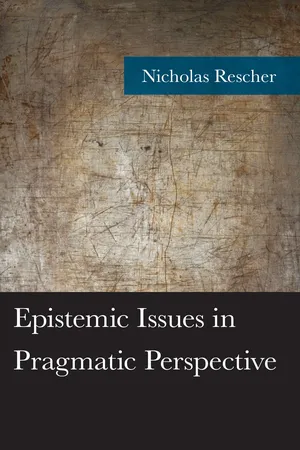
Epistemic Issues in Pragmatic Perspective
About this book
This book presents a nonstandard approach to epistemology. Where standard epistemology generally focuses on the certain knowledge the Greeks called epistêmê, the present focus is on some less assured modes of information. Its deliberations will focus on such cognitively suboptimal processes as conjecture, guesswork, and plausible supposition. This shift of focus has implications for virtually every sector of information management, and the book's instigations presented here will explore some of them. Throughout the rule of pragmatic considerations stand in the foreground.As the book's deliberations set out in detail, the nature of our knowledge of reality is inherently conditioned by the fact of its beings the product of what is, at best and at most, a matter of rational guesswork. And so as regards our knowledge, we had best adopt the pragmatic optimism of expecting—and hoping—that our best is good enough.
Information
Topic
PhilosophySubtopic
Epistemology in PhilosophyTable of contents
- Cover
- Epistemic Issues in Pragmatic Perspective
- Epistemic Issues in Pragmatic Perspective
- Contents
- Preface
- Introduction
- Chapter 1
- Sensible Conjecture
- Chapter 2
- Imprecision
- Chapter 3
- Truth-Contextuality and Plausibility
- Chapter 4
- Managing Imperfect Information
- Chapter 5
- Common Sense
- Chapter 6
- On Terminating an Explanatory Regress
- Chapter 7
- Quantitative Epistemology
- Chapter 8
- On Kinds of Things and Cognitive Idealism
- Chapter 9
- Prediction and Knowability
- Chapter 10
- Cognitive Fashions
- Chapter 11
- Problems of Absolute Truth
- Chapter 12
- Unethical Beliefs and Reprehensible Opinions
- Chapter 13
- Culpable Ignorance
- Chapter 14
- Epistemic Triage
- Chapter 15
- Inconceivable Possibilities
- Chapter 16
- Optimalism in Explaining the Nature of Things
- Chapter 17
- Conclusion
- Name Index
- About the Author
Trusted by 375,005 students
Access to over 1.5 million titles for a fair monthly price.
Study more efficiently using our study tools.
Frequently asked questions
Yes, you can cancel anytime from the Subscription tab in your account settings on the Perlego website. Your subscription will stay active until the end of your current billing period. Learn how to cancel your subscription
No, books cannot be downloaded as external files, such as PDFs, for use outside of Perlego. However, you can download books within the Perlego app for offline reading on mobile or tablet. Learn how to download books offline
Perlego offers two plans: Essential and Complete
- Essential is ideal for learners and professionals who enjoy exploring a wide range of subjects. Access the Essential Library with 800,000+ trusted titles and best-sellers across business, personal growth, and the humanities. Includes unlimited reading time and Standard Read Aloud voice.
- Complete: Perfect for advanced learners and researchers needing full, unrestricted access. Unlock 1.5M+ books across hundreds of subjects, including academic and specialized titles. The Complete Plan also includes advanced features like Premium Read Aloud and Research Assistant.
We are an online textbook subscription service, where you can get access to an entire online library for less than the price of a single book per month. With over 1.5 million books across 990+ topics, we’ve got you covered! Learn about our mission
Look out for the read-aloud symbol on your next book to see if you can listen to it. The read-aloud tool reads text aloud for you, highlighting the text as it is being read. You can pause it, speed it up and slow it down. Learn more about Read Aloud
Yes! You can use the Perlego app on both iOS and Android devices to read anytime, anywhere — even offline. Perfect for commutes or when you’re on the go.
Please note we cannot support devices running on iOS 13 and Android 7 or earlier. Learn more about using the app
Please note we cannot support devices running on iOS 13 and Android 7 or earlier. Learn more about using the app
Yes, you can access Epistemic Issues in Pragmatic Perspective by Nicholas Rescher in PDF and/or ePUB format, as well as other popular books in Philosophy & Epistemology in Philosophy. We have over 1.5 million books available in our catalogue for you to explore.