- 261 pages
- English
- PDF
- Available on iOS & Android
eBook - PDF
About this book
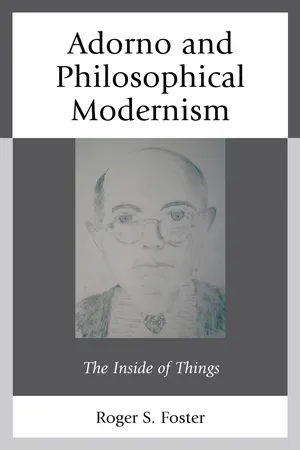
Adorno and Philosophical Modernism: The Inside of Things offers an original interpretation and vigorous defense of Theodor Adorno's idea of philosophy as the practice of what Roger Foster calls "philosophical modernism." Adorno's philosophical writings, from the early 1930s to the mature works of the late 1960s, are deeply informed by a distinctively modernist vision of human experience. This book seeks to establish that Adorno's unique and lasting contribution to philosophy consists in his sustained and rigorous development of this modernist vision into an encompassing practice of philosophical interpretation. The essential features of this vision can be discerned in all of Adorno's major writings in philosophy, social theory, and aesthetics. Its defining element is the idea of a pattern underlying ordinary experience, which, although not directly accessible, can be disclosed by the reconstructive work of philosophical or literary language. This vision, Foster argues, can be discerned in the major works of literary modernism (including Woolf, Proust, and Musil) as well as in the interpretive technique of psychoanalysis developed by Sigmund Freud. The importance of Adorno's contribution to twentieth-century philosophy can only be fully appreciated by understanding how he developed this vision into an overarching practice of philosophical interpretation that furnished a coherent and profound response to the decay of experience afflicting late-modern societies. In this book, Foster expounds that interpretive practice, exploring its ramifications and, in particular, its relation with literary modernism, and places it in critical dialogue with alternative philosophical responses.
Information
Topic
PhilosophySubtopic
Aesthetics in PhilosophyTable of contents
- Contents
- Abbreviations
- Acknowledgments
- Introduction: Why Adorno, Today?
- Chapter One: Philosophical Modernism
- Chapter Two: Adorno and Heidegger on Language and the Inexpressible
- Chapter Three: Philosophy in the Open
- Chapter Four: Language and Aesthetic Experience
- Chapter Five: The Internal History of Truth
- Chapter Six: Modernist Ethics: Musil and Adorno
- Chapter Seven: Virginia Woolf: Literature and Aesthetic Experience
- Conclusion: Modernist Criticism
- Bibliography
- Index
Trusted by 375,005 students
Access to over 1.5 million titles for a fair monthly price.
Study more efficiently using our study tools.
Frequently asked questions
Yes, you can cancel anytime from the Subscription tab in your account settings on the Perlego website. Your subscription will stay active until the end of your current billing period. Learn how to cancel your subscription
No, books cannot be downloaded as external files, such as PDFs, for use outside of Perlego. However, you can download books within the Perlego app for offline reading on mobile or tablet. Learn how to download books offline
We are an online textbook subscription service, where you can get access to an entire online library for less than the price of a single book per month. With over 1.5 million books across 990+ topics, we’ve got you covered! Learn about our mission
Look out for the read-aloud symbol on your next book to see if you can listen to it. The read-aloud tool reads text aloud for you, highlighting the text as it is being read. You can pause it, speed it up and slow it down. Learn more about Read Aloud
Yes! You can use the Perlego app on both iOS and Android devices to read anytime, anywhere — even offline. Perfect for commutes or when you’re on the go.
Please note we cannot support devices running on iOS 13 and Android 7 or earlier. Learn more about using the app
Please note we cannot support devices running on iOS 13 and Android 7 or earlier. Learn more about using the app
Yes, you can access Adorno and Philosophical Modernism by Roger S. Foster in PDF and/or ePUB format, as well as other popular books in Philosophy & Aesthetics in Philosophy. We have over 1.5 million books available in our catalogue for you to explore.