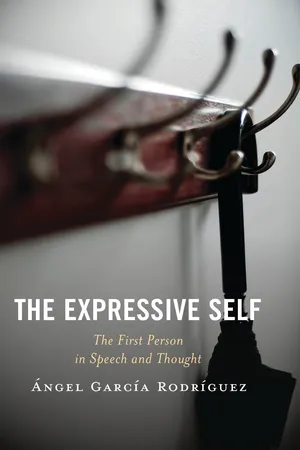
Expression is typically construed as a relation between two ontologically distinct items—namely, a vehicle and a content—but it is better construed non-relationally, since the content is an intrinsic aspect or quality of the expressive vehicle. Upon this basis, The Expressive Self: The First Person in Speech and Thought argues that the distinctive nature of the first-person perspective must be accounted for in expressive, rather than epistemic, terms. For though others can report on what one expresses, one alone is able to non-relationally express oneself; one alone is able to produce vehicles that are episodes of one's self-consciousness.
According to Ángel García Rodríguez, the ensuing expressive model of the self provides clarity on some prominent contemporary puzzles, notably Moore's paradox, self-deception, and McKinsey's paradox, given the duality of non-relationally expressive and reporting uses of the underlying first-person claims. Moreover, the phenomena of self-reference and first-person authority, both psychological and bodily, pose no objection to the model.
Throughout, the author engages critically with alternative conceptions of the self, delivering a novel account that helps advance the debate about the nature of the self and of the first person.
- 217 pages
- English
- PDF
- Available on iOS & Android
eBook - PDF
About this book
Information
Topic
PhilosophySubtopic
Epistemology in PhilosophyTable of contents
- Cover
- Half Title
- Title Page
- Copyright Page
- Contents
- Acknowledgments
- Introduction
- Part I: Models
- Part I: Models
- Chapter 1: Special Access
- Chapter 2: Expression
- Part II: Puzzles
- Part II: Puzzles
- Chapter 3: Moore’s Paradox
- Chapter 4: Self-Deception
- Chapter 5: McKinsey’s Paradox
- Part III: Challenges
- Part III: Challenges
- Chapter 6: Self-Reference
- Chapter 7: First-Person Authority
- Conclusion: The Expressive Self
- References
- Index
- About the Author
Trusted by 375,005 students
Access to over 1.5 million titles for a fair monthly price.
Study more efficiently using our study tools.
Frequently asked questions
Yes, you can cancel anytime from the Subscription tab in your account settings on the Perlego website. Your subscription will stay active until the end of your current billing period. Learn how to cancel your subscription
No, books cannot be downloaded as external files, such as PDFs, for use outside of Perlego. However, you can download books within the Perlego app for offline reading on mobile or tablet. Learn how to download books offline
Perlego offers two plans: Essential and Complete
- Essential is ideal for learners and professionals who enjoy exploring a wide range of subjects. Access the Essential Library with 800,000+ trusted titles and best-sellers across business, personal growth, and the humanities. Includes unlimited reading time and Standard Read Aloud voice.
- Complete: Perfect for advanced learners and researchers needing full, unrestricted access. Unlock 1.5M+ books across hundreds of subjects, including academic and specialized titles. The Complete Plan also includes advanced features like Premium Read Aloud and Research Assistant.
We are an online textbook subscription service, where you can get access to an entire online library for less than the price of a single book per month. With over 1.5 million books across 990+ topics, we’ve got you covered! Learn about our mission
Look out for the read-aloud symbol on your next book to see if you can listen to it. The read-aloud tool reads text aloud for you, highlighting the text as it is being read. You can pause it, speed it up and slow it down. Learn more about Read Aloud
Yes! You can use the Perlego app on both iOS and Android devices to read anytime, anywhere — even offline. Perfect for commutes or when you’re on the go.
Please note we cannot support devices running on iOS 13 and Android 7 or earlier. Learn more about using the app
Please note we cannot support devices running on iOS 13 and Android 7 or earlier. Learn more about using the app
Yes, you can access The Expressive Self by Ángel García Rodríguez in PDF and/or ePUB format, as well as other popular books in Philosophy & Epistemology in Philosophy. We have over 1.5 million books available in our catalogue for you to explore.