This edited volume is the first publication to tackle the issue of researching human-technology relations from a methodological postphenomenological perspective. While the 'traditional' phenomenology of the 20th century, with figures like Husserl, Heidegger and Merleau-Ponty, provided valuable insights into the formal structures of essence, being and embodiment, etc. their mode of philosophizing mostly involved abstract 'pure' thinking. Although rooted in this tradition, the postphenomenological approach to the study of human-technology relations emphasizes the "empirical turn" and interdisciplinary work in the field of philosophy – and reaches out to other disciplines like anthropology, education, media studies, and science and technology studies (STS).
The contributors discuss what it means for the field of postphenomenology to be empirically based and what kind of methodology is required in order for researchers to go out and study human-technology relations in this perspective. In many disciplines, methodology refers to the analytical approach taken – e.g. the analytical concepts you employ to make an analysis; in postphenomenology, these might include concepts such as multistability, variation, or mediation. In a discipline like anthropology, it also refers to reflections over the methods researchers use to approach an empirical field. Methods can include interviews of different kinds, participant observations, surveys, and auto-ethnography. Furthermore, methodology can include ethical issues tied to doing research in an empirical field. These practical aspects are not separate from, but rather connected to, theoretical approaches. This book ties together the methods, ethics, and theories of postphenomenology in a groundbreaking volume on methodology. With postphenomenological studies of education, digital media, biohacking, health, robotics, and skateboarding as points of reference, the authors of this volume, in twelve chapters, provide new perspectives on what a comprehensive postphenomenological research methodology must consist of.
eBook - PDF
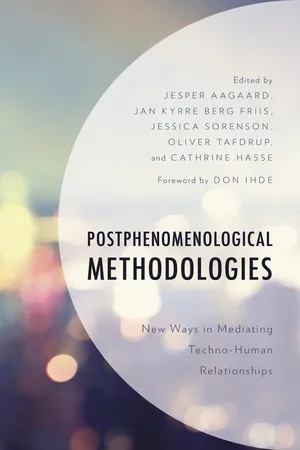
Postphenomenological Methodologies
New Ways in Mediating Techno-Human Relationships
- 295 pages
- English
- PDF
- Available on iOS & Android
eBook - PDF
Postphenomenological Methodologies
New Ways in Mediating Techno-Human Relationships
About this book
Information
Topic
EducationSubtopic
Education TechnologyTable of contents
- Cover
- Postphenomenological Methodologies
- Postphenomenological Methodologies: New Ways in Mediating Techno-Human Relationships
- Copyright page
- Contents
- Foreword
- An Introduction toPostphenomenological Methodologies
- Educational Technologies
- Introduction
- Introduction
- Self-Tracking and Imaging Technologies
- Introduction
- Robotic Technologies
- Introduction
- Introduction
- General Methodological Issues
- Introduction
- Introduction
- Introduction
- Index
- List of Contributors
Trusted by 375,005 students
Access to over 1.5 million titles for a fair monthly price.
Study more efficiently using our study tools.
Frequently asked questions
Yes, you can cancel anytime from the Subscription tab in your account settings on the Perlego website. Your subscription will stay active until the end of your current billing period. Learn how to cancel your subscription
No, books cannot be downloaded as external files, such as PDFs, for use outside of Perlego. However, you can download books within the Perlego app for offline reading on mobile or tablet. Learn how to download books offline
Perlego offers two plans: Essential and Complete
- Essential is ideal for learners and professionals who enjoy exploring a wide range of subjects. Access the Essential Library with 800,000+ trusted titles and best-sellers across business, personal growth, and the humanities. Includes unlimited reading time and Standard Read Aloud voice.
- Complete: Perfect for advanced learners and researchers needing full, unrestricted access. Unlock 1.5M+ books across hundreds of subjects, including academic and specialized titles. The Complete Plan also includes advanced features like Premium Read Aloud and Research Assistant.
We are an online textbook subscription service, where you can get access to an entire online library for less than the price of a single book per month. With over 1.5 million books across 990+ topics, we’ve got you covered! Learn about our mission
Look out for the read-aloud symbol on your next book to see if you can listen to it. The read-aloud tool reads text aloud for you, highlighting the text as it is being read. You can pause it, speed it up and slow it down. Learn more about Read Aloud
Yes! You can use the Perlego app on both iOS and Android devices to read anytime, anywhere — even offline. Perfect for commutes or when you’re on the go.
Please note we cannot support devices running on iOS 13 and Android 7 or earlier. Learn more about using the app
Please note we cannot support devices running on iOS 13 and Android 7 or earlier. Learn more about using the app
Yes, you can access Postphenomenological Methodologies by Jesper Aagaard,Jan Kyrre Berg Friis,Jessica Sorenson,Oliver Tafdrup,Cathrine Hasse in PDF and/or ePUB format, as well as other popular books in Education & Education Technology. We have over 1.5 million books available in our catalogue for you to explore.