The capacity for reasonable argument about practical and political matters is important to our daily lives. Yet what does arguing really involve? Often, our very concept of what it is to argue seems systematically distorted. Practical, political arguing is too often stylized as hyper-cognitive, ending by treating people as objects rather than other selves — in ways that are fundamentally unreasonable.
This book examines what follows from seeing people as deliberating and acting in ways that intertwine a variety of emotional and evaluative processes and effects of virtue or character. From this point of view, practical arguing involves not just cognition, emotion, and virtue, but also practices, including imaginative practices. Politics of Practical Reasoning: Integrating Action, Discourse and Argument uses these ideas to interrogate ways in which reasoning is bound up with the interrelated lives that human beings lead in their everyday, public and political worlds.
We build here on efforts to re-concretize practical reasoning in modern traditions linked to phenomenology and Wittgensteinian thought, also referring back to Aristotle and the Stoics in classical times. Medieval theologians and philosophers such as Aquinas confront the same issue, as do Enlightenment thinkers such as Smith and Kant. Using the history of philosophical thought as one of our major sources, the contributors sympathize with the link underscored between interpretation, tradition and reasoning by Gadamer, the stress placed on communicative and emancipatory action by Habermas, and MacIntyre's notion of praxis as highlighting deliberation within communities. All these approaches respond to practical reasoning as practical.
Building on these points of view, the volume both explores what practical reasoning itself means, and applies it to particular questions: what it means to respond to arguments about meaningful work or disability, or how to debate institutional ethics or art. None of these debates is susceptible to exclusively cognitive or technical solutions; this does not mean abandoning them to unreason.
Practical and political reasoning is examined here from an appropriately broad spectrum of approaches, founded in a concern for what human reasoning can justifiably be expected to involve, and what justifying it can reasonably be expected to achieve.
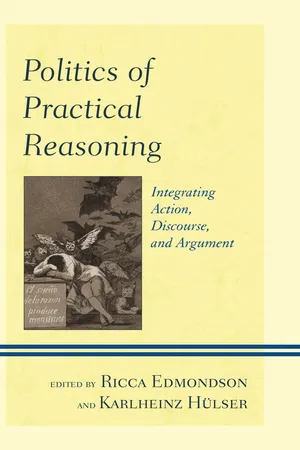
eBook - ePub
Politics of Practical Reasoning
Integrating Action, Discourse, and Argument
- English
- ePUB (mobile friendly)
- Available on iOS & Android
eBook - ePub
Politics of Practical Reasoning
Integrating Action, Discourse, and Argument
About this book
Information
Topic
PhilosophySubtopic
Ethics & Moral PhilosophyTable of contents
- Contents
- Preface
- Introduction
- Part I: Fundamental Structures of Practical Reasoning
- Chapter 1: Aristotle’s Political Anthropology
- Chapter 2: Pragmatics and the Idea of the Illocutionary in Stoic Language Theory
- Chapter 3: Utrum gratitudo sit virtus moralis vel passio animae, or: Gratitude—An Aristotelian Virtue or an Emotion?
- Chapter 4: Seeing Ourselves as Others See Us
- Chapter 5: Reasons to Act and Practical Reasoning
- Part II: Developing Convincing Arguments
- Chapter 6: Practical Reasoning in Place
- Chapter 7: Toulmin’s Rhetorical Logic
- Chapter 8: Reason, Production, and Rival Visions of Working Life
- Chapter 9: Reasoning About Disability in the Light of Advances in Technology
- Chapter 10: Principles in Practice
- Part III: Engagement for the Practical Unity of Life
- Chapter 11: The Theory of Double Truth Revisited
- Chapter 12: Philosophia sine qua non
- Chapter 13: Skeptical Wisdom
- Chapter 14: Art as “Organizer” of Life
- Afterword
- About the Contributors
Trusted by 375,005 students
Access to over 1.5 million titles for a fair monthly price.
Study more efficiently using our study tools.
Frequently asked questions
Yes, you can cancel anytime from the Subscription tab in your account settings on the Perlego website. Your subscription will stay active until the end of your current billing period. Learn how to cancel your subscription
No, books cannot be downloaded as external files, such as PDFs, for use outside of Perlego. However, you can download books within the Perlego app for offline reading on mobile or tablet. Learn how to download books offline
Perlego offers two plans: Essential and Complete
- Essential is ideal for learners and professionals who enjoy exploring a wide range of subjects. Access the Essential Library with 800,000+ trusted titles and best-sellers across business, personal growth, and the humanities. Includes unlimited reading time and Standard Read Aloud voice.
- Complete: Perfect for advanced learners and researchers needing full, unrestricted access. Unlock 1.5M+ books across hundreds of subjects, including academic and specialized titles. The Complete Plan also includes advanced features like Premium Read Aloud and Research Assistant.
We are an online textbook subscription service, where you can get access to an entire online library for less than the price of a single book per month. With over 1.5 million books across 990+ topics, we’ve got you covered! Learn about our mission
Look out for the read-aloud symbol on your next book to see if you can listen to it. The read-aloud tool reads text aloud for you, highlighting the text as it is being read. You can pause it, speed it up and slow it down. Learn more about Read Aloud
Yes! You can use the Perlego app on both iOS and Android devices to read anytime, anywhere — even offline. Perfect for commutes or when you’re on the go.
Please note we cannot support devices running on iOS 13 and Android 7 or earlier. Learn more about using the app
Please note we cannot support devices running on iOS 13 and Android 7 or earlier. Learn more about using the app
Yes, you can access Politics of Practical Reasoning by Ricca Edmondson,Karlheinz Hülser in PDF and/or ePUB format, as well as other popular books in Philosophy & Ethics & Moral Philosophy. We have over 1.5 million books available in our catalogue for you to explore.