For almost 60 years, the United States government has sent more than 230,000 of its citizens abroad to serve as Peace Corps Volunteers (PCVs) for two-year tours, often in very poor countries. As these Volunteers work in grassroots development, helping to build local capacity, they also serve as citizen diplomats and contribute to U.S. public diplomacy. The unique experience of the Peace Corps provides the Volunteers knowledge and a profound understanding of another country or region of the world. Volunteers continue to serve their country as they bring their experience and knowledge back to the United States. Many of them go on to serve in the State Department and in the United States Agency for International Development. Some have even risen to the top ranks of the Foreign Service.
Thomas Nisley argues that the Peace Corps is an important tool of U.S. foreign policy that contributes on multiple levels. As these citizen diplomats do their work, they help to improve the popular image of the United States, contributing to U.S. "soft power." Soft power is a co-optive power, getting others to want what you want.
After a general exploration of how the Peace Corps contributes to U.S. foreign policy, the book takes a direct focus on Latin America. Dr. Nisley provides evidence, along with a theoretical explanation, that PCVs do indeed improve the popular perception of the United States in Latin America. He then examines three different periods in U.S foreign policy toward Latin America and shows how the Peace Corps made its contribution.
Not all U.S. policy makers have equally recognized the role of the Peace Corps in U.S. foreign policy. Some have even dismissed it outright. This book argues that the Peace Corps plays an important role in U.S. foreign policy. Although the Peace Corps is much stronger today than it was in the late 1970s and early 1980s, U.S. foreign policy would be well served if the Peace Corps were further strengthen and expanded, not only in Latin America but in the world. We should consider the wider policy benefits of the Peace Corps.
eBook - PDF
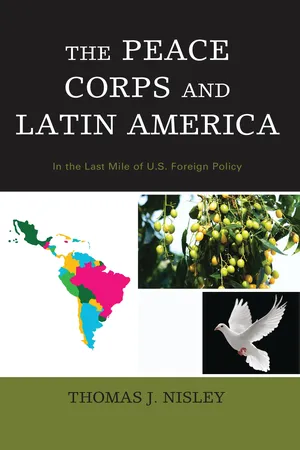
The Peace Corps and Latin America
In the Last Mile of U.S. Foreign Policy
- 159 pages
- English
- PDF
- Available on iOS & Android
eBook - PDF
About this book
Information
Table of contents
- Table of Contents
- Acknowledgments
- Preface
- 1 The Peace Corps Idea
- 2 The Peace Corps as an Instrument of U.S. Foreign Policy
- 3 The Contact Hypothesis, the Peace Corps, and the Popular Perception of the United States in Latin America
- 4 Peace Corps, the Cold War, and Latin America
- 5 Reagan, the Peace Corps, and the Civil Wars in Central America
- 6 The Rise and Decline of the Peace Corps in Post–Cold War Latin America
- 7 Conclusion
- Bibliography
- Index
- About the Author
Trusted by 375,005 students
Access to over 1.5 million titles for a fair monthly price.
Study more efficiently using our study tools.
Frequently asked questions
Yes, you can cancel anytime from the Subscription tab in your account settings on the Perlego website. Your subscription will stay active until the end of your current billing period. Learn how to cancel your subscription
No, books cannot be downloaded as external files, such as PDFs, for use outside of Perlego. However, you can download books within the Perlego app for offline reading on mobile or tablet. Learn how to download books offline
Perlego offers two plans: Essential and Complete
- Essential is ideal for learners and professionals who enjoy exploring a wide range of subjects. Access the Essential Library with 800,000+ trusted titles and best-sellers across business, personal growth, and the humanities. Includes unlimited reading time and Standard Read Aloud voice.
- Complete: Perfect for advanced learners and researchers needing full, unrestricted access. Unlock 1.5M+ books across hundreds of subjects, including academic and specialized titles. The Complete Plan also includes advanced features like Premium Read Aloud and Research Assistant.
We are an online textbook subscription service, where you can get access to an entire online library for less than the price of a single book per month. With over 1.5 million books across 990+ topics, we’ve got you covered! Learn about our mission
Look out for the read-aloud symbol on your next book to see if you can listen to it. The read-aloud tool reads text aloud for you, highlighting the text as it is being read. You can pause it, speed it up and slow it down. Learn more about Read Aloud
Yes! You can use the Perlego app on both iOS and Android devices to read anytime, anywhere — even offline. Perfect for commutes or when you’re on the go.
Please note we cannot support devices running on iOS 13 and Android 7 or earlier. Learn more about using the app
Please note we cannot support devices running on iOS 13 and Android 7 or earlier. Learn more about using the app
Yes, you can access The Peace Corps and Latin America by Thomas J. Nisley in PDF and/or ePUB format, as well as other popular books in Politics & International Relations & International Relations. We have over 1.5 million books available in our catalogue for you to explore.