When Mount Auburn opened as the first "rural" cemetery in the United States in 1831, it represented a new way for Americans to think about burial sites. It broke with conventional notions about graveyards as places to bury and commemorate the dead. Rather, the founders of Mount Auburn and the spate of similar cemeteries that followed over the next three decades before the Civil War created institutions that they envisioned being used by the living in new ways. Cemeteries became places for leisure, communing with nature, and creating a version of collective memory. In fact, these cemeteries reflected changing values and attitudes of Americans spanning much of the nineteenth century. In the process, they became paradoxical: they were "rural" yet urban, natural yet designed, artistic yet industrial, commemorating the dead yet used by the living.
The Rural Cemetery Movement: Places of Paradox in Nineteenth-Century America breaks new ground in the history of cemeteries in the nineteenth century. This book examines these "rural" cemeteries modeled after Mount Auburn that were founded between the 1830s and 1850s. As such, it provides a new way of thinking about these spaces and new paradigm for seeing and visiting them. While they fulfilled the sacred function of burial, they were first and foremost businesses. The landscape and design, regulation of gravestones, appearance, and rhetoric furthered their role as a business that provided necessary services in cities that went well beyond merely burying bodies. They provided urban green spaces and respites from urban life, established institutions where people could craft their roles in collective memory, and served as prototypes for both urban planning and city parks.
These cemeteries grew and thrived in the second half of the nineteenth century; for most, the majority of their burials came before 1910. This expansion of cemeteries coincided with profound urban growth in the United States. Unlike their predecessors, founders of these burial grounds intended them to be used in many ways that reflected their views and values about nature, life and death, and relationships. Emphasis on worldly accomplishments increased with industrialization and growth in the United States, which was reflected in changing ways people commemorated their dead during the period under this study. Thus, these cemeteries are a prism through which to understand the values, attitudes, and culture of urban America from mid-century through the Progressive Era.
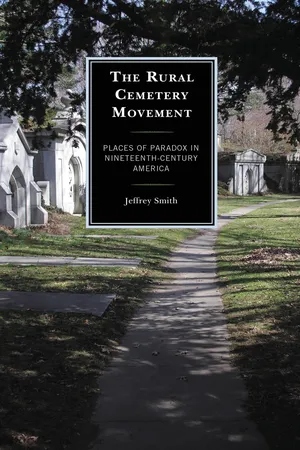
- 181 pages
- English
- PDF
- Available on iOS & Android
eBook - PDF
About this book
Information
Table of contents
- Cover
- The Rural Cemetery Movement
- The Rural Cemetery Movement
- Contents
- Acknowledgments
- Introduction
- Chapter 1
- Cemeteries as Sacred yet Secular
- Chapter 2
- Nature versus “Nature”
- Chapter 3
- Cemeteries as Urban Amenities
- Chapter 4
- The Cemetery Business
- Chapter 5
- Cemetery Design and Social Class
- Chapter 6
- Monuments, Commemoration, and Collective Memory
- Conclusion
- Bibliography
- Index
- About the Author
Trusted by 375,005 students
Access to over 1.5 million titles for a fair monthly price.
Study more efficiently using our study tools.
Frequently asked questions
Yes, you can cancel anytime from the Subscription tab in your account settings on the Perlego website. Your subscription will stay active until the end of your current billing period. Learn how to cancel your subscription
No, books cannot be downloaded as external files, such as PDFs, for use outside of Perlego. However, you can download books within the Perlego app for offline reading on mobile or tablet. Learn how to download books offline
Perlego offers two plans: Essential and Complete
- Essential is ideal for learners and professionals who enjoy exploring a wide range of subjects. Access the Essential Library with 800,000+ trusted titles and best-sellers across business, personal growth, and the humanities. Includes unlimited reading time and Standard Read Aloud voice.
- Complete: Perfect for advanced learners and researchers needing full, unrestricted access. Unlock 1.5M+ books across hundreds of subjects, including academic and specialized titles. The Complete Plan also includes advanced features like Premium Read Aloud and Research Assistant.
We are an online textbook subscription service, where you can get access to an entire online library for less than the price of a single book per month. With over 1.5 million books across 990+ topics, we’ve got you covered! Learn about our mission
Look out for the read-aloud symbol on your next book to see if you can listen to it. The read-aloud tool reads text aloud for you, highlighting the text as it is being read. You can pause it, speed it up and slow it down. Learn more about Read Aloud
Yes! You can use the Perlego app on both iOS and Android devices to read anytime, anywhere — even offline. Perfect for commutes or when you’re on the go.
Please note we cannot support devices running on iOS 13 and Android 7 or earlier. Learn more about using the app
Please note we cannot support devices running on iOS 13 and Android 7 or earlier. Learn more about using the app
Yes, you can access The Rural Cemetery Movement by Jeffrey Smith in PDF and/or ePUB format, as well as other popular books in History & American Civil War History. We have over 1.5 million books available in our catalogue for you to explore.