The Thinker's Guide to Scientific Thinking focuses on developing the intellectual skills inherent in the well-cultivated practice of every area of scientific research and study. It helps students and practicing scientists come to reason within the logic of science and to see the field as a cohesive whole.
From astronomers to zoologists and physicists to chemists, skilled scientists use careful analysis to question data, test theories, draw logical conclusions, and propose feasible solutions. Students in science courses, and scientists themselves will find their analytical abilities enhanced by the engaging framework of inquiry set forth by Richard Paul and Linda Elder in this guide.
As part of the Thinker's Guide Library, this book advances the mission of the Foundation for Critical Thinking to promote fairminded critical societies through cultivating essential intellectual abilities and virtues across every field of study across world.
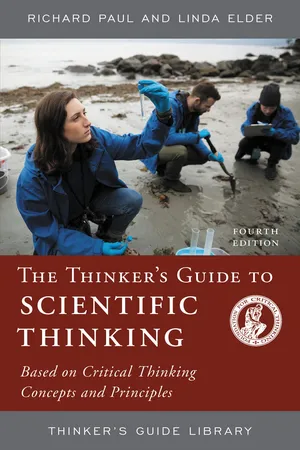
eBook - ePub
The Thinker's Guide to Scientific Thinking
Based on Critical Thinking Concepts and Principles
- English
- ePUB (mobile friendly)
- Available on iOS & Android
eBook - ePub
The Thinker's Guide to Scientific Thinking
Based on Critical Thinking Concepts and Principles
About this book
Information
Topic
EducationSubtopic
Education Theory & PracticeTable of contents
- Why Scientific Thinking?
- The Elements of Scientific Thought
- Questions Using the Elements of Scientific Thought
- A Checklist for Scientific Reasoning
- Scientific Thinking Seeks to Quantify, Explain, and Predict Relationships in Nature
- Universal Intellectual Standards Essential to Sound Scientific Thinking
- Intellectual Standards in Scientific Thinking
- The Figuring Mind Thinking Scientifically
- How to Analyze the Logic of a Scientific Article, Essay, or Chapter
- Analyzing the Logic of a Science Textbook
- Experimental Thinking Requires Experimental Controls
- The Logic of an Experiment
- Post Experiment Analysis
- How to Evaluate an Author’s or Experimenter’s Scientific Reasoning
- Two Kinds of Scientific Questions
- Asking One-System and Conflicting-System Questions
- Scientific Reasoning Abilities
- Analyzing & Assessing Scientific Research
- Purpose
- Questions at Issue or Central Problem
- Information
- Inference and Interpretation
- Assumptions
- Concepts and Ideas
- Point of View
- Implications and Consequences
- Intellectual Dispositions Essential to Scientific Thinking
- Scientific Thinkers Routinely Apply the Intellectual Standards
- Development of the Scientific Mind
- Analyzing the Logic of a Subject
- The Logic of Scientific Reasoning
- The Questioning Mind in Science
- The Logic of Science
- The Logic of Physics
- The Logic of Chemistry
- The Logic of Geology
- The Logic of Astronomy
- The Logic of Biology
- The Logic of Zoology
- The Logic of Botany
- The Logic of Biochemistry
- The Logic of Paleontology
- The Logic of Animal Physiology
- The Logic of Archaeology
- The Logic of Ecology
- The Problem of Pseudo-Scientific and Unscientific Thinking
- A Pseudo-Science: Why Astrology Is Not a Science
- A Critical Approach to Scientific Thinking
- Ethics and Science
- The Thinker’s Guide Library
Trusted by 375,005 students
Access to over 1.5 million titles for a fair monthly price.
Study more efficiently using our study tools.
Frequently asked questions
Yes, you can cancel anytime from the Subscription tab in your account settings on the Perlego website. Your subscription will stay active until the end of your current billing period. Learn how to cancel your subscription
No, books cannot be downloaded as external files, such as PDFs, for use outside of Perlego. However, you can download books within the Perlego app for offline reading on mobile or tablet. Learn how to download books offline
We are an online textbook subscription service, where you can get access to an entire online library for less than the price of a single book per month. With over 1.5 million books across 990+ topics, we’ve got you covered! Learn about our mission
Look out for the read-aloud symbol on your next book to see if you can listen to it. The read-aloud tool reads text aloud for you, highlighting the text as it is being read. You can pause it, speed it up and slow it down. Learn more about Read Aloud
Yes! You can use the Perlego app on both iOS and Android devices to read anytime, anywhere — even offline. Perfect for commutes or when you’re on the go.
Please note we cannot support devices running on iOS 13 and Android 7 or earlier. Learn more about using the app
Please note we cannot support devices running on iOS 13 and Android 7 or earlier. Learn more about using the app
Yes, you can access The Thinker's Guide to Scientific Thinking by Richard Paul,Linda Elder in PDF and/or ePUB format, as well as other popular books in Education & Education Theory & Practice. We have over 1.5 million books available in our catalogue for you to explore.