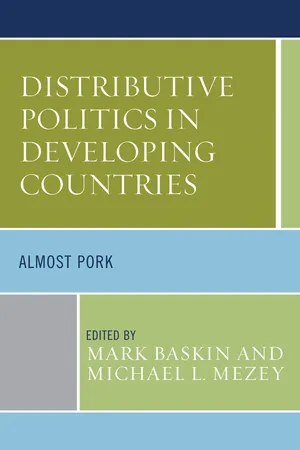
This book explores the increasing use of Constituency Development Funds (CDFs) in emerging democratic governments in Africa, Asia, the Caribbean, and Oceania. CDFs dedicate public money to benefit parliamentary constituencies through allocations and/or spending decisions influenced by Members of Parliament (MPs). The contributors employ the term CDF as a generic term although such funds have a different names, such as electoral development funds (Papua New Guinea), constituency development catalyst funds (Tanzania), or Member of Parliament Local Area Development Fund (India), etc.
In some ways, the funds resemble the ad hoc pork barrel policy-making employed in the U.S. Congress for the past 200 years. However, unlike earmarks, CDFs generally become institutionalized in the government's annual budget and are distributed according to different criteria in each country. They enable MPs to influence programs in their constituencies that finance education, and build bridges, roads, community centers, clinics and schools. In this sense, a CDF is a politicized form of spending that can help fill in the important gaps in government services in constituencies that have not been addressed in the government's larger, comprehensive policy programs.
This first comprehensive treatment of CDFs in the academic and development literatures emerges from a project at the State University of New York Center for International Development. This project has explored CDFs in 19 countries and has developed indicators on their emergence, operations, and oversight. The contributors provide detailed case studies of the emergence and operations of CDFs in Kenya, Uganda, Jamaica, and India, as well as an analysis of earmarks in the U.S. Congress, and a broader analysis of the emergence of the funds in Africa. They cover the emergence, institutionalization, and accountability of these funds; analyze key issues in their operations; and offer provisional conclusions of what the emergence and operations of these funds say about the democratization of politics in developing countries and current approaches to international support for democratic governance in developing countries.
- English
- ePUB (mobile friendly)
- Available on iOS & Android
eBook - ePub
About this book
Information
Table of contents
- Cover-Page
- Half-Title
- Title
- Copyright
- Contents
- Preface
- Acknowledgments
- 1 Introduction: Are Constituency Development Funds a Policy Tool?
- 2 Why CDFs in Africa? Representation vs. Constituency Service
- 3 Money for Small Things: Experience and Lessons of Kenya’s Constituency Development Fund
- 4 In Name Only: Uganda’s Constituency Development Fund
- 5 Earmarks in the United States
- 6 Drug Dons and the Development of Executive Driven Bi-Partisan CDFs in Jamaica
- 7 Constituency Needs, Constitutional Propriety and Clientelist Patronage: Constituency Development Funds in India
- 8 Conclusion: Constituency Development Funds and the Role of the Representative
- Appendix 1
- Appendix 2: CDF Variables
- Appendix 3: Code Sheet for CDF Institutionalization and Accountability Steps, by Country
- Appendix 4: Principles and Guidelines for Constituency Development Funds
- Appendix 5: CDF Toolbox
- Appendix 6: Tool #3: Public Participation
- Index
- About the Contributors
Trusted by 375,005 students
Access to over 1.5 million titles for a fair monthly price.
Study more efficiently using our study tools.
Frequently asked questions
Yes, you can cancel anytime from the Subscription tab in your account settings on the Perlego website. Your subscription will stay active until the end of your current billing period. Learn how to cancel your subscription
No, books cannot be downloaded as external files, such as PDFs, for use outside of Perlego. However, you can download books within the Perlego app for offline reading on mobile or tablet. Learn how to download books offline
Perlego offers two plans: Essential and Complete
- Essential is ideal for learners and professionals who enjoy exploring a wide range of subjects. Access the Essential Library with 800,000+ trusted titles and best-sellers across business, personal growth, and the humanities. Includes unlimited reading time and Standard Read Aloud voice.
- Complete: Perfect for advanced learners and researchers needing full, unrestricted access. Unlock 1.5M+ books across hundreds of subjects, including academic and specialized titles. The Complete Plan also includes advanced features like Premium Read Aloud and Research Assistant.
We are an online textbook subscription service, where you can get access to an entire online library for less than the price of a single book per month. With over 1.5 million books across 990+ topics, we’ve got you covered! Learn about our mission
Look out for the read-aloud symbol on your next book to see if you can listen to it. The read-aloud tool reads text aloud for you, highlighting the text as it is being read. You can pause it, speed it up and slow it down. Learn more about Read Aloud
Yes! You can use the Perlego app on both iOS and Android devices to read anytime, anywhere — even offline. Perfect for commutes or when you’re on the go.
Please note we cannot support devices running on iOS 13 and Android 7 or earlier. Learn more about using the app
Please note we cannot support devices running on iOS 13 and Android 7 or earlier. Learn more about using the app
Yes, you can access Distributive Politics in Developing Countries by Mark Baskin,Michael L. Mezey in PDF and/or ePUB format, as well as other popular books in Politics & International Relations & Democracy. We have over 1.5 million books available in our catalogue for you to explore.