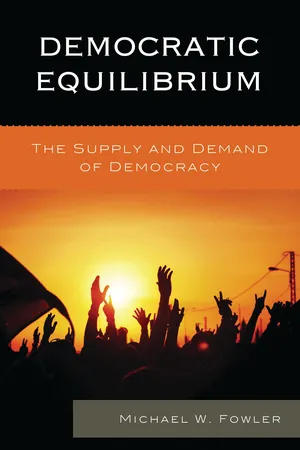
Democratic Equilibrium: The Supply and Demand of Democracy defines a model for political change, change that results in either an increase or decrease in democracy. The book presents a model that builds upon the existing literature to bridge several major gaps in political change theory.
This book provides a holistic supply and demand model that draws upon works from political science, economics, and history. The work conducts an econometric test of the model and validates the results with field research cases from Mexico, the Philippines, and Senegal. The econometric chapter is a rare quantitative analysis of the effects of violence and development upon democracy. This topic is central to contemporary academic and policy debates about how to create democracies, consolidate democracies, achieve development and improve security, especially within developing countries. This topic is especially timely as the Arab Spring represents a unique opportunity and challenge for democratic change across the Middle East and North Africa. Recent events in Tunisia and Egypt demonstrate that democracy studies remain just as relevant today as they were twenty years ago.
The findings indicate that common structural explanations of democracy are incomplete since the structural relationships are not stable or constant over time. Instead, democratic change (or lack thereof) can be explained using a supply and demand model. Key actors (including the military, political parties, NGOs, the ruling regime, and civil society) are the suppliers and consumers that determine a country's resulting level of democracy. However, stating that actors are important is a major over-simplification. Each key actor builds preferences based upon a variety of factors, most importantly: security, income, and the adoption of democratic norms. It is this key dynamic that explains why insurgency, poverty, and under-development do not have a linearly negative effect on democracy. Instead, these factors have a centripetal effect on political development, pulling a country's government towards an intermediate state of political transition in which regimes stagnate in a partially democratic, partially autocratic regime type. Conversely, the model also explains why high income, democratic norms, and security do not necessarily lead to democratization in all cases.
- English
- ePUB (mobile friendly)
- Available on iOS & Android
eBook - ePub
About this book
Information
Table of contents
- Cover-Page
- Half-Title
- I Introduction
- II Proposing a Model of Political Change
- III Quantitative Analysis: Testing Structural Determinants of Democracy
- IV Mexico: Democratic Evolution Despite Violence
- V Philippines: A Resurgence of Democracy Overcomes Insurgency and Poverty
- VI Senegal: The Case of a Poor, Under-Developed Democracy
- VII Conclusion: The Supply and Demand of Democracy
- Appendix
- References
- Index
- About the Author
Trusted by 375,005 students
Access to over 1.5 million titles for a fair monthly price.
Study more efficiently using our study tools.
Frequently asked questions
Yes, you can cancel anytime from the Subscription tab in your account settings on the Perlego website. Your subscription will stay active until the end of your current billing period. Learn how to cancel your subscription
No, books cannot be downloaded as external files, such as PDFs, for use outside of Perlego. However, you can download books within the Perlego app for offline reading on mobile or tablet. Learn how to download books offline
Perlego offers two plans: Essential and Complete
- Essential is ideal for learners and professionals who enjoy exploring a wide range of subjects. Access the Essential Library with 800,000+ trusted titles and best-sellers across business, personal growth, and the humanities. Includes unlimited reading time and Standard Read Aloud voice.
- Complete: Perfect for advanced learners and researchers needing full, unrestricted access. Unlock 1.5M+ books across hundreds of subjects, including academic and specialized titles. The Complete Plan also includes advanced features like Premium Read Aloud and Research Assistant.
We are an online textbook subscription service, where you can get access to an entire online library for less than the price of a single book per month. With over 1.5 million books across 990+ topics, we’ve got you covered! Learn about our mission
Look out for the read-aloud symbol on your next book to see if you can listen to it. The read-aloud tool reads text aloud for you, highlighting the text as it is being read. You can pause it, speed it up and slow it down. Learn more about Read Aloud
Yes! You can use the Perlego app on both iOS and Android devices to read anytime, anywhere — even offline. Perfect for commutes or when you’re on the go.
Please note we cannot support devices running on iOS 13 and Android 7 or earlier. Learn more about using the app
Please note we cannot support devices running on iOS 13 and Android 7 or earlier. Learn more about using the app
Yes, you can access Democratic Equilibrium by Michael W. Fowler in PDF and/or ePUB format, as well as other popular books in Politics & International Relations & Comparative Politics. We have over 1.5 million books available in our catalogue for you to explore.