This edited volume presents thirteen contributions that reflect upon the practical, ethical, theoretical and methodological challenges that researchers face when conducting fieldwork in settings that are characterized with deteriorating security situations, increasing state control and conflicting inter-ethnic relations. More precisely, they shed light to the intricacies of conducting fieldwork on highly politicized and sensitive topics in the region of Kurdistan in Iraq, Syria and Turkey as well as among Kurdish diaspora members in Europe.
This volume is multidisciplinary in its focus and approach. It includes contributions from scholars from various disciplinary backgrounds, ranging from sociology and political science to social psychology and anthropology. The complexity of security situations, and the atmospheres of distrust and suspicion have led the contributors to be creative and to adapt their research methods in ways that at times transcend disciplinary boundaries and conventions. Relatedly, the contributions also open the often-considered Pandora's box of discussing the failures in what is often a "messy" research field, and how to adopt one's methods to rapidly changing political circumstances. This necessitates greater reflexivity in existing power relations of the surrounding context and how those affect not only the interaction situations between the researcher and the participants, but also raise questions for the overall research process, concerning namely social justice, representation and knowledge production. The contributions unravel this by unpacking positionalities beyond ethnicities, discussing how gendered and other positionalities are constructed in fieldwork interactions and by illustrating how the surrounding structures of power and dominance are present in every-day fieldwork.
What differentiates this book from the existing literature is that it is the first academic endeavor that solely focuses on methodological reflections aimed to the field of Kurdish Studies. It offers a comprehensive and multidisciplinary account of scholars' fieldwork experiences in the Kurdish regions and as such, it is also of value to scholars conducting or about to conduct fieldwork in conflict regions elsewhere.
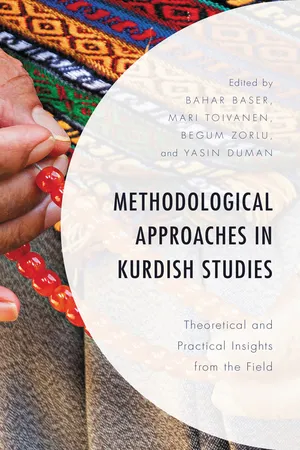
eBook - PDF
Methodological Approaches in Kurdish Studies
Theoretical and Practical Insights from the Field
- 283 pages
- English
- PDF
- Available on iOS & Android
eBook - PDF
Methodological Approaches in Kurdish Studies
Theoretical and Practical Insights from the Field
About this book
Information
Table of contents
- Cover
- MethodologicalApproaches in KurdishStudies
- Methodological Approaches in Kurdish Studies: Theoretical and Practical Insights from the Field
- Copyright page
- Contents
- Introduction
- Research Fields on the Move: On Space and Knowledge
- Fieldwork in Troubled Terrains
- Insider, Outsider, or Something Beyond?
- Essays on Field Experiences
Trusted by 375,005 students
Access to over 1.5 million titles for a fair monthly price.
Study more efficiently using our study tools.
Frequently asked questions
Yes, you can cancel anytime from the Subscription tab in your account settings on the Perlego website. Your subscription will stay active until the end of your current billing period. Learn how to cancel your subscription
No, books cannot be downloaded as external files, such as PDFs, for use outside of Perlego. However, you can download books within the Perlego app for offline reading on mobile or tablet. Learn how to download books offline
Perlego offers two plans: Essential and Complete
- Essential is ideal for learners and professionals who enjoy exploring a wide range of subjects. Access the Essential Library with 800,000+ trusted titles and best-sellers across business, personal growth, and the humanities. Includes unlimited reading time and Standard Read Aloud voice.
- Complete: Perfect for advanced learners and researchers needing full, unrestricted access. Unlock 1.5M+ books across hundreds of subjects, including academic and specialized titles. The Complete Plan also includes advanced features like Premium Read Aloud and Research Assistant.
We are an online textbook subscription service, where you can get access to an entire online library for less than the price of a single book per month. With over 1.5 million books across 990+ topics, we’ve got you covered! Learn about our mission
Look out for the read-aloud symbol on your next book to see if you can listen to it. The read-aloud tool reads text aloud for you, highlighting the text as it is being read. You can pause it, speed it up and slow it down. Learn more about Read Aloud
Yes! You can use the Perlego app on both iOS and Android devices to read anytime, anywhere — even offline. Perfect for commutes or when you’re on the go.
Please note we cannot support devices running on iOS 13 and Android 7 or earlier. Learn more about using the app
Please note we cannot support devices running on iOS 13 and Android 7 or earlier. Learn more about using the app
Yes, you can access Methodological Approaches in Kurdish Studies by Bahar Baser,Mari Toivanen,Begum Zorlu,Yasin Duman in PDF and/or ePUB format, as well as other popular books in Politics & International Relations & International Relations. We have over 1.5 million books available in our catalogue for you to explore.