This volume settles the debate between analytic and continental philosophy. It turns to art, more specifically popular culture, to demonstrate the validity of continental philosophy. Drawing on the philosophy of Georg Hegel (perhaps the most important of continental philosophers), James Kreines holds that reason in the world metaphysically exists. Reasons of the world are reasons of the Hegelian Absolute. Thus, similar to the fact that gravity is curves in the space-time continuum along which matter moves – reasons are the grooves in the Absolute along which human decision-making occurs. Art allows us to conceptualize, understand, speculate about the grooves (reasons) of the Absolute.
Two key points can be drawn from Kreines's position: first, normative values are embedded in reality. Thus, in complete contradistinction to analytic philosophy, there is no bifurcation between the empirical and the normative – to exist is to have normative value. Secondly, the role of social science is to cogitate, explore, identify the reasons of the world that shape social, political norms. Such an approach would decisively move the social sciences away from an emphasis on statistically significant patterns of human behavior (e.g., voting studies) and toward an approach that seeks to analyze the reasons of the world that motivate/shape social and political decisions. Art (particularly popular culture) becomes an important source in identifying the way that people reason about the world and how they perceive political elites reasoning in the world.
To adjudicate between continental and analytic philosophy this book on relies on the broadcast iterations of Star Trek, as well as Nazi cinema. With regard to contemporary American politics, in addition to Star Trek, it draws on the television series Game of Thrones, Veep, House of Cards, and The Man in the High Castle. Popular culture is germane to philosophy and contemporary politics because television/movie creators frequently try to attract viewers by conveying authentic philosophical and political motifs. Conversely, viewers seek out authentic movies and television shows. This is in contrast to opinion surveys (for instance), as the formation of the data begins with the surveyor seeking to directly solicit an opinion – however impromptu or shallow.
eBook - PDF
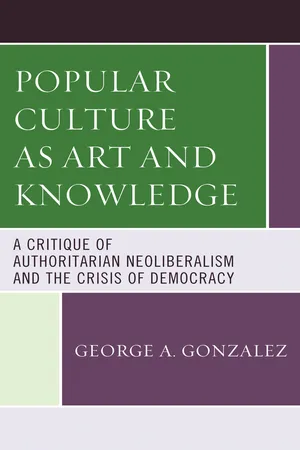
Popular Culture as Art and Knowledge
A Critique of Authoritarian Neoliberalism and the Crisis of Democracy
- 131 pages
- English
- PDF
- Available on iOS & Android
eBook - PDF
Popular Culture as Art and Knowledge
A Critique of Authoritarian Neoliberalism and the Crisis of Democracy
About this book
Information
Table of contents
- Contents
- Introduction
- Chapter One. Deconstruction versus Reason in the World
- Chapter Two. The Absolute and Nazi Cinema
- Chapter Three. Star Trek, Scientism, the Progressive Dialectic, and the Pre-Theoretical
- Chapter Four. Star Trek and the Ontology of Things
- Chapter Five. Star Trek, Love, and Instrumental Reason
- Chapter Six. Justice as Dialectic: Blue Bloods versus Dirty Harry
- Chapter Seven. Nazi Takeover of America: The Man in the High Castle and Star Trek
- Chapter Eight. Post-9/11 Politics on Television: Veep, House of Cards, Game of Thrones, and Star Trek: Enterprise
- Conclusion. Art as Knowledge of Metaphysics and Politics
- Bibliography
- Index
- About the Author
Trusted by 375,005 students
Access to over 1.5 million titles for a fair monthly price.
Study more efficiently using our study tools.
Frequently asked questions
Yes, you can cancel anytime from the Subscription tab in your account settings on the Perlego website. Your subscription will stay active until the end of your current billing period. Learn how to cancel your subscription
No, books cannot be downloaded as external files, such as PDFs, for use outside of Perlego. However, you can download books within the Perlego app for offline reading on mobile or tablet. Learn how to download books offline
Perlego offers two plans: Essential and Complete
- Essential is ideal for learners and professionals who enjoy exploring a wide range of subjects. Access the Essential Library with 800,000+ trusted titles and best-sellers across business, personal growth, and the humanities. Includes unlimited reading time and Standard Read Aloud voice.
- Complete: Perfect for advanced learners and researchers needing full, unrestricted access. Unlock 1.5M+ books across hundreds of subjects, including academic and specialized titles. The Complete Plan also includes advanced features like Premium Read Aloud and Research Assistant.
We are an online textbook subscription service, where you can get access to an entire online library for less than the price of a single book per month. With over 1.5 million books across 990+ topics, we’ve got you covered! Learn about our mission
Look out for the read-aloud symbol on your next book to see if you can listen to it. The read-aloud tool reads text aloud for you, highlighting the text as it is being read. You can pause it, speed it up and slow it down. Learn more about Read Aloud
Yes! You can use the Perlego app on both iOS and Android devices to read anytime, anywhere — even offline. Perfect for commutes or when you’re on the go.
Please note we cannot support devices running on iOS 13 and Android 7 or earlier. Learn more about using the app
Please note we cannot support devices running on iOS 13 and Android 7 or earlier. Learn more about using the app
Yes, you can access Popular Culture as Art and Knowledge by George A. Gonzalez in PDF and/or ePUB format, as well as other popular books in Social Sciences & Political History & Theory. We have over 1.5 million books available in our catalogue for you to explore.