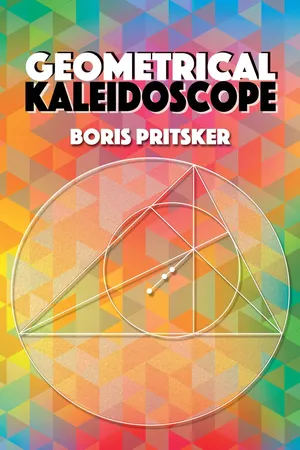
A high school course in geometry and some curiosity and enthusiasm for the subject are the only prerequisites for tackling this original exploration into the field, long a favorite for readers whose interest in math is not onlypracticaland educational, but also recreational. The book centers on geometric thinking—what it means, how to develop it, and how to recognize it. Readers will discover fascinating insights into many aspects of geometry and geometrical properties and theorems, including such classic examples as Archimedes' law of the lever, Euler's line and circleproperties, Fagnano's problem, and Napoleon's theorem.
The volume is divided into sections on individual topics such as "Medians of a Triangle, " and "Area of a Quadrilateral." Chapters typically begin with some interesting geometrical history, some relevant theorems, and some worked examples of problems followed by problems for readers to figure out for themselves (solutions are provided at the end of the book). The result is a many-faceted exploration, rather like a kaleidoscope, focusing on the mysteries and the pleasures of geometry.
- 144 pages
- English
- ePUB (mobile friendly)
- Available on iOS & Android
eBook - ePub
Geometrical Kaleidoscope
About this book
Information
Subtopic
GeometryIndex
MathematicsTable of contents
- Cover
- Title Page
- Copyright page
- Contents
- Preface
- 1. Medians, Centroid, and Center of Gravity of a System of Points
- 2. Altitudes and the Orthocenter of a Triangle and Some of its Properties
- 3. The Orthic Triangle and Some of its Properties
- 4. The Angle Bisector of a Triangle and its Properties
- 5. The Area of a Quadrilateral
- 6. The Theorem of Ratios of the Areas of Similar Polygons
- 7. A Pivotal Approach: Applying Rotation in Problem Solving
- 8. Auxiliary Elements in Problem Solving
- 9. Constructions Siblings
- 10. Session of One Interesting Construction Problem
- 11. Morley’s Theorem
- Solutions to the Problems and Exercises
- References
Trusted by 375,005 students
Access to over 1.5 million titles for a fair monthly price.
Study more efficiently using our study tools.
Frequently asked questions
Yes, you can cancel anytime from the Subscription tab in your account settings on the Perlego website. Your subscription will stay active until the end of your current billing period. Learn how to cancel your subscription
No, books cannot be downloaded as external files, such as PDFs, for use outside of Perlego. However, you can download books within the Perlego app for offline reading on mobile or tablet. Learn how to download books offline
Perlego offers two plans: Essential and Complete
- Essential is ideal for learners and professionals who enjoy exploring a wide range of subjects. Access the Essential Library with 800,000+ trusted titles and best-sellers across business, personal growth, and the humanities. Includes unlimited reading time and Standard Read Aloud voice.
- Complete: Perfect for advanced learners and researchers needing full, unrestricted access. Unlock 1.5M+ books across hundreds of subjects, including academic and specialized titles. The Complete Plan also includes advanced features like Premium Read Aloud and Research Assistant.
We are an online textbook subscription service, where you can get access to an entire online library for less than the price of a single book per month. With over 1.5 million books across 990+ topics, we’ve got you covered! Learn about our mission
Look out for the read-aloud symbol on your next book to see if you can listen to it. The read-aloud tool reads text aloud for you, highlighting the text as it is being read. You can pause it, speed it up and slow it down. Learn more about Read Aloud
Yes! You can use the Perlego app on both iOS and Android devices to read anytime, anywhere — even offline. Perfect for commutes or when you’re on the go.
Please note we cannot support devices running on iOS 13 and Android 7 or earlier. Learn more about using the app
Please note we cannot support devices running on iOS 13 and Android 7 or earlier. Learn more about using the app
Yes, you can access Geometrical Kaleidoscope by Boris Pritsker in PDF and/or ePUB format, as well as other popular books in Mathematics & Geometry. We have over 1.5 million books available in our catalogue for you to explore.