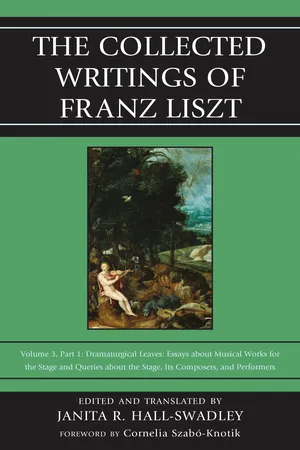
In Dramaturgical Leaves: Essays about Musical Works for the Stage and Queries about the Stage, Its Composers and Performers, the third volume in Janita R. Hall-Swadley's The Collected Writings of Franz Liszt, Liszt heralds his admiration for early nineteenth-century opera and musical stage works. He honors Gluck, the musical prophet, as the cultivator of dramatic truth in the Romantic opera Orpheus, expounds on Beethoven's harmonic inventions and innovative treatment of form in Fidelio, and argues for the latter's incidental music to Goethe's Egmont as the epitome of music organicism, a complete unity of words and tone. He also comments on Weber's Euryanthe as offering the most progressive musical characterizations and declamation—even more so than his popular work Der Freischütz—and on how both works prefigure Wagner's music dramas; awards Mendelssohn, whose genius Liszt ranks only slightly less than Beethoven's, top honors for creating in Midsummer's Night Dream the highest standards of music poetry; suggests how Scribe and Meyerbeer's Robert the Devil paints a mental image of art's eternal flames, where poet and musician share equal space in the development of music tragedy; reveals how the poetic deficiencies in the libretto to Schubert's Alfonso and Estrella are too easily overlooked because of the music's melodic and lyrical supremacy; and offers in contrast Auber's Mute from Portici, a remarkable text by many historically picturesque musical motives that are universal and nationalistic at the same time. Finally Liszt offers an early gender study in music in his essay about Bellini's Montague and Capulet (as well as its impact on nineteenth-century audiences), a look at Boieldieu's White Lady as a sublime depiction of literary music, and Donizetti's Favorite as colored with a special type of imagery, a laterna magica, in Liszt's hand. The beloved soprano Pauline Viardot-Garcia receives special attention in an essay devoted entirely to her, and Liszt proffers a critique of entr'acte music as a pointless tradition that dethrones music and insults the artist and composer by making music a "palate cleanser."
This volume includes a detailed discussion about what it meant to be patronized by Liszt and how his support—financial, literary, and musical—helped shape many a music career. It also offers commentary on how gender in opera was sometimes obscured not only for dramatic interest but also as part of the process of outlining a nation's identity,as well as a thorough study of Liszt's concepts of Gestalt theory, the Archetype, and his musical Weltanschauung (his musical "world view"), all revealing his contribution to 19th-century music philosophy as it relates to opera. Finally, a historical review of entr'acte music is presented—how it began and how it developed—to clarify Liszt's stance against it, making this volume a necessary read for music historians, serious musicians, and music connoisseurs alike.
eBook - ePub
The Collected Writings of Franz Liszt
Dramaturgical Leaves: Essays about Musical Works for the Stage and Queries about the Stage, Its Composers, and Performers Part 1
- English
- ePUB (mobile friendly)
- Available on iOS & Android
eBook - ePub
The Collected Writings of Franz Liszt
Dramaturgical Leaves: Essays about Musical Works for the Stage and Queries about the Stage, Its Composers, and Performers Part 1
About this book
Information
Subtopic
MusicTable of contents
- Expanded Contents Based on the 1880/83 Gesammelte Schriften
- Figures
- Foreword
- Acknowledgments
- Introduction
- The Writings
- Bibliography
- About the Editor/Translator
Trusted by 375,005 students
Access to over 1.5 million titles for a fair monthly price.
Study more efficiently using our study tools.
Frequently asked questions
Yes, you can cancel anytime from the Subscription tab in your account settings on the Perlego website. Your subscription will stay active until the end of your current billing period. Learn how to cancel your subscription
No, books cannot be downloaded as external files, such as PDFs, for use outside of Perlego. However, you can download books within the Perlego app for offline reading on mobile or tablet. Learn how to download books offline
Perlego offers two plans: Essential and Complete
- Essential is ideal for learners and professionals who enjoy exploring a wide range of subjects. Access the Essential Library with 800,000+ trusted titles and best-sellers across business, personal growth, and the humanities. Includes unlimited reading time and Standard Read Aloud voice.
- Complete: Perfect for advanced learners and researchers needing full, unrestricted access. Unlock 1.5M+ books across hundreds of subjects, including academic and specialized titles. The Complete Plan also includes advanced features like Premium Read Aloud and Research Assistant.
We are an online textbook subscription service, where you can get access to an entire online library for less than the price of a single book per month. With over 1.5 million books across 990+ topics, we’ve got you covered! Learn about our mission
Look out for the read-aloud symbol on your next book to see if you can listen to it. The read-aloud tool reads text aloud for you, highlighting the text as it is being read. You can pause it, speed it up and slow it down. Learn more about Read Aloud
Yes! You can use the Perlego app on both iOS and Android devices to read anytime, anywhere — even offline. Perfect for commutes or when you’re on the go.
Please note we cannot support devices running on iOS 13 and Android 7 or earlier. Learn more about using the app
Please note we cannot support devices running on iOS 13 and Android 7 or earlier. Learn more about using the app
Yes, you can access The Collected Writings of Franz Liszt by Janita R. Hall-Swadley in PDF and/or ePUB format, as well as other popular books in Media & Performing Arts & Music. We have over 1.5 million books available in our catalogue for you to explore.