The eruption in the early 1990s of highly visible humanitarian crises and exceedingly bloody civil wars in the Horn of Africa, imploding Yugoslavia, and Rwanda, set in motion a trend towards third party intervention in communal conflict in areas as far apart as the Balkans and East Timor. However haltingly and selectively, that trend towards extra-systemic means of managing ethnic and national conflict is still discernible, motivated as it was in the 1990s by the inability of in-house accommodation methods to resolve ethno-political conflicts peacefully and the tendency of such conflicts to spill into the international system in the form of massive refugee flows, regional instability, and failed states hosting criminal and terrorist elements. In its various forms, third party intervention has become a fixed part of the current international system
Our book examines the various forms in which that intervention occurs, from the least intrusive and costly forms of third party activity to the most intrusive and expensive endeavors. More specifically, organized in the form of overview essays followed by case studies that explore the utility and limitations, successes and failures of various forms of third party activity in managing conflict, the book begins by examining diplomatic intervention and then proceeds to cover, in turn, legal, economic, and military instruments of conflict management before concluding with a section on political tutelage arrangements and nation/capacity building operations.
The chapters themselves are authored by a mix of contributors drawn from relevant disciplines, both senior and younger scholars, academics and practitioners, and North Americans and Europeans. All treat a common theme but no attempt was made to solicit work from contributors with a common orientation towards the value of third party intervention. Nor were the authors straight-jacketed with heavy content guidelines from the editors. Their essays validate the value of this approach. Far from being chaotic in nature, they generally supplement one another, while offering opposing viewpoints on the overall topic; for example, our Italian contributor who specializes in non-government organizations offers a chapter illustrating their utility under certain conditions, whereas the chapter from an Afghan practitioner notes the downside of too much reliance on NGOs in nation-building operations. The essays also cover topics not often treated, and are written from the viewpoint of those on the ground. The chapter on creating a police force in post-Dayton Bosnia-Herzegovina, for example, reads much like a diary from the American colonel who was sent to Bosnia in early 1996 charged with that task.
eBook - ePub
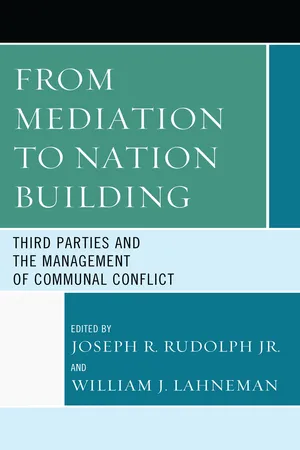
From Mediation to Nation-Building
Third Parties and the Management of Communal Conflict
- English
- ePUB (mobile friendly)
- Available on iOS & Android
eBook - ePub
From Mediation to Nation-Building
Third Parties and the Management of Communal Conflict
About this book
Information
Table of contents
- Dedication
- Acknowledgments
- Chapter 1 Introduction: Communal Conflict and Third Party Intervention in a “Responsibility to Protect” World
- Part One Diplomacy
- Part 2 Legal Approaches
- Part 3 Economic Measures
- Part 4 Military Operations and Communal Conflict
- Part 5 Mediation, Political Tutelage, and Nation-building as Tools of Conflict Prevention and Management
- Part 6 Conclusions
- Bibliography
- About the Contributors
Trusted by 375,005 students
Access to over 1.5 million titles for a fair monthly price.
Study more efficiently using our study tools.
Frequently asked questions
Yes, you can cancel anytime from the Subscription tab in your account settings on the Perlego website. Your subscription will stay active until the end of your current billing period. Learn how to cancel your subscription
No, books cannot be downloaded as external files, such as PDFs, for use outside of Perlego. However, you can download books within the Perlego app for offline reading on mobile or tablet. Learn how to download books offline
Perlego offers two plans: Essential and Complete
- Essential is ideal for learners and professionals who enjoy exploring a wide range of subjects. Access the Essential Library with 800,000+ trusted titles and best-sellers across business, personal growth, and the humanities. Includes unlimited reading time and Standard Read Aloud voice.
- Complete: Perfect for advanced learners and researchers needing full, unrestricted access. Unlock 1.5M+ books across hundreds of subjects, including academic and specialized titles. The Complete Plan also includes advanced features like Premium Read Aloud and Research Assistant.
We are an online textbook subscription service, where you can get access to an entire online library for less than the price of a single book per month. With over 1.5 million books across 990+ topics, we’ve got you covered! Learn about our mission
Look out for the read-aloud symbol on your next book to see if you can listen to it. The read-aloud tool reads text aloud for you, highlighting the text as it is being read. You can pause it, speed it up and slow it down. Learn more about Read Aloud
Yes! You can use the Perlego app on both iOS and Android devices to read anytime, anywhere — even offline. Perfect for commutes or when you’re on the go.
Please note we cannot support devices running on iOS 13 and Android 7 or earlier. Learn more about using the app
Please note we cannot support devices running on iOS 13 and Android 7 or earlier. Learn more about using the app
Yes, you can access From Mediation to Nation-Building by Joseph R. Rudolph Jr.,William J. Lahneman in PDF and/or ePUB format, as well as other popular books in Politics & International Relations & Arms Control. We have over 1.5 million books available in our catalogue for you to explore.