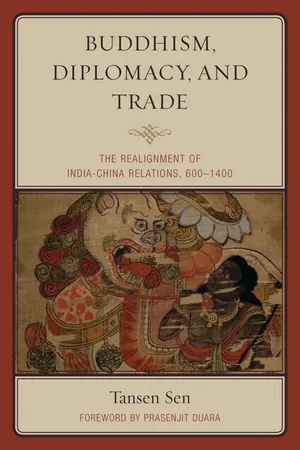
Relations between China and India underwent a dramatic transformation from Buddhist-dominated to commerce-centered exchanges in the seventh to fifteenth centuries. The unfolding of this transformation, its causes, and wider ramifications are examined in this masterful analysis of the changing patterns of the interaction between the two most important cultural spheres in Asia.
Tansen Sen offers a new perspective on Sino-Indian relations during the Tang dynasty (618–907), arguing that the period is notable not only for religious and diplomatic exchanges but also for the process through which China emerged as a center of Buddhist learning, practice, and pilgrimage. Before the seventh century, the Chinese clergy—given the spatial gap between the sacred Buddhist world of India and the peripheral China—suffered from a "borderland complex." A close look at the evolving practice of relic veneration in China (at Famen Monastery in particular), the exposition of Mount Wutai as an abode of the bodhisattva Mañjusri, and the propagation of the idea of Maitreya's descent in China, however, reveals that by the eighth century China had overcome its complex and successfully established a Buddhist realm within its borders.
The emergence of China as a center of Buddhism had profound implications on religious interactions between the two countries and is cited by Sen as one of the main causes for the weakening of China's spiritual attraction toward India. At the same time, the growth of indigenous Chinese Buddhist schools and teachings retrenched the need for doctrinal input from India. A detailed examination of the failure of Buddhist translations produced during the Song dynasty (960–1279), demonstrates that these developments were responsible for the unraveling of religious bonds between the two countries and the termination of the Buddhist phase of Sino-Indian relations.
Sen proposes that changes in religious interactions were paralleled by changes in commercial exchanges. For most of the first millennium, trading activities between India and China were closely connected with and sustained through the transmission of Buddhist doctrines. The eleventh and twelfth centuries, however, witnessed dramatic changes in the patterns and structure of mercantile activity between the two countries. Secular bulk and luxury goods replaced Buddhist ritual items, maritime channels replaced the overland Silk Road as the most profitable conduits of commercial exchange, and many of the merchants involved were followers of Islam rather than Buddhism. Moreover, policies to encourage foreign trade instituted by the Chinese government and the Indian kingdoms contributed to the intensification of commercial activity between the two countries and transformed the China-India trading circuit into a key segment of cross-continental commerce.
eBook - ePub
Buddhism, Diplomacy, and Trade
The Realignment of India–China Relations, 600–1400
- English
- ePUB (mobile friendly)
- Available on iOS & Android
eBook - ePub
About this book
Information
Table of contents
- List of Illustrations
- Foreword
- Acknowledgments
- List of Abbreviations
- Introduction: China’s Encounter and Predicament with the Indic World
- 1 Military Concerns and Spiritual Underpinnings of Tang-India Diplomacy
- 2 The Emergence of China as a Central Buddhist Realm
- 3 The Termination of the Buddhist Phase of India-China Interactions
- 4 The Reconfiguration of India-China Trade and Its Underlying Causes
- 5 The Phases and the Wider Implications of the Reconfiguration of India-China Trade
- Conclusion: From Buddhism to Commerce: The Realignment and Its Implications
- Bibliography
- About the Author
Trusted by 375,005 students
Access to over 1.5 million titles for a fair monthly price.
Study more efficiently using our study tools.
Frequently asked questions
Yes, you can cancel anytime from the Subscription tab in your account settings on the Perlego website. Your subscription will stay active until the end of your current billing period. Learn how to cancel your subscription
No, books cannot be downloaded as external files, such as PDFs, for use outside of Perlego. However, you can download books within the Perlego app for offline reading on mobile or tablet. Learn how to download books offline
Perlego offers two plans: Essential and Complete
- Essential is ideal for learners and professionals who enjoy exploring a wide range of subjects. Access the Essential Library with 800,000+ trusted titles and best-sellers across business, personal growth, and the humanities. Includes unlimited reading time and Standard Read Aloud voice.
- Complete: Perfect for advanced learners and researchers needing full, unrestricted access. Unlock 1.5M+ books across hundreds of subjects, including academic and specialized titles. The Complete Plan also includes advanced features like Premium Read Aloud and Research Assistant.
We are an online textbook subscription service, where you can get access to an entire online library for less than the price of a single book per month. With over 1.5 million books across 990+ topics, we’ve got you covered! Learn about our mission
Look out for the read-aloud symbol on your next book to see if you can listen to it. The read-aloud tool reads text aloud for you, highlighting the text as it is being read. You can pause it, speed it up and slow it down. Learn more about Read Aloud
Yes! You can use the Perlego app on both iOS and Android devices to read anytime, anywhere — even offline. Perfect for commutes or when you’re on the go.
Please note we cannot support devices running on iOS 13 and Android 7 or earlier. Learn more about using the app
Please note we cannot support devices running on iOS 13 and Android 7 or earlier. Learn more about using the app
Yes, you can access Buddhism, Diplomacy, and Trade by Tansen Sen in PDF and/or ePUB format, as well as other popular books in History & Chinese History. We have over 1.5 million books available in our catalogue for you to explore.